
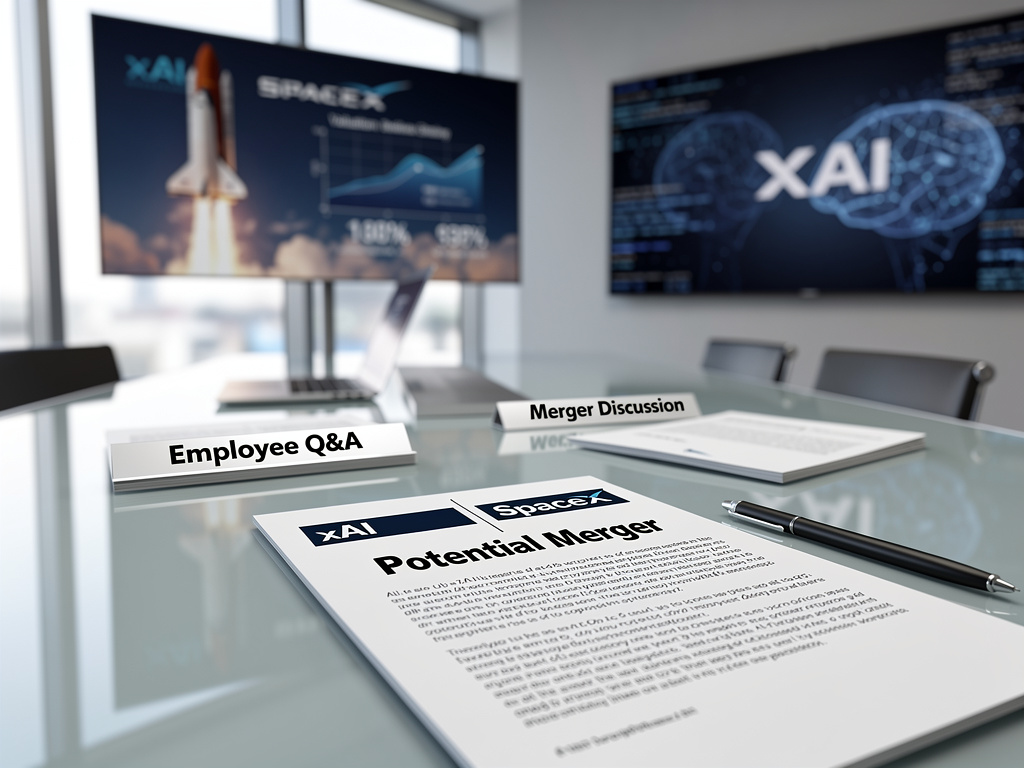
Elon Musk’s sprawling business empire is on the verge of a potentially transformative merger that could redefine the boundaries between artificial intelligence and space exploration. Internal communications obtained by Business Insider reveal that xAI, Musk’s artificial intelligence venture, has distributed a detailed question-and-answer document to employees addressing concerns about a potential merger with SpaceX, the aerospace manufacturer valued at approximately $350 billion. The move signals what could become one of the most significant corporate consolidations in the technology sector, combining cutting-edge machine learning capabilities with advanced rocket technology and satellite infrastructure.
The internal Q&A document addresses employee concerns ranging from equity compensation to organizational structure, suggesting that serious merger discussions have progressed beyond preliminary stages. According to the Business Insider report, xAI leadership has been working to reassure staff members about their positions and equity stakes in the combined entity, a critical consideration given that xAI recently achieved a valuation of $50 billion following its latest funding round. The document’s existence alone represents a significant development in Musk’s strategy to create synergies across his various ventures, which also include Tesla, Neuralink, and The Boring Company.
Industry analysts have long speculated about the potential for cross-pollination between Musk’s companies, but a formal merger between xAI and SpaceX would represent an unprecedented integration of artificial intelligence and aerospace capabilities. The combination could accelerate development of autonomous spacecraft navigation systems, enhance satellite communication networks, and potentially revolutionize how AI models are trained using SpaceX’s Starlink satellite constellation. Such integration would give the merged entity unique advantages in processing vast amounts of data from space-based sensors while simultaneously improving the efficiency of rocket launches and orbital operations.
Strategic Rationale Behind the Unprecedented Consolidation
The strategic logic underlying a potential xAI-SpaceX merger extends far beyond simple corporate consolidation. SpaceX’s Starlink satellite network, which currently comprises more than 6,000 satellites in low Earth orbit, generates enormous quantities of data that could prove invaluable for training large language models and other AI systems. By integrating xAI’s computational capabilities with SpaceX’s space-based infrastructure, Musk could create a vertically integrated AI powerhouse with access to unique data sources and computing resources that competitors cannot easily replicate. This advantage becomes particularly significant as AI companies increasingly compete for training data and computational power.
Furthermore, xAI’s Grok chatbot and underlying AI models could enhance SpaceX’s operational efficiency in ways that generate immediate value. Autonomous systems powered by advanced AI could optimize rocket manufacturing processes, predict maintenance requirements for the Starlink constellation, and improve mission planning for crewed flights to the International Space Station and future Mars missions. The potential applications extend to SpaceX’s Starship program, where AI-driven simulations and predictive modeling could accelerate the development timeline for the fully reusable heavy-lift launch vehicle that Musk envisions as central to his Mars colonization ambitions.
The financial implications of such a merger would be substantial, creating a combined entity with a valuation potentially exceeding $400 billion. This scale would position the merged company as one of the most valuable private enterprises in history, surpassing even the most optimistic valuations of other technology unicorns. For investors in both companies, the merger could offer enhanced liquidity options and exposure to two high-growth sectors simultaneously, though it would also concentrate significant risk in Musk’s ability to execute on an increasingly complex strategic vision.
Regulatory Hurdles and Competitive Dynamics
Any merger between xAI and SpaceX would face intense scrutiny from multiple regulatory bodies, including the Federal Trade Commission, the Department of Justice, and potentially the Committee on Foreign Investment in the United States given SpaceX’s sensitive national security contracts. The concentration of AI capabilities and critical space infrastructure under a single corporate umbrella could raise antitrust concerns, particularly if regulators determine that the combination would reduce competition in either the commercial space launch market or the emerging AI sector. SpaceX’s existing contracts with NASA, the Department of Defense, and intelligence agencies add additional layers of regulatory complexity that could extend the approval process significantly.
The competitive response from rivals in both industries would likely be swift and aggressive. Amazon’s Project Kuiper satellite constellation and Jeff Bezos’s Blue Origin space venture represent the most direct competition in aerospace, while companies like OpenAI, Anthropic, and Google’s DeepMind compete directly with xAI in artificial intelligence. A merged xAI-SpaceX entity would possess capabilities that no single competitor could match, potentially forcing rivals to pursue their own mergers or partnerships to remain competitive. This dynamic could trigger a wave of consolidation across both industries, fundamentally reshaping the competitive environment.
International competitors, particularly China’s rapidly advancing space program and AI initiatives, would view such a merger as a significant escalation in the global technology race. China has made substantial investments in both space exploration and artificial intelligence as part of its strategic priorities, and a combined xAI-SpaceX entity would represent a formidable American competitor with integrated capabilities that Beijing would struggle to replicate quickly. This geopolitical dimension adds urgency to the merger discussions while simultaneously complicating the regulatory approval process.
Employee Concerns and Cultural Integration Challenges
The internal Q&A document distributed to xAI employees reflects genuine concerns about how a merger would affect day-to-day operations, career trajectories, and company culture. SpaceX has cultivated a reputation for intense work expectations and a mission-driven culture focused on making humanity a multi-planetary species, while xAI has positioned itself as an AI safety-conscious alternative to competitors like OpenAI. Reconciling these distinct organizational cultures while maintaining the innovative edge that has characterized both companies represents one of the most significant challenges facing merger planners.
Equity compensation structures present particularly complex challenges in any merger scenario. xAI employees who joined the company expecting their equity to appreciate based solely on AI market dynamics would suddenly find their holdings tied to the success of space exploration ventures and satellite operations. Conversely, long-tenured SpaceX employees might resist dilution of their holdings to accommodate xAI staff, particularly if they perceive the AI venture as less central to SpaceX’s core mission. The internal communications suggest that leadership recognizes these concerns and is working to develop compensation structures that align incentives across the merged organization.
Talent retention will prove critical to the success of any merger, as both xAI and SpaceX employ highly sought-after engineers and researchers who could easily find opportunities at competing firms. The AI sector in particular has experienced intense competition for top talent, with leading researchers commanding compensation packages that can exceed millions of dollars annually. If key personnel perceive the merger as detrimental to their interests or career development, the resulting exodus could undermine the strategic rationale for combining the companies in the first place.
Technical Synergies and Innovation Potential
Beyond the strategic and financial considerations, the technical synergies between xAI and SpaceX could unlock genuinely novel capabilities that neither company could develop independently. SpaceX’s experience with high-reliability systems engineering could inform the development of more robust AI models, while xAI’s expertise in large language models and machine learning could enhance SpaceX’s autonomous flight systems. The combination of these competencies could accelerate progress toward fully autonomous spacecraft capable of conducting complex missions with minimal human intervention, a critical capability for deep space exploration where communication delays make real-time human control impractical.
The Starlink satellite network could serve as a distributed computing platform for AI training and inference, leveraging the processing power of thousands of satellites to create a space-based neural network with unique capabilities. This approach could reduce latency for certain AI applications while providing redundancy and resilience that terrestrial data centers cannot match. Additionally, the energy requirements for AI training have become a significant concern for the industry, and space-based solar power generation could eventually provide a solution to this challenge, though such applications remain speculative at this stage.
Research and development initiatives could benefit from shared resources and cross-functional teams that combine expertise in propulsion systems, materials science, machine learning, and orbital mechanics. This interdisciplinary approach could yield breakthroughs in areas such as autonomous navigation for Mars missions, predictive maintenance for reusable rockets, and optimization algorithms for satellite constellation management. The potential for innovation extends to entirely new product categories that neither company has yet explored, such as AI-powered space mining operations or autonomous satellite servicing capabilities.
Market Implications and Industry Transformation
The broader implications of an xAI-SpaceX merger extend well beyond the two companies directly involved. Such a combination would establish a new paradigm for how technology companies approach vertical integration and cross-industry synergies. Other technology leaders might pursue similar strategies, combining capabilities across previously distinct sectors to create competitive advantages that pure-play companies cannot match. This trend could accelerate the concentration of technological capabilities among a small number of highly integrated firms, raising important questions about competition, innovation, and market structure.
Investors would need to reassess their strategies for gaining exposure to both the AI and space sectors, as the merger would create a dominant player that straddles both industries. Venture capital firms and private equity investors might redirect capital toward smaller, more specialized companies that can serve niche markets not addressed by the merged entity, potentially fostering innovation at the edges of these industries even as the center becomes more concentrated. Public market investors would likely increase pressure on competing firms to articulate clear strategies for competing against an integrated xAI-SpaceX powerhouse.
The merger could also influence government policy regarding both space exploration and artificial intelligence development. Policymakers might view the combined entity as a strategic national asset worthy of support, or alternatively as a concentration of power that requires enhanced oversight and regulation. The outcome of these policy debates could shape the trajectory of both industries for decades to come, influencing everything from research funding priorities to export controls on advanced technologies.
Looking Ahead to an Uncertain Future
As xAI employees digest the information contained in the internal Q&A document, the broader technology community watches closely for signals about how seriously Musk is pursuing this merger. The billionaire entrepreneur has a history of ambitious proposals that sometimes materialize and sometimes remain unrealized visions, making it difficult to assess the probability that this particular consolidation will actually occur. However, the existence of detailed internal communications suggests that planning has progressed beyond casual speculation to serious strategic consideration.
The timeline for any potential merger remains unclear, with regulatory approval processes alone likely to extend for many months or even years. During this period, both companies will need to maintain operational focus while managing the uncertainty that merger discussions inevitably create. Competitors will not remain idle, and the window of opportunity for realizing the strategic benefits of combination could narrow if rivals successfully develop their own integrated capabilities or if regulatory opposition proves insurmountable.
What remains certain is that the potential merger of xAI and SpaceX represents a pivotal moment in the evolution of both the artificial intelligence and space exploration industries. Whether this vision ultimately becomes reality or remains an ambitious proposal, the very fact that such a combination is under serious consideration signals the increasingly blurred boundaries between once-distinct technological domains. As AI becomes more integral to aerospace operations and space-based infrastructure becomes more important for AI development, the logic underlying Musk’s consolidation strategy may prove prescient regardless of whether this particular merger succeeds. The coming months will reveal whether this bold gambit transforms the technology sector or becomes another chapter in the long history of ambitious mergers that promised synergies but failed to deliver.


 WebProNews is an iEntry Publication