
In an era when retailers struggle with razor-thin margins and fierce competition from e-commerce giants, one warehouse club has mastered a seemingly paradoxical business model: sell products at near-cost while generating billions in profit. Costco Wholesale Corporation has built an empire on deep discounts, unchanged prices on iconic products like the $1.50 hot dog combo that hasn’t budged since 1985, and a fiercely loyal customer base willing to pay for the privilege of shopping there. The question that puzzles industry outsiders and fascinates retail analysts is deceptively simple: how does it all add up?
The answer reveals a sophisticated financial architecture that turns conventional retail wisdom on its head. While traditional retailers derive the bulk of their profits from product markups—often ranging from 25 to 50 percent—Costco operates on markups capped at around 14 to 15 percent, according to Daily Mail. This pricing discipline, combined with a membership model that generates predictable, high-margin revenue before a single item crosses the checkout scanner, has created what retail analyst Carol Spieckerman describes as the company’s “secret sauce.” The model has proven remarkably resilient, generating annual sales exceeding $254 billion when membership fees are included, and maintaining renewal rates that are the envy of subscription-based businesses across all industries.
The Membership Model: Profit Before Purchase
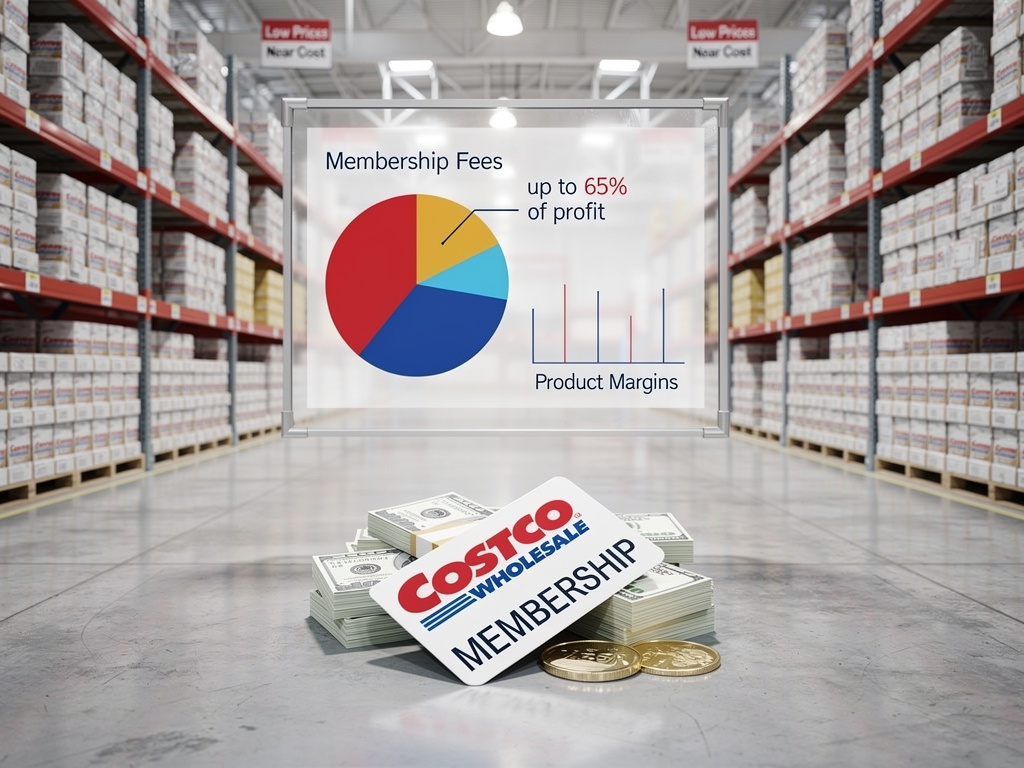
“Costco’s membership fees are the secret sauce, accounting for 50 to 65 percent of total profit,” Spieckerman told Daily Mail. “This means Costco can afford to operate on razor-thin product margins because the profit is already locked in through membership renewals and volume sales.” This fundamental insight explains how the company can maintain its aggressive pricing strategy while still delivering robust returns to shareholders. The membership fees—$65 annually for the basic Gold Star tier and $130 for the Executive membership—represent pure profit with minimal associated costs. Unlike product sales, which require inventory investment, logistics, and staffing, membership revenue flows directly to the bottom line with extraordinary efficiency.
The scale of this revenue stream is staggering. Neil Saunders, a retail analyst at GlobalData, told Daily Mail that “Costco rakes in about $5.3 billion a year from membership fees.” That translates to more than $14 million per day in high-margin income. “While this is only 2 percent of total revenue, the fees are very high margin and make a major contribution to the bottom line,” Saunders explained. “This means Costco does not have to make much money on the products they sell, which allows them to keep prices low.” The company has repeatedly emphasized that protecting renewal rates across its more than 80 million paid members in the United States and 130 million globally remains its top priority—a strategic focus that shapes every operational decision from pricing to product selection.
The Psychology of Prepayment and Customer Behavior
The membership model creates powerful psychological dynamics that extend far beyond the simple transaction of paying an annual fee. By requiring customers to pay upfront for shopping privileges, Costco transforms casual browsers into committed participants with a vested interest in maximizing their investment. This prepayment creates what behavioral economists call the “sunk cost effect”—once customers have paid the membership fee, they’re motivated to shop frequently enough to justify the expense. The result is higher visit frequency, larger basket sizes, and customers who actively seek reasons to shop at Costco rather than competitors.
This psychological contract also manifests in unexpected ways, including significantly lower theft rates compared to traditional retailers. Analysts attribute this phenomenon to customers feeling they’re part of an exclusive club rather than anonymous shoppers in a conventional store. The membership barrier creates a sense of community and shared values around smart shopping and quality products at fair prices. This club mentality encourages not just repeat visits and higher spending, but also better in-store behavior—a subtle but valuable benefit that reduces shrinkage and security costs while enhancing the shopping experience for all members.
Strategic Product Selection: Less is More
Walk into a typical supermarket and you’ll find dozens of brands competing for attention in every category—perhaps 40 different olive oils, 30 varieties of pasta sauce, or 50 types of breakfast cereal. Costco takes the opposite approach, deliberately limiting selection to create operational advantages that translate directly into lower prices and higher efficiency. Instead of stocking 40 olive oil brands, Costco might carry four carefully curated options, including its private-label Kirkland Signature brand. This radical simplification gives the company enormous leverage with suppliers desperate to secure shelf space in front of millions of affluent, high-spending customers.
The benefits of limited selection extend throughout the supply chain and operations. Fewer SKUs (stock keeping units) mean faster inventory turnover, reducing the capital tied up in merchandise sitting in warehouses. Storage costs decrease when products don’t languish on shelves gathering dust. Waste diminishes when items move quickly from distribution center to shopping cart. The simplified product mix also streamlines logistics, allowing Costco to negotiate better terms with manufacturers who can count on high-volume, predictable orders rather than sporadic purchases across dozens of competing brands. Suppliers often manufacture products exclusively for Costco in larger formats or special packaging, further reducing costs through economies of scale.
Kirkland Signature: The Private Label Powerhouse
“Kirkland Signature is Costco’s not-so-secret weapon,” Spieckerman noted in her analysis for Daily Mail. The private label brand, introduced in 1995 and named after the company’s original headquarters location in Kirkland, Washington, has evolved into one of the most successful store brands in retail history. By selling products under its own label—often manufactured by the same companies that produce premium national brands—Costco captures higher margins while still dramatically undercutting competitors on price. The Kirkland Signature portfolio now spans hundreds of products across virtually every category, from organic foods and vitamins to clothing, batteries, and alcoholic beverages.
The financial impact of Kirkland Signature cannot be overstated. The brand now generates tens of billions of dollars in annual sales, making it one of the largest consumer brands in North America by revenue. More importantly, it reinforces the core value proposition that shopping at Costco means accessing quality products without paying for brand-name marketing premiums. Blind taste tests and quality comparisons frequently show Kirkland products matching or exceeding national brand equivalents, validating the company’s claim that members aren’t sacrificing quality for savings. This reputation for quality has allowed Costco to expand Kirkland into premium categories like organic foods, high-end wines, and even luxury items, further deepening customer loyalty and increasing basket sizes.
Loss Leaders as Loyalty Generators
Perhaps no aspect of Costco’s strategy attracts more attention than its willingness to deliberately lose money on certain high-profile products. The $1.50 hot dog and soda combo, unchanged since 1985 despite decades of inflation, has become legendary in retail circles. The $4.99 rotisserie chicken, often priced below what the raw bird costs at competitors, draws customers into stores with the promise of an unbeatable dinner solution. Gasoline prices consistently undercut nearby stations, sometimes by 20 cents per gallon or more. These loss leaders—products intentionally sold at or below cost—function as powerful marketing tools that generate far more value through customer acquisition and retention than they sacrifice in direct profit.
“The $1.50 hot dog combo is iconic—it’s been that price since 1985,” Spieckerman told Daily Mail. “Yes, Costco knowingly loses money on certain items like hot dogs, rotisserie chickens, and sometimes fuel. Costco’s loss leaders are loyalty generators and traffic drivers. It’s a small price to pay for customer devotion.” The strategy works because these products serve multiple functions simultaneously: they drive foot traffic, create positive word-of-mouth marketing, generate media coverage that reinforces brand perception, and keep members feeling they’re getting exceptional value. Once inside the warehouse, customers inevitably add other items to their carts, ensuring that the store visit remains profitable even if individual products operate at a loss.
Supplier Relationships and Buying Power
Behind Costco’s ability to maintain aggressive pricing lies a procurement operation renowned throughout the retail industry for its effectiveness and discipline. “Costco’s buying power gives them incredible leverage with suppliers,” Spieckerman explained to Daily Mail. “And Costco’s buyers are legendary in the industry for driving hard bargains while maintaining quality standards.” The company’s buyers operate with clear mandates: secure the lowest possible prices while refusing to compromise on quality. This reputation for tough but fair negotiations, combined with the promise of high-volume orders and prominent placement, gives Costco extraordinary influence over pricing and terms.
The company’s scale amplifies this advantage. With annual sales exceeding $250 billion from product sales alone, Costco ranks among the largest retailers globally. Suppliers recognize that securing a position on Costco’s limited shelves can make or break product launches and significantly impact overall sales volumes. This dynamic allows Costco to demand not just lower wholesale prices, but also exclusive products, special packaging sizes that competitors can’t match, and favorable payment terms. The company also benefits from its straightforward approach to merchandising—products that don’t meet sales expectations are quickly removed, creating constant pressure on suppliers to deliver items that resonate with Costco’s demographic of middle-to-upper-income households seeking value without sacrificing quality.
The Credit Card Strategy: Deepening Financial Ties
Earlier this year, Costco enhanced its financial services strategy by boosting cashback rewards on gasoline purchases for holders of its co-branded credit card. The upgrade increased the reward rate to 5 percent on gas purchased at Costco locations using the Costco Anywhere Visa Card, issued by Citi, up from the previous 4 percent. This enhancement represents more than a simple customer perk—it’s a strategic move to deepen financial relationships with members while generating additional revenue streams through credit card partnerships and transaction fees.
“The boosted gas rewards is a bid to get more people to take its credit card—which helps the company’s profits,” Saunders told Daily Mail. “Those with branded credit cards tend to be a little more loyal to the chains they get them from.” The co-branded card strategy serves multiple purposes: it captures transaction data that helps Costco understand shopping patterns, it increases switching costs for members who accumulate rewards, and it generates revenue through interchange fees and profit-sharing arrangements with the card issuer. Members who use the Costco credit card for everyday purchases outside the warehouse effectively become more embedded in the Costco ecosystem, making them less likely to let memberships lapse or shift spending to competitors.
Ancillary Services: Hidden Revenue Streams
Beyond the warehouse floor, Costco has built a diverse portfolio of services that most members barely think about but that collectively contribute meaningful revenue and deepen customer relationships. The company operates travel booking services, optical and hearing centers, pharmacies, tire installation centers, and facilitates insurance referrals across auto, home, life, and health policies. These services share common characteristics: they leverage Costco’s brand reputation for value and quality, they require minimal capital investment since partners often handle fulfillment, and they create additional touchpoints that reinforce the value of membership beyond grocery and household goods.
The insurance referral program exemplifies this approach. Costco partners with established insurers to offer auto, home, life, and health policies at discounted rates for members, while earning referral bonuses for each policy sold. Similarly, the auto buying program connects members with more than 3,000 dealerships to offer pre-negotiated pricing, incentives, and discounts on vehicles and accessories. Members benefit from simplified shopping and guaranteed savings, dealerships gain access to pre-qualified buyers, and Costco earns referral fees without maintaining inventory or showrooms. Individually, none of these services drive the business, but together they add steady income streams—often with third parties handling operational complexity—while giving members additional reasons to maintain their memberships year after year.
Operational Efficiency Through Simplicity
Costco’s warehouse aesthetic—concrete floors, industrial shelving, products displayed on pallets, and minimal signage—isn’t an accident or oversight. It’s a deliberate choice that dramatically reduces costs while reinforcing the value proposition. The company spends remarkably little on advertising compared to traditional retailers, relying instead on word-of-mouth marketing and the inherent appeal of its pricing. Store design emphasizes function over form, with no expensive fixtures, elaborate displays, or atmospheric lighting. Products often remain in their original shipping boxes stacked on pallets, eliminating the labor costs associated with shelf stocking and creating a treasure-hunt shopping experience that some customers find engaging.
This no-frills approach extends to every aspect of operations. Costco warehouses typically stock 3,700 to 4,000 active SKUs, compared to 30,000 or more in traditional supermarkets. This simplification reduces complexity throughout the organization, from purchasing and logistics to inventory management and store operations. Fewer products mean employees can become expert in their departments more quickly, reducing training costs and improving customer service. The streamlined product mix also enables sophisticated inventory management, with most items turning over rapidly and generating cash flow that funds operations without excessive borrowing. The result is an operating model that delivers exceptional value to customers while maintaining healthy profit margins for shareholders—a combination that has proven difficult for competitors to replicate.
The Trust Equation: Pricing Transparency and Customer Confidence
A subtle but crucial element of Costco’s success lies in its approach to pricing psychology. Unlike traditional retailers that use frequent sales, promotional pricing, and complex loyalty programs to create the illusion of value, Costco maintains consistent everyday low prices and avoids gimmicks. The 14-15 percent markup cap is well-known among members and reinforced through consistent pricing practices. “This builds trust and removes the need for shoppers to hunt for deals,” Spieckerman noted in her analysis for Daily Mail. Shoppers trust that prices are fair, don’t waste time comparing labels or waiting for sales, and buy more confidently when they’re in the warehouse.
This pricing transparency creates a virtuous cycle. Members don’t need to play games, clip coupons, or time purchases around promotional calendars. They can shop with confidence that they’re getting fair value on every visit. This reduces decision fatigue and purchase anxiety, making shopping at Costco more efficient and satisfying. The predictability also encourages larger purchases—members are willing to buy in bulk because they trust they’re not overpaying and won’t find the same item cheaper elsewhere next week. Costco makes less per item than competitors, but the combination of higher visit frequency, larger basket sizes, and operational efficiency more than compensates. The model depends on volume, and the trust equation ensures that volume remains consistently high.
Membership Renewal: The Ultimate Success Metric
For Costco, the most important metric isn’t same-store sales growth, profit margins, or even total revenue—it’s membership renewal rate. The company has consistently maintained renewal rates above 90 percent in North America, an extraordinary achievement in subscription-based businesses. This metric reflects the cumulative impact of every strategic choice: fair pricing, quality products, efficient operations, and a shopping experience that delivers tangible value. High renewal rates provide predictable revenue, reduce customer acquisition costs, and create a stable foundation for long-term planning and investment.
The focus on renewals shapes corporate culture and decision-making at every level. Store managers are evaluated partly on renewal rates in their territories. Buyers understand that disappointing product quality or insufficient value can impact renewals. Even decisions about warehouse locations and hours of operation consider member convenience and satisfaction. This alignment around a single, clear objective—keeping members happy enough to renew year after year—creates organizational coherence that’s difficult for competitors to match. It also explains why Costco has resisted pressure to squeeze additional profit from product sales or reduce service levels. Management understands that the membership model only works if members perceive ongoing value that justifies the annual fee.
The Competitive Moat: Why Costco’s Model Resists Replication
Despite Costco’s transparent business model and decades of success, competitors have struggled to replicate its formula. The membership warehouse club format has proven remarkably resistant to disruption, even as e-commerce has transformed retail. Part of this resilience stems from the interconnected nature of Costco’s advantages. The membership model funds low prices, which drive traffic and loyalty, which justifies the membership fee, creating a self-reinforcing cycle. The limited selection and bulk formats create operational efficiencies that are difficult to achieve with conventional retail assortments. The private label strategy requires years of investment in supplier relationships and quality control systems.
“Costco has extremely high loyalty because it offers a strong value equation—good products, high quality and low prices—combined with a shopping experience many customers enjoy,” Saunders explained to Daily Mail. “That shows up clearly in its membership renewal rates. Of course, the warehouse model is not for everyone. Some shoppers do not like buying in bulk or find the stores overwhelming, but that is not a sign of failure. No retailer can please everyone, and Costco has a very distinct model that it is happy to stick with because it works.” This willingness to serve a specific customer segment exceptionally well, rather than attempting to be all things to all shoppers, has allowed Costco to build deep competitive advantages in its chosen market.
Financial Performance and Shareholder Value
The proof of Costco’s model lies in its financial performance. The company has delivered consistent revenue growth and profitability over decades, weathering economic downturns and competitive pressures that have devastated other retailers. Annual sales approaching $255 billion when membership fees are included place Costco among the largest retailers globally. More impressively, the company achieves this scale while maintaining disciplined cost control and returning value to shareholders through dividends and special distributions. The stock has been a consistent performer, rewarding long-term investors who recognized the durability of the membership model and the strength of customer loyalty.
The financial structure also provides flexibility during challenging periods. Because membership fees provide a stable profit base, Costco can maintain aggressive pricing even when cost pressures increase, knowing that membership renewals will sustain profitability. This was evident during recent inflationary periods when many retailers raised prices significantly. Costco absorbed some cost increases rather than fully passing them to members, protecting its value reputation and renewal rates. The strategy reflects long-term thinking—short-term margin pressure is acceptable if it preserves the customer relationships that drive sustainable profitability. This patient capital approach, supported by a membership model that provides predictable cash flow, gives Costco strategic advantages that quarterly-focused competitors struggle to match.
The Future of the Warehouse Club Model
As retail continues evolving in the digital age, questions persist about the long-term viability of physical warehouse clubs. Yet Costco has demonstrated remarkable adaptability, building a growing e-commerce presence while leveraging physical locations as fulfillment centers and customer touchpoints. The membership model translates effectively online, with members accessing the same value proposition through digital channels. The bulk format and limited selection that define the warehouse experience also streamline online operations, reducing the complexity that plagues retailers trying to profitably fulfill orders from vast product catalogs.
The company’s focus on consumables and frequently purchased items also provides insulation from e-commerce disruption. While shoppers have shifted many purchases online, categories like fresh food, gasoline, and pharmacy services still drive regular store visits. These visits create opportunities for impulse purchases and discovery of new products, generating sales that pure-play online retailers struggle to capture. The treasure-hunt aspect of Costco shopping—never knowing exactly what special items or seasonal products might appear—also encourages regular visits and creates engagement that transcends simple transactional relationships. As long as Costco maintains its value proposition and continues earning member trust through consistent execution, the model appears positioned to thrive regardless of broader retail disruption.
Lessons for Retail and Beyond
Costco’s success offers lessons that extend beyond retail into subscription businesses, loyalty programs, and customer relationship management across industries. The fundamental insight—that customers will pay upfront for guaranteed value—has applications wherever trust and consistency matter. The discipline of capping margins and resisting short-term profit opportunities in favor of long-term customer relationships challenges conventional business thinking that prioritizes maximizing revenue from each transaction. The focus on a single key metric (renewal rate) that captures overall customer satisfaction provides clarity that many organizations lack.
Perhaps most importantly, Costco demonstrates that operational simplicity can be a competitive advantage in an era that often celebrates complexity and customization. By deliberately limiting choices, maintaining consistent pricing, and focusing relentlessly on a core value proposition, the company has built a business model that’s simultaneously transparent and difficult to replicate. The “secret sauce” isn’t really secret—it’s membership fees, operational discipline, and customer trust. But combining these elements into a coherent system that delivers value to customers, employees, suppliers, and shareholders requires execution excellence that proves elusive for most organizations. After four decades of consistent performance, Costco has proven that doing simple things exceptionally well can build enduring competitive advantages and substantial shareholder value.


 WebProNews is an iEntry Publication