
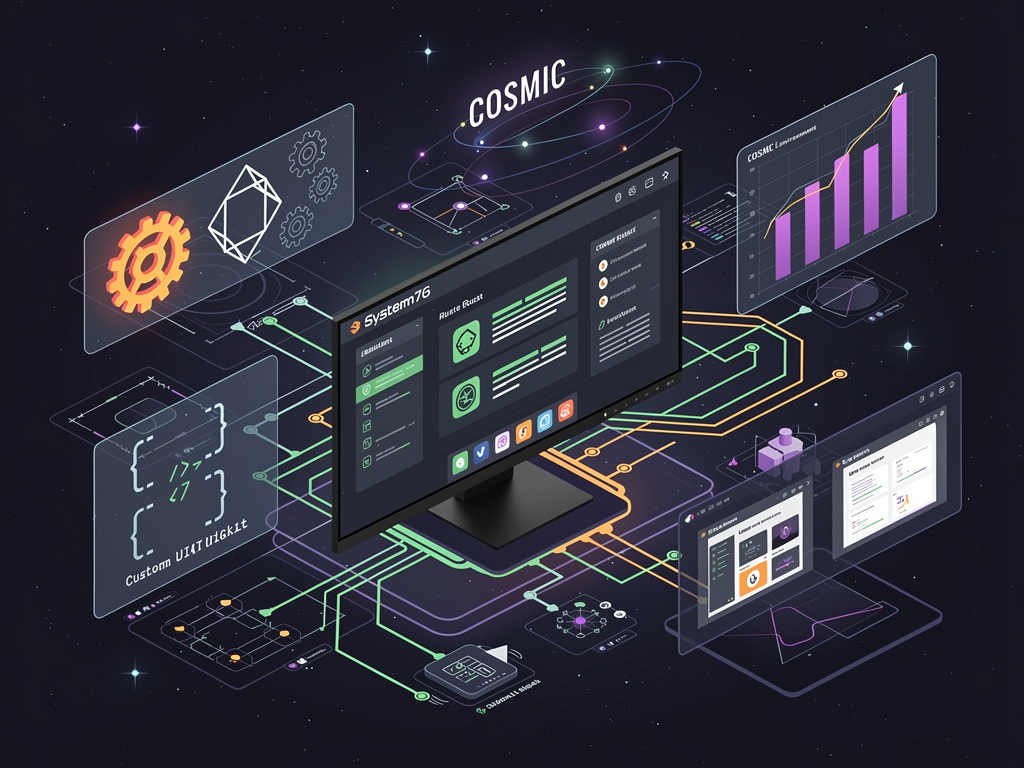
The Linux desktop environment arena, long dominated by veterans like GNOME and KDE Plasma, faces a formidable new contender as System76’s COSMIC Desktop Environment approaches its stable release. Built entirely in Rust with a custom-designed toolkit, this ambitious project represents more than just another interface option—it signals a fundamental rethinking of how desktop environments should be architected, maintained, and evolved in the modern era.
According to Phoronix, the development team has been steadily implementing features that address long-standing pain points in existing desktop environments while introducing novel approaches to window management, customization, and system integration. The project, which began as System76’s response to GNOME’s controversial design decisions, has evolved into a comprehensive desktop solution that could reshape expectations for Linux desktop experiences.
The technical foundation of COSMIC represents a departure from traditional desktop environment development. By choosing Rust as the primary programming language and developing the custom Iced toolkit specifically for this purpose, System76 has positioned the project to avoid many of the memory safety issues and performance bottlenecks that plague C and C++-based alternatives. This architectural decision, while requiring significant upfront investment, promises long-term benefits in stability, security, and maintainability that could prove decisive as the project matures.
Architectural Innovation Drives Development Philosophy
The COSMIC Desktop’s development trajectory reveals a methodical approach to feature implementation that prioritizes system stability and user experience over rapid feature accumulation. Recent progress reports indicate that the team has focused on core functionality refinements, including workspace management improvements, panel customization options, and application integration capabilities that rival or exceed those found in established environments.
The workspace management system in COSMIC introduces tiling window management as a first-class feature rather than an afterthought or extension. This integration allows users to seamlessly switch between floating and tiling layouts without installing additional software or wrestling with configuration files. The implementation leverages Rust’s type system to ensure window state transitions remain consistent and predictable, addressing a common source of frustration in traditional desktop environments where window management can feel inconsistent across different applications and contexts.
Panel customization represents another area where COSMIC distinguishes itself from competitors. Unlike GNOME’s relatively rigid top bar or KDE’s occasionally overwhelming configuration options, COSMIC aims to strike a balance between flexibility and usability. Users can create multiple panels, position them on any screen edge, and populate them with applets that provide system information and quick access to common functions. The configuration system stores these preferences in human-readable TOML files, making it possible for advanced users to share configurations or script panel setups for different use cases.
Application Ecosystem Development Accelerates
Beyond the desktop shell itself, System76 has invested heavily in developing native applications that showcase COSMIC’s capabilities while providing essential functionality. The COSMIC Files application reimagines file management with modern features like tabs, split views, and integrated search that feels responsive even when indexing large directory structures. Similarly, COSMIC Terminal provides a GPU-accelerated terminal emulator that handles complex rendering scenarios without the performance degradation common in older terminal applications.
The settings application demonstrates COSMIC’s philosophy of progressive disclosure—presenting commonly adjusted options prominently while making advanced settings accessible without overwhelming new users. This approach contrasts with GNOME’s increasingly minimalist settings application and KDE’s comprehensive but sometimes daunting System Settings. Early user feedback suggests this middle path resonates with users who want control over their environment without needing to parse through hundreds of configuration options to find basic settings.
Application theming in COSMIC utilizes a sophisticated system that goes beyond simple color scheme selection. The theming engine supports per-application color overrides, allowing users to maintain visual consistency while accommodating applications that benefit from specific color treatments. This granular control extends to window decorations, icon themes, and cursor designs, creating a cohesive visual experience that adapts to user preferences without requiring manual configuration of individual applications.
Performance Optimization Through Modern Tooling
Performance characteristics represent a critical differentiator for COSMIC, particularly as the desktop environment targets both high-end workstations and resource-constrained devices. The Rust foundation enables aggressive compiler optimizations that would be risky or impossible in C-based projects due to potential undefined behavior. Memory usage profiles show COSMIC maintaining competitive resource consumption while providing visual effects and animations that enhance usability rather than merely serving aesthetic purposes.
The rendering pipeline leverages modern graphics APIs to ensure smooth animations and responsive interactions even on older hardware. Unlike some desktop environments that rely heavily on GPU acceleration and struggle on systems with limited graphics capabilities, COSMIC implements fallback rendering paths that maintain acceptable performance across diverse hardware configurations. This attention to hardware compatibility reflects System76’s experience as a hardware manufacturer understanding the real-world constraints users face.
Wayland support in COSMIC has been prioritized from the project’s inception, avoiding the technical debt accumulated by desktop environments that began in the X11 era and later retrofitted Wayland compatibility. This forward-looking approach eliminates entire categories of bugs and limitations while enabling features that would be difficult or impossible under X11’s architecture. Screen sharing, HDR support, and per-monitor scaling all benefit from COSMIC’s Wayland-native design, providing users with capabilities that feel modern rather than bolted on.
Community Engagement and Development Transparency
System76’s approach to COSMIC development emphasizes transparency and community involvement while maintaining clear technical leadership. The project’s GitHub repositories receive regular updates, and developers actively engage with user feedback through various channels. This openness extends to the development roadmap, with the team regularly sharing progress updates and soliciting input on feature priorities and implementation approaches.
The decision to develop COSMIC as free and open-source software, despite System76’s significant investment, demonstrates a commitment to the broader Linux ecosystem that extends beyond immediate commercial interests. While System76 will ship COSMIC as the default desktop environment on Pop!_OS, the project’s licensing ensures that other distributions can adopt, modify, and redistribute COSMIC without restriction. This approach could accelerate adoption and encourage community contributions that benefit all users regardless of their chosen distribution.
Documentation efforts have kept pace with feature development, with comprehensive guides covering installation, configuration, and customization. The documentation targets multiple audience levels, from new Linux users seeking basic orientation to experienced system administrators requiring detailed technical specifications. This investment in documentation reflects an understanding that technical excellence alone cannot ensure adoption—users need accessible resources to fully leverage the desktop environment’s capabilities.
Integration Challenges and Compatibility Considerations
Despite COSMIC’s technical merits, the desktop environment faces significant challenges in achieving widespread adoption. The Linux desktop ecosystem has substantial inertia, with established environments benefiting from years of refinement, extensive application support, and user familiarity. COSMIC must not only match existing functionality but provide compelling reasons for users to switch from environments they already know and have customized to their preferences.
Application compatibility represents a particular challenge, as COSMIC must support the diverse array of toolkits and frameworks used by Linux applications. While the desktop environment handles GTK and Qt applications competently, ensuring consistent behavior and appearance across these different technologies requires ongoing attention. The team has implemented compatibility layers and fallback mechanisms to handle edge cases, but achieving seamless integration across the entire Linux application ecosystem remains an evolving effort.
The relationship between COSMIC and other desktop environments will likely evolve as the project matures. Rather than viewing COSMIC as a direct competitor, some in the Linux community see it as a catalyst for innovation that could inspire improvements across all desktop environments. Features pioneered in COSMIC may influence development directions in GNOME, KDE, and other projects, ultimately benefiting users regardless of their chosen environment. This cross-pollination of ideas represents one of the open-source ecosystem’s greatest strengths.
Future Trajectory and Market Positioning
As COSMIC approaches its stable release, questions about its long-term viability and market position become increasingly relevant. System76’s commitment to the project appears robust, with the company allocating substantial engineering resources to ongoing development and maintenance. However, sustaining a desktop environment requires continuous investment over many years, and the project’s success will depend partly on achieving adoption beyond Pop!_OS users.
The potential for COSMIC to attract users from other ecosystems, including Windows and macOS, represents an intriguing possibility. The desktop environment’s blend of power-user features and approachable design could appeal to users seeking alternatives to commercial operating systems. If COSMIC can deliver on its promise of stability, performance, and usability while maintaining the flexibility that attracts users to Linux, it could become a significant factor in desktop Linux adoption rates.
Industry observers note that COSMIC’s success or failure will provide valuable insights into desktop environment development strategies. The Rust-based architecture, custom toolkit development, and integrated application ecosystem represent significant departures from conventional approaches. If COSMIC achieves its goals, it could validate these architectural choices and influence future projects. Conversely, challenges encountered during development and deployment will offer lessons about the practical constraints facing desktop environment developers in the modern era.
The coming months will prove critical as COSMIC transitions from alpha releases to production-ready software. System76 has indicated that the stable release will coincide with the next major Pop!_OS version, providing millions of users with their first exposure to the desktop environment. User reception during this period will largely determine whether COSMIC becomes a mainstream option or remains a niche alternative for enthusiasts. Regardless of the outcome, the project has already demonstrated that significant innovation remains possible in the Linux desktop space, challenging assumptions about the maturity and stagnation of desktop environment development.


 WebProNews is an iEntry Publication