
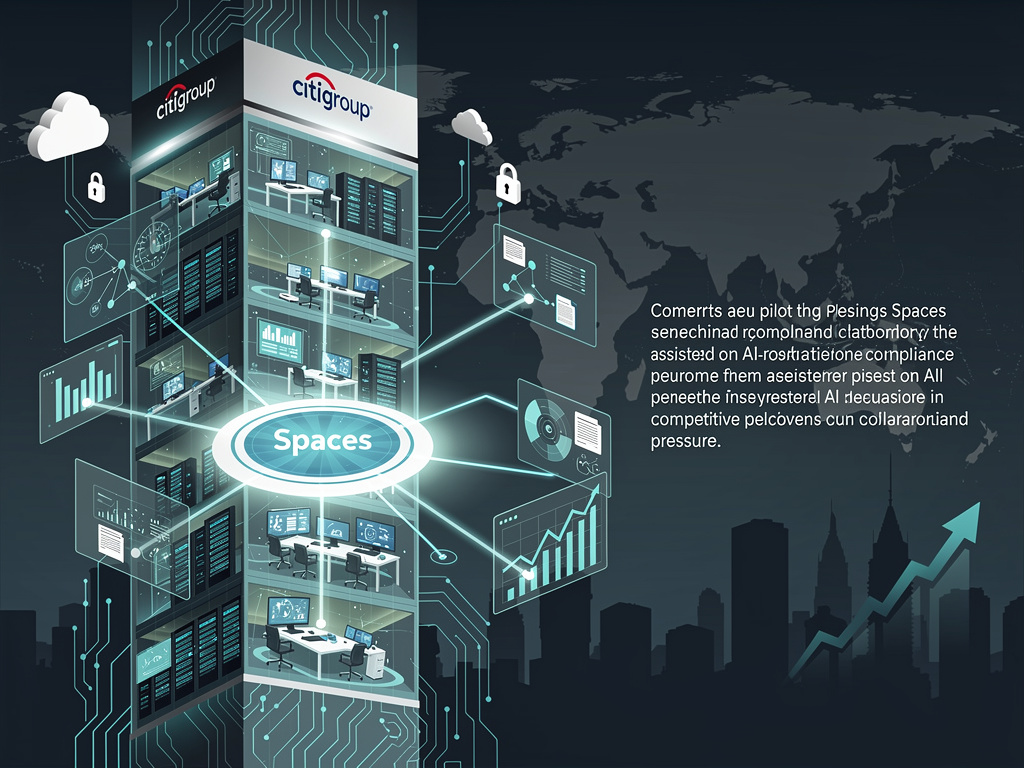
Citigroup is embarking on an ambitious internal experiment that could redefine how its employees harness artificial intelligence for daily work, piloting a collaborative workspace feature designed to integrate AI assistance directly into team projects. The initiative, called Spaces, represents the financial giant’s latest effort to move beyond isolated AI experiments toward enterprise-wide adoption that could influence how the broader banking industry approaches workplace technology transformation.
According to CIO Dive, Chief Technology Officer David Griffiths announced that Spaces will enable teams to collaborate on projects within Citi’s existing AI platform infrastructure. The feature aims to break down silos that have traditionally separated individual AI users from their colleagues, creating shared environments where multiple employees can leverage AI capabilities simultaneously while working toward common objectives. This approach signals a maturation of enterprise AI strategy, moving from individual productivity tools toward collaborative intelligence systems.
The pilot program arrives as financial institutions face mounting pressure to demonstrate tangible returns on their substantial AI investments while navigating regulatory scrutiny and talent retention challenges. Citigroup has committed billions to technology modernization in recent years, with AI forming a cornerstone of CEO Jane Fraser’s transformation agenda. Spaces represents a critical test of whether collaborative AI tools can deliver the productivity gains that justify these expenditures while maintaining the security and compliance standards demanded by financial regulators.
Strategic Positioning Within Citi’s Broader Technology Overhaul
The Spaces initiative cannot be divorced from Citigroup’s comprehensive technology infrastructure renovation, a multi-year effort that has consumed significant resources and executive attention. The bank has been working to consolidate disparate systems, eliminate technical debt, and create unified platforms that can support advanced capabilities like collaborative AI. This foundation-building has been essential but costly, with Citi spending approximately $6 billion annually on technology investments, according to regulatory filings and investor presentations.
Griffiths has been instrumental in driving Citi’s AI strategy since joining the organization, emphasizing practical applications over theoretical potential. His approach has focused on identifying specific use cases where AI can demonstrably improve employee efficiency, reduce errors, or accelerate decision-making. The Spaces feature reflects this pragmatic philosophy, targeting the common workplace scenario of teams collaborating on complex projects that require data analysis, document generation, and strategic planning—areas where AI assistance could provide measurable value.
The financial services sector has witnessed an acceleration of AI adoption across various functions, from fraud detection and risk management to customer service and trading operations. However, much of this implementation has occurred in specialized departments with dedicated technical teams. Citi’s Spaces pilot represents an attempt to democratize AI access across the organization, enabling employees regardless of technical expertise to incorporate AI into collaborative workflows. This democratization strategy carries both promise and risk, as it requires robust governance frameworks to prevent misuse while encouraging experimentation.
Navigating the Competitive Intelligence Race in Banking
Citigroup’s AI collaboration initiative unfolds against a backdrop of intense competition among major financial institutions to establish technological advantages. JPMorgan Chase has deployed its own AI assistant, dubbed LLM Suite, to approximately 60,000 employees for tasks including email composition and document summarization. Bank of America has invested heavily in its virtual assistant Erica, which has handled hundreds of millions of client interactions. Morgan Stanley has partnered with OpenAI to create AI tools for its wealth management advisors, providing access to the firm’s extensive research repository through conversational interfaces.
These competing initiatives share common objectives—improving productivity, enhancing client service, and attracting technology-savvy talent—but differ in implementation details and strategic emphasis. Citi’s focus on collaborative workspaces distinguishes its approach from competitors who have primarily emphasized individual assistant functionality. This distinction matters because modern banking increasingly requires cross-functional collaboration, with complex transactions and client relationships involving multiple departments and expertise areas. An AI system designed for collaboration could theoretically provide greater value than individual tools by facilitating the knowledge sharing and coordination that complex financial services demand.
The competitive dynamics extend beyond traditional banking rivals to include technology companies offering enterprise AI solutions. Microsoft’s Copilot, Google’s Workspace AI features, and Salesforce’s Einstein GPT all compete for enterprise adoption, offering capabilities that overlap with bank-developed systems. Financial institutions must decide whether to build proprietary solutions, adopt commercial platforms, or pursue hybrid approaches. Citi’s development of Spaces suggests a preference for customized tools that can integrate with existing systems and address industry-specific requirements that generic platforms might not accommodate.
Implementation Challenges and Organizational Change Management
Deploying collaborative AI tools across a global organization with approximately 240,000 employees presents formidable logistical and cultural challenges. Employees must be trained not only on technical functionality but also on appropriate use cases, limitations, and governance requirements. The bank must establish clear policies regarding what information can be shared through AI-assisted workspaces, how to verify AI-generated content, and when human judgment should override algorithmic suggestions. These policies must balance innovation encouragement with risk management, a particularly delicate equilibrium in heavily regulated banking.
Change management becomes especially complex when introducing tools that fundamentally alter work processes. Some employees may embrace AI collaboration enthusiastically, while others resist due to concerns about job security, privacy, or skepticism about AI reliability. Citi must navigate these varied reactions while maintaining productivity and morale during the transition period. The pilot approach allows the bank to identify and address resistance points before broader rollout, gathering feedback from early adopters to refine both technology and training programs.
Technical integration represents another significant hurdle. Spaces must interface with Citi’s existing technology ecosystem, including communication platforms, document management systems, data warehouses, and security infrastructure. The AI models underlying the collaboration feature require access to relevant information while respecting data governance boundaries that prevent unauthorized access to sensitive client or proprietary information. Achieving this balance demands sophisticated architecture that can contextualize requests, verify permissions, and audit usage—capabilities that extend well beyond basic AI functionality.
Regulatory Considerations and Risk Management Frameworks
Financial regulators worldwide have begun developing frameworks for AI governance, creating compliance requirements that banks must navigate as they deploy these technologies. The Federal Reserve, Office of the Comptroller of the Currency, and international bodies like the Basel Committee on Banking Supervision have issued guidance emphasizing model risk management, algorithmic transparency, and accountability for AI-driven decisions. Citi’s Spaces implementation must demonstrate compliance with these evolving standards while maintaining the flexibility to adapt as regulations develop.
The collaborative nature of Spaces introduces unique regulatory considerations compared to individual AI tools. When multiple employees contribute to AI-assisted work products, questions arise regarding accountability, audit trails, and quality control. If an AI-generated analysis contains errors that influence business decisions, determining responsibility becomes more complex when multiple team members participated in the process. Citi must establish clear documentation practices and approval workflows that satisfy regulatory expectations for oversight and control.
Data privacy regulations add another compliance dimension, particularly for a global institution operating across multiple jurisdictions with varying requirements. European GDPR provisions, California’s privacy laws, and emerging regulations in Asia all impose restrictions on how personal information can be processed and shared. An AI collaboration platform that facilitates information sharing among geographically dispersed teams must incorporate sophisticated controls ensuring compliance with applicable privacy frameworks. These technical and procedural safeguards represent significant development investments that extend implementation timelines and costs.
Measuring Success and Defining ROI Metrics
Determining whether Spaces delivers sufficient value to justify expansion beyond pilot status requires establishing clear success metrics before widespread deployment. Traditional productivity measurements—tasks completed per employee, time savings, error reduction—provide starting points but may not capture the full value of improved collaboration. Better decision quality, faster project completion, and enhanced knowledge sharing offer benefits that prove more difficult to quantify but potentially deliver greater strategic impact.
Citi will likely evaluate both quantitative and qualitative indicators during the pilot phase. Quantitative metrics might include adoption rates among pilot participants, frequency of use, time spent on collaborative tasks before and after implementation, and measurable output improvements. Qualitative assessments could gather employee feedback on user experience, perceived value, and suggestions for enhancement. The combination provides a more comprehensive evaluation than either approach alone, informing decisions about feature refinement and deployment strategy.
The broader question facing Citi and its competitors involves whether AI collaboration tools can generate competitive advantages or merely represent necessary investments to maintain parity. If all major banks deploy similar capabilities, the technology becomes table stakes rather than differentiator. True competitive advantage would require either superior implementation that delivers measurably better results or innovative applications that competitors cannot easily replicate. Citi’s success with Spaces will ultimately be judged not just on internal metrics but on whether the initiative contributes to market share gains, client satisfaction improvements, or talent acquisition advantages.
Implications for the Future of Banking Work
The Spaces pilot offers a preview of how artificial intelligence might reshape professional work in financial services and beyond. If successful, collaborative AI workspaces could become standard infrastructure, as ubiquitous as email or video conferencing. This normalization would accelerate the shift from AI as specialized tool to AI as general-purpose capability embedded throughout work processes. The implications extend to workforce planning, skill requirements, organizational structure, and competitive dynamics across the industry.
For Citigroup’s employees, widespread AI collaboration could mean significant changes to daily routines and career development paths. Roles might evolve to emphasize skills that complement AI capabilities—strategic thinking, relationship management, creative problem-solving—while routine analytical and documentation tasks become increasingly automated. This evolution creates both opportunities and anxieties, requiring thoughtful change management and investment in reskilling programs that help employees adapt to AI-augmented work environments.
The banking industry’s AI trajectory will be shaped by pioneers like Citigroup who test new approaches and share lessons learned, either directly or through observable outcomes. As Spaces progresses from pilot to potential broader deployment, competitors will watch closely, ready to emulate successes and avoid pitfalls. This dynamic creates a form of collaborative competition where industry-wide capabilities advance through distributed experimentation, even as individual institutions seek proprietary advantages. The coming years will reveal whether collaborative AI workspaces become transformative infrastructure or join the long list of promising technologies that failed to deliver anticipated value at enterprise scale.


 WebProNews is an iEntry Publication