
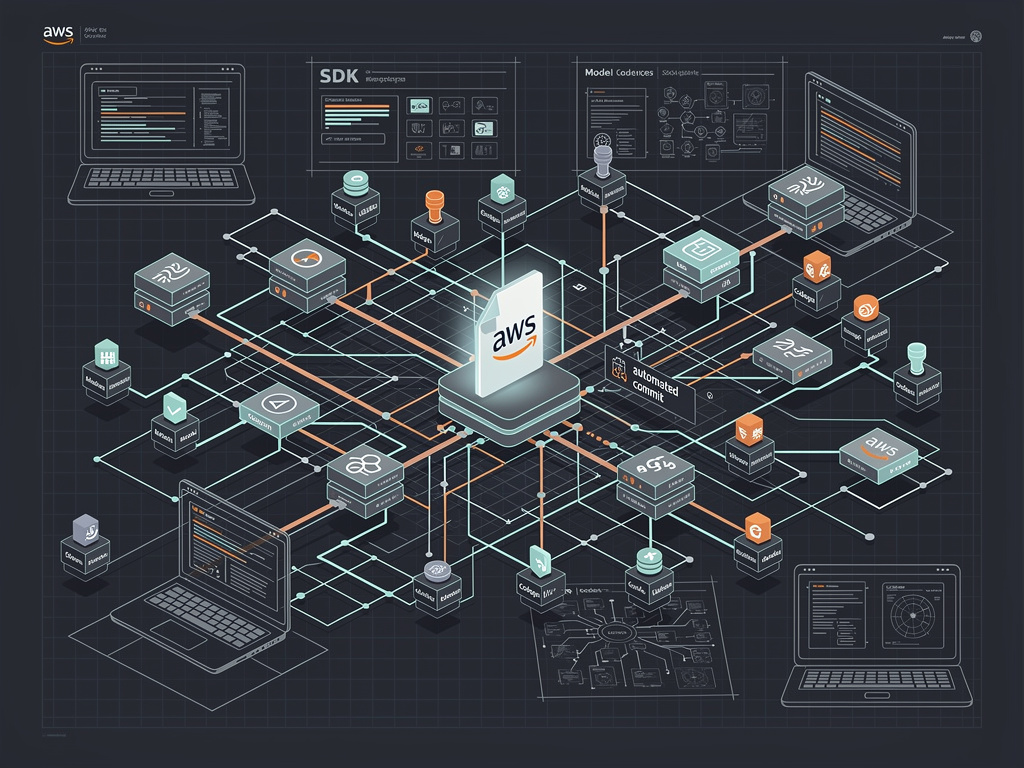
In the sprawling ecosystem of Amazon Web Services, where thousands of developers depend on software development kits to build and deploy cloud applications, even the smallest code change can ripple across industries. A recent commit to the AWS SDK for Go V2 — tagged release-2025-06-26 — offers a revealing window into the relentless, often invisible work required to keep the modern cloud infrastructure running smoothly. The commit, authored by the AWS SDK Go automation pipeline, touches dozens of service clients simultaneously and underscores the scale at which AWS must operate to maintain developer trust.
The commit in question, merged into the main branch of the aws-sdk-go-v2 repository on GitHub, is a sweeping update that modifies API models, client configurations, and documentation across a broad swath of AWS services. While such commits rarely make headlines, they represent the backbone of cloud development — the constant, iterative refinement that ensures developers can interact with AWS services reliably and predictably.
A Release That Touches Nearly Every Corner of AWS
The June 26, 2025 release is not a single feature launch or a dramatic security patch. Instead, it is a coordinated update spanning numerous AWS service modules. According to the commit’s changelog and associated pull request metadata on GitHub, the release includes updates to services such as Amazon EC2, AWS Lambda, Amazon S3, AWS IAM, Amazon DynamoDB, and many others. Each service module receives updated API models that reflect changes made on the AWS backend — new parameters, deprecated fields, updated documentation strings, and occasionally entirely new API operations.
This kind of bulk update is characteristic of how AWS manages its SDK releases. Rather than shipping individual patches for each service, the SDK team aggregates changes and pushes them in coordinated releases. This approach minimizes version fragmentation and ensures that developers who update their dependencies get a consistent snapshot of the AWS API surface. The trade-off, however, is complexity: each release must be tested against a matrix of services, Go versions, and deployment configurations before it can be safely merged.
The Automation Behind the Curtain
One of the most notable aspects of this commit is its authorship. The change was not made by a single human developer but by an automated pipeline — a pattern that AWS has increasingly relied upon to manage the sheer volume of SDK updates required across multiple programming languages. AWS maintains SDKs for Go, Python (Boto3), JavaScript, Java, .NET, Ruby, PHP, and others. Each must be kept in sync with the canonical API definitions maintained internally by AWS service teams.
The automation tooling ingests updated API model files — typically expressed in JSON or Smithy, AWS’s own interface definition language — and generates the corresponding Go code, including request and response types, serialization logic, endpoint resolution, and retry configurations. This code generation approach, while efficient, is not without risk. Subtle errors in model definitions can propagate into generated code, potentially causing runtime failures for developers who adopt the new release without thorough testing. AWS mitigates this through extensive integration testing, but the responsibility ultimately falls on individual development teams to validate updates in their own environments.
Why Go Matters in the AWS Ecosystem
The choice of Go as a first-class SDK language is no accident. Go has become a dominant language for cloud-native development, prized for its simplicity, concurrency model, and fast compilation times. Tools like Terraform, Kubernetes, Docker, and countless microservices frameworks are written in Go, making the AWS SDK for Go a critical dependency for a significant portion of the cloud-native community. According to the Go Developer Survey 2024 published by the Go team, cloud development remains one of the top use cases for the language, with AWS as the most commonly used cloud provider among Go developers.
The V2 iteration of the SDK, which AWS began developing several years ago, represented a major architectural overhaul from the original aws-sdk-go. It introduced modular service clients — meaning developers only import the packages they need — along with a revamped middleware system, improved credential handling, and better support for context propagation. These changes aligned the SDK with modern Go idioms and reduced binary sizes for applications that only interact with a handful of AWS services. The ongoing stream of releases, like the one on June 26, ensures that this architecture continues to evolve alongside the AWS platform itself.
The Granular Details: What Changed and Why It Matters
Digging into the specific changes in the commit, the update includes modifications to API model files across dozens of service directories. These model files define the shape of every API request and response, including field names, data types, validation constraints, and documentation. When AWS adds a new feature to a service — say, a new instance type in EC2 or a new configuration option in Lambda — the corresponding model file is updated, and the SDK’s code generation pipeline produces new Go types and methods to expose that feature to developers.
Documentation updates, while less glamorous, are equally important. Many of the changes in this release involve updated doc strings that clarify parameter usage, note deprecations, or describe new behaviors. For developers working with the SDK in an IDE, these doc strings are often the first point of reference — appearing as inline tooltips and autocomplete descriptions. Poorly documented APIs lead to misuse, bugs, and wasted developer time, making these incremental documentation improvements a meaningful investment in developer experience.
The Broader Challenge of Multi-SDK Synchronization
AWS’s approach to SDK management reflects a broader challenge facing all major cloud providers: how to keep dozens of client libraries, spanning multiple programming languages, in lockstep with a rapidly evolving set of backend services. Google Cloud, Microsoft Azure, and other providers face similar pressures, each with their own code generation frameworks and release cadences. AWS’s use of Smithy — an open-source interface definition language the company released in 2020 — is its answer to this problem. Smithy allows AWS to define service APIs once and generate client code for every supported language from a single source of truth.
This model-driven approach has significant advantages. It reduces the likelihood of inconsistencies between SDKs in different languages, speeds up the time-to-release for new features, and allows a relatively small team of SDK engineers to support a vast number of services. However, it also means that the quality of the generated code is only as good as the model definitions and the code generators themselves. Any bug in the Smithy models or the Go code generator can affect every developer using the SDK, making the testing and validation pipeline a critical piece of infrastructure in its own right.
What Developers Should Watch For
For teams that depend on the AWS SDK for Go V2, releases like this one warrant careful attention. While most changes are backward-compatible — AWS is generally conservative about breaking changes in its SDKs — there are occasional shifts that can affect application behavior. New required fields, changes to default values, or updated validation rules can all introduce subtle issues that only surface in production. AWS publishes detailed changelogs with each release, and developers are advised to review these before upgrading.
The broader takeaway from this commit is one of scale and discipline. AWS operates one of the largest and most complex API surfaces in the technology industry, and keeping that surface accessible to developers across multiple languages requires a level of engineering rigor that is easy to underestimate. Each automated commit, each updated model file, each revised doc string is a small but essential piece of the machinery that keeps the cloud running. For the developers who depend on it, the best releases are the ones they never have to think about — the ones that simply work.
As cloud services continue to proliferate and the expectations placed on SDK quality grow ever higher, the work happening in repositories like aws-sdk-go-v2 will only become more consequential. The June 26 release is a snapshot of that ongoing effort — unremarkable on its surface, but deeply instructive for anyone who wants to understand how the cloud is built and maintained, one commit at a time.


 WebProNews is an iEntry Publication