
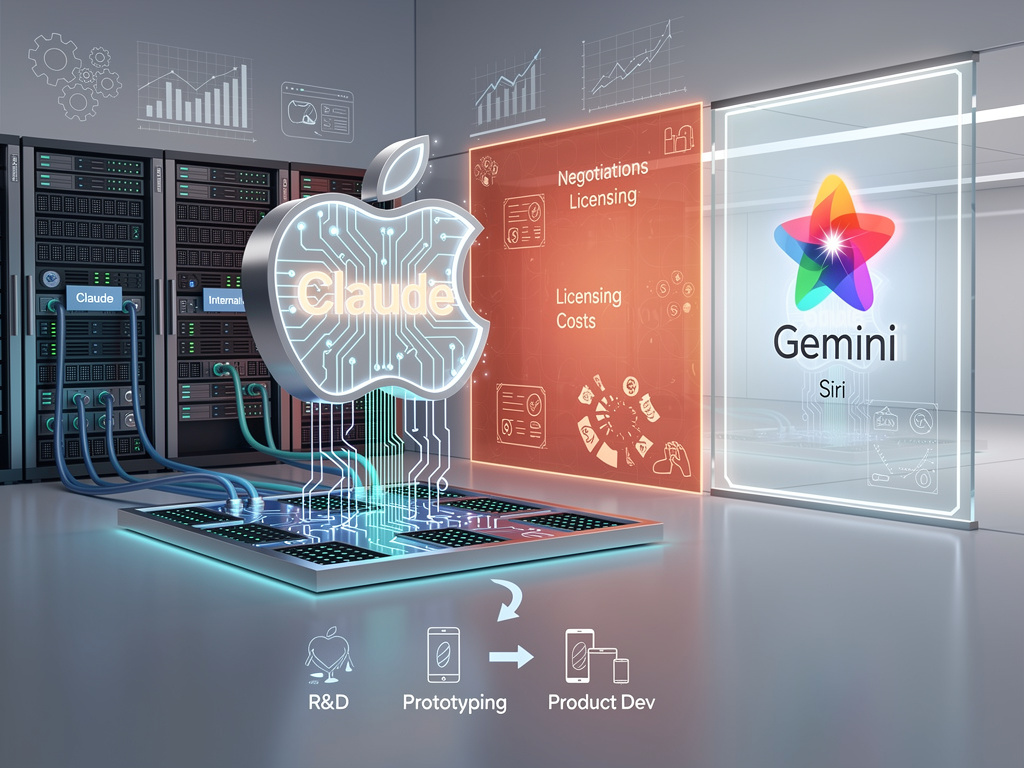
In a revelation that underscores the complex web of partnerships defining the artificial intelligence race, Apple Inc. has emerged as one of Anthropic’s most significant enterprise customers—even as the iPhone maker publicly promotes its consumer-facing partnership with Google’s Gemini for Siri capabilities. According to Bloomberg reporter Mark Gurman speaking on 9to5Mac, “Apple runs on Anthropic at this point,” with the AI startup’s Claude models powering substantial portions of Apple’s internal product development operations.
The disclosure reveals a striking dichotomy in Apple’s AI strategy: while consumers interact with Google’s technology through Siri’s latest intelligence features, Apple’s own engineers and product teams rely heavily on Anthropic’s Claude for their day-to-day development work. This arrangement highlights the pragmatic reality facing even the world’s most valuable technology company—building competitive AI capabilities requires leveraging multiple external partners, each serving different strategic purposes within the organization.
The situation becomes even more intriguing when considering what might have been. AppleInsider reports that Apple had seriously considered rebuilding Siri around Claude’s technology, a move that would have positioned Anthropic as the public face of Apple’s AI ambitions. However, negotiations ultimately collapsed over financial terms that Apple deemed excessive, leading the company to pursue its current arrangement with Google instead.
The Deal That Almost Was: Anthropic’s Pricing Gambit
According to sources familiar with the negotiations, Anthropic’s pricing demands for powering a consumer-facing Siri exceeded what Apple considered reasonable for a feature that would need to scale across more than two billion active devices worldwide. The financial gap between the two companies proved insurmountable, despite Apple’s clear appreciation for Claude’s capabilities. MacRumors notes that this decision point represented a critical juncture in Apple’s AI strategy, forcing the company to separate its internal tooling needs from its consumer product requirements.
The breakdown in negotiations speaks to broader tensions in the AI industry, where startups like Anthropic must balance the validation and revenue that comes from partnering with tech giants against the risk of becoming overly dependent on a single customer or undervaluing their technology. For Anthropic, which has raised billions in funding from investors including Google and Amazon, maintaining pricing power represents a crucial element of long-term viability. The company’s willingness to walk away from what would have been the highest-profile consumer AI deployment in the world demonstrates confidence in its market position.
Industry analysts suggest that Anthropic’s negotiating stance may have been influenced by its existing relationships with other major tech companies. With Google as a significant investor and Amazon Web Services as a key cloud infrastructure partner, Anthropic may have faced complex considerations about exclusively powering Apple’s consumer AI features. The financial terms demanded might have reflected not just the technical value of Claude, but also the strategic complications such an arrangement would create.
Internal Adoption Reveals Claude’s Enterprise Strength
Despite the failed consumer partnership, Apple’s extensive internal use of Anthropic’s technology provides perhaps the most compelling endorsement of Claude’s capabilities. Cult of Mac reports that Anthropic’s models have become deeply embedded in Apple’s product development workflows, assisting engineers with code generation, documentation, and problem-solving across multiple product lines. This internal adoption occurred organically, driven by individual teams discovering Claude’s utility rather than through top-down mandate.
The scope of Apple’s internal Anthropic usage extends beyond simple productivity tools. According to Gurman’s reporting, Claude assists with video processing tasks, product development workflows, and technical documentation—core functions that directly impact Apple’s ability to bring new products to market. This deep integration suggests that Apple’s engineering culture has embraced Claude as a fundamental tool, similar to how development environments or collaboration platforms become standard infrastructure.
What makes this arrangement particularly noteworthy is the trust it implies. Apple, famous for its secrecy and control over proprietary information, has evidently determined that the productivity gains from using Claude justify the inherent risks of relying on an external AI service for internal operations. This suggests that Apple has negotiated specific data handling and privacy protections with Anthropic, likely including guarantees that Claude models won’t be trained on Apple’s proprietary information.
The Google Partnership: A Different Value Proposition
Apple’s ultimate decision to partner with Google for consumer-facing Siri features reflects a different calculus than its internal tooling choices. Google’s Gemini models come with the advantage of integration with Google’s vast knowledge infrastructure and search capabilities, features particularly valuable for a voice assistant that needs to answer factual questions and retrieve current information. Additionally, Google’s willingness to structure a deal that works at Apple’s scale—potentially involving revenue sharing arrangements rather than pure per-query pricing—made the partnership economically viable.
The Google deal also provides Apple with strategic flexibility. By partnering with multiple AI providers rather than committing exclusively to one, Apple maintains negotiating leverage and reduces dependence on any single vendor. This multi-vendor approach mirrors strategies employed by other major enterprises navigating the rapidly evolving AI sector, where technological leadership can shift quickly and pricing models remain in flux.
However, the arrangement creates an unusual situation where Apple’s public AI strategy diverges from its internal practices. While consumers receive Google-powered intelligence features, Apple’s own product teams work with Anthropic’s technology. This split reflects the different requirements of these use cases: consumer features prioritize scale, cost-efficiency, and integration with existing services, while internal tools emphasize capability, reliability, and alignment with engineering workflows.
Implications for the AI Competitive Dynamic
Apple’s dual-vendor approach illuminates the current state of competition in enterprise and consumer AI markets. No single provider has yet achieved the combination of capability, cost-effectiveness, and scale required to serve all use cases for a company of Apple’s size and complexity. Even as AI companies race to achieve artificial general intelligence, the practical reality involves specialized applications of different models for different purposes.
For Anthropic, Apple’s internal adoption represents both validation and revenue, even without the consumer Siri deal. Enterprise licensing to large technology companies provides sustainable income while the company continues developing more advanced models. The relationship also gives Anthropic insight into real-world usage patterns at massive scale, information that can inform future development priorities. However, the company’s pricing stance in the Siri negotiations suggests confidence that it doesn’t need to accept unfavorable terms to achieve growth.
The situation also highlights Apple’s ongoing challenge in AI development. Despite massive investments in machine learning and billions spent on acquisitions, Apple has not achieved the internal AI capabilities that would allow it to compete independently with OpenAI, Anthropic, or Google. The company’s strength remains in integration, user experience, and privacy-focused implementation rather than foundational model development. This reality forces Apple into partnerships that create dependencies on potential competitors—an uncomfortable position for a company that prizes control over its technology stack.
Privacy Considerations and Data Governance
The revelation of Apple’s extensive Anthropic usage raises important questions about data handling and privacy—areas where Apple has built its brand identity. For Apple to allow Claude access to internal product development information, the company must have established rigorous data governance frameworks ensuring that sensitive information remains protected. These protections likely include contractual guarantees that Apple’s data won’t be used to train Anthropic’s general models, along with technical controls over data retention and access.
Anthropic’s positioning around AI safety and responsible development may have made it a more palatable partner for Apple compared to some competitors. The company’s emphasis on constitutional AI and interpretability aligns with Apple’s public statements about approaching AI cautiously and prioritizing user welfare. This philosophical alignment likely factored into Apple’s willingness to adopt Claude for internal use, even as financial disagreements prevented a consumer partnership.
Looking forward, Apple’s AI strategy will likely continue evolving as the company seeks to reduce dependence on external providers while maintaining access to cutting-edge capabilities. The company’s significant investments in custom silicon designed for AI workloads suggest a long-term goal of bringing more intelligence features on-device, reducing reliance on cloud-based AI services. However, the complexity and resource requirements of frontier AI models mean that partnerships will remain necessary for the foreseeable future, making the terms of these relationships critical to Apple’s competitive position in an increasingly AI-defined technology industry.


 WebProNews is an iEntry Publication