
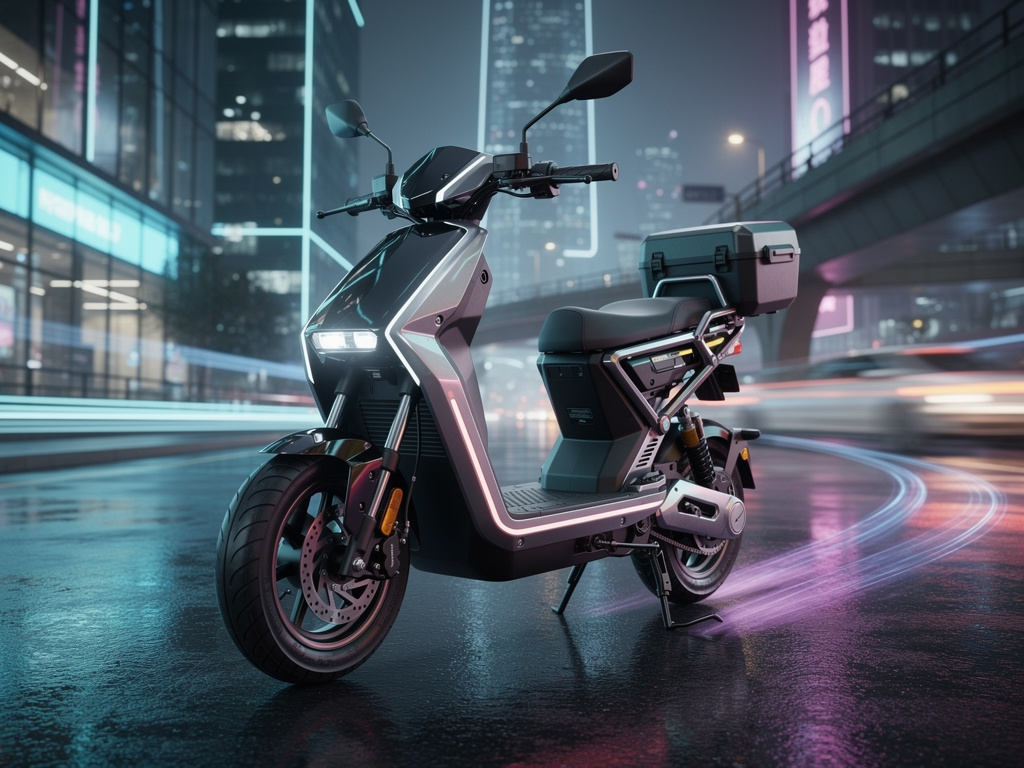
The Cyberpunk Scooter That Could Redefine City Streets
In the bustling world of urban transportation, where electric vehicles are vying for dominance amid congested roads and environmental pressures, a new contender has emerged that blends retro charm with futuristic grit. The Infinite Machine P1 e-scooter, often likened to the lovechild of a classic Vespa and Tesla’s angular Cybertruck, is turning heads with its audacious design and high-performance specs. Priced at $10,000, this custom-built machine promises a silent ride at speeds up to 65 mph and a 60-mile range, positioning it as a premium option for city dwellers seeking alternatives to cars or traditional mopeds.
Founded by a team of engineers with backgrounds in automotive and tech innovation, Infinite Machine aims to disrupt the personal electric vehicle market. The P1’s design draws inspiration from industrial aesthetics, featuring sharp lines and a metallic exoskeleton that evokes cyberpunk visions from films like “Blade Runner.” Unlike conventional scooters that prioritize sleek curves, the P1 embraces a brutalist style, with exposed components and modular elements that allow for customization. This approach not only sets it apart visually but also functionally, as the scooter’s frame is engineered for durability in harsh urban environments.
Early reviews highlight the P1’s breakthrough performance. According to a hands-on report from The Register, the scooter accelerates smoothly and maintains stability at high speeds, thanks to its advanced electric motor and battery system. Riders note the eerie silence of operation, a stark contrast to gas-powered counterparts, which enhances the experience in noise-sensitive city areas. The 60-mile range, while not revolutionary, is optimized for daily commutes, with fast-charging capabilities that can replenish the battery in under two hours using standard outlets.
Engineering a Futuristic Ride
At the heart of the P1 is a proprietary powertrain developed in-house by Infinite Machine. The scooter’s electric motor delivers instant torque, propelling it from zero to 60 mph in seconds that rival some motorcycles. This is complemented by regenerative braking technology, which recaptures energy during deceleration to extend range—a feature increasingly common in electric vehicles but refined here for scooter dynamics. The battery pack, rated at several kilowatt-hours, is swappable, allowing users to upgrade or replace units without specialized tools, a nod to practicality in a market where downtime can deter adoption.
The design philosophy extends beyond aesthetics. Infinite Machine’s website, infinitemachine.com, describes the P1 as a “non-car for the future,” emphasizing its role in reducing urban congestion and emissions. Built with lightweight aluminum alloys, the scooter weighs in at around 200 pounds, making it maneuverable yet sturdy enough for pothole-ridden streets. Integrated tech features include a digital dashboard with GPS navigation, smartphone connectivity for remote monitoring, and even anti-theft systems that use geofencing to alert owners of unauthorized movement.
Industry insiders point to the P1’s modular architecture as a key differentiator. Users can attach accessories like cargo racks or passenger seats, transforming it from a solo commuter to a versatile utility vehicle. This flexibility addresses a common pain point in the electric scooter segment, where one-size-fits-all models often fall short for diverse user needs. As noted in a detailed first-impressions piece from Electrek, the scooter’s bold angles not only look striking but also improve aerodynamics, contributing to its impressive top speed.
Market Dynamics and Competitive Pressures
The electric scooter sector is heating up, with global sales projected to surge as cities push for sustainable transport options. In India, for instance, the market has exploded from negligible figures in 2020 to over a million units in 2025, driven by affordable models and government incentives. Posts on X (formerly Twitter) from users like those in the electric vehicles community reflect growing enthusiasm, with discussions around innovative designs like swappable batteries and high-range capabilities mirroring trends seen in the P1.
Closer to home, the U.S. market is witnessing a shift toward premium electric two-wheelers. Infinite Machine secured a significant $9 million funding round led by venture firm a16z, as reported by TechCrunch, to scale production and marketing efforts. This investment underscores investor confidence in scooters as a viable alternative to cars for short trips—data suggests 60% of U.S. journeys are under five miles, a distance perfectly suited to e-scooters. However, challenges remain, including regulatory hurdles like speed limits and licensing requirements that vary by state.
Competitors are not idle. Brands like Ola Electric and Ather have captured market share in Asia with feature-rich models boasting ranges up to 140 km and rapid acceleration. X posts from tech enthusiasts highlight market share shifts, such as Ola’s decline from 40% in early 2024 to under 8% by late 2025, attributed to quality issues and competition from legacy players emphasizing after-sales service. Infinite Machine positions the P1 against these by focusing on premium build quality and tech integration, aiming to appeal to affluent urbanites disillusioned with mass-market options.
Innovation in Design and User Experience
Delving deeper into the P1’s technology, the scooter incorporates smart features that elevate it beyond basic transport. An onboard AI system optimizes power distribution based on riding patterns, learning from user behavior to maximize efficiency. This is paired with over-the-air software updates, allowing Infinite Machine to roll out improvements without hardware changes—a strategy borrowed from the automotive industry, as seen in Tesla’s ecosystem.
The company’s expansion into related products, such as the Olto e-bike unveiled in mid-2025, signals a broader vision. Described in a feature from Designboom, the Olto features magnetic foldable pedals and an automatic anti-theft lock, showcasing Infinite Machine’s knack for blending form and function. This diversification could help the brand build a loyal user base, much like how Apple expanded from computers to personal devices.
User feedback from forums like Reddit’s electric vehicles community, as captured in a thread linking to Electrek’s hands-on, praises the P1’s everyday usability. Riders appreciate the ergonomic seating and intuitive controls, which make it accessible for newcomers to electric mobility. Yet, some critiques from The Register’s forums question the $10,000 price tag, comparing it unfavorably to electrified Vespas that offer similar performance at half the cost, albeit with lower speeds.
Sustainability and Broader Implications
Sustainability is a cornerstone of the P1’s appeal. By eschewing fossil fuels, it contributes to lower carbon footprints in cities plagued by pollution. Infinite Machine sources materials ethically, with a focus on recyclable components, aligning with global trends toward green manufacturing. Recent news from WIRED on the Olto e-bike highlights the company’s push into bike-lane-friendly designs, potentially influencing urban planning to accommodate such vehicles.
Looking ahead, the electric scooter market’s evolution could reshape city infrastructure. With predictions from X posts estimating 17 million e-bike sales by 2025 and a broader market worth hundreds of billions by decade’s end, innovations like the P1 might accelerate adoption. Challenges like battery recycling and charging infrastructure persist, but Infinite Machine’s modular approach offers a blueprint for addressing them.
For industry players, the P1 represents a bold experiment in premium electric mobility. As venture capital flows into startups like Infinite Machine, the sector may see more hybrid designs that merge nostalgia with cutting-edge tech. Whether this cyberpunk scooter becomes a staple or a niche curiosity depends on consumer uptake, but its arrival signals an exciting chapter in urban transport’s ongoing transformation.
Strategic Outlook for Electric Mobility
Venturing into strategic considerations, Infinite Machine’s funding success positions it well for expansion. The a16z-backed round, detailed in TechCrunch, will fund production ramps and possibly international distribution, targeting markets like Europe where scooter culture thrives. This could pit the P1 against established names like Vespa’s electric models, which, as forum discussions on The Register note, prioritize style over raw performance.
Technological advancements are another focal point. The P1’s integration of features like tire pressure monitoring and regenerative braking echoes innovations in models like the Simple ONE Gen 1.5, as shared in X posts from tech reviewers. These elements not only enhance safety but also appeal to data-driven riders who value connectivity.
Broader market trends, gleaned from sources like CNET‘s roundup of top 2025 scooters, emphasize range and charging times as key differentiators. The P1’s 60-mile capability and quick recharge align with urban needs, potentially carving out a segment for high-end commuters unwilling to compromise on design or speed.
Pioneering Urban Transport’s Next Wave
As electric vehicles gain traction, Infinite Machine’s emphasis on “non-cars” challenges traditional automotive paradigms. The P1’s design, inspired by cyberpunk motifs, resonates with a generation seeking expressive, eco-friendly options. Insights from Uncrate Supply describe it as the ultimate urban ride, underscoring its appeal in lifestyle segments.
Community sentiment on platforms like Reddit and X reveals a mix of excitement and skepticism. Enthusiasts laud the futuristic look, while pragmatists question affordability amid economic pressures. Nevertheless, with endorsements from publications like Electrek, the P1 is poised to influence design trends across the industry.
Ultimately, the Infinite Machine P1 embodies a fusion of heritage and innovation, potentially heralding a new era where scooters aren’t just practical but aspirational. As cities evolve, vehicles like this could play a pivotal role in sustainable, efficient mobility, bridging the gap between yesterday’s icons and tomorrow’s necessities.


 WebProNews is an iEntry Publication