
When Sir Jim Ratcliffe, Britain’s wealthiest industrialist, decided to build a rugged off-road vehicle from scratch, the automotive world raised a collective eyebrow. Now, as Ineos Automotive accelerates its ambitions beyond the original Grenadier SUV, the company is proving that its foray into vehicle manufacturing is far more than a billionaire’s vanity project — it is a calculated, multi-billion-dollar industrial play that is beginning to reshape expectations about what a newcomer can accomplish in an industry defined by century-old incumbents.
The company, a subsidiary of the Ineos petrochemical empire, has been steadily expanding its footprint, product lineup, and dealer network since the Grenadier first rolled off the production line at a former Mercedes-Benz factory in Hambach, France, in late 2023. With the recent addition of the Quartermaster pickup truck variant and growing whispers about electrified powertrains, Ineos is positioning itself not as a niche curiosity but as a legitimate contender in the global utility vehicle segment.
From Chemical Plants to Assembly Lines: The Ineos Origin Story
Ineos Automotive was born out of Ratcliffe’s personal frustration with the discontinuation of the original Land Rover Defender. The British billionaire, an avid outdoorsman, believed there was an unmet market demand for a no-nonsense, mechanically robust 4×4 that prioritized capability over luxury. Rather than simply lamenting the Defender’s departure, Ratcliffe committed billions of pounds to designing, engineering, and manufacturing an entirely new vehicle — the Grenadier — named after the London pub where the idea was first sketched on a napkin.
The scale of the undertaking was staggering. Ineos acquired the Hambach factory from Mercedes-Benz parent Daimler in 2021, securing a modern production facility with existing automotive infrastructure. The company tapped BMW for its 3.0-liter turbocharged inline-six engines — available in both gasoline and diesel configurations — and partnered with Austria’s Magna Steyr for chassis engineering. ZF supplied the eight-speed automatic transmission and transfer case, while Carraro provided the beam axles. The result was a vehicle that, while entirely new, was built from a carefully curated selection of proven, world-class components.
Meeting the Market: Dealer Networks and Early Sales Performance
As Automotive News has reported, Ineos has been actively building out its retail strategy, engaging with dealers and refining its go-to-market approach as it seeks to establish a durable presence in key markets including the United States, United Kingdom, Europe, Australia, and parts of Africa and the Middle East. The company’s dealer meetings have focused on aligning expectations, discussing sales targets, and addressing the unique challenges of representing a brand that lacks the decades of consumer awareness enjoyed by rivals like Toyota, Jeep, and Land Rover.
Early sales figures have been modest but instructive. In its first full year of deliveries, Ineos moved several thousand Grenadiers globally — a figure that, while small by mass-market standards, represents meaningful traction for a startup automaker selling a vehicle priced north of $70,000 in most markets. The company has been transparent about the fact that initial volumes would be limited, emphasizing that building brand credibility and customer loyalty is a marathon, not a sprint. Dealers who have signed on report that the Grenadier attracts a passionate, knowledgeable buyer — often someone who has owned Defenders, Land Cruisers, or G-Wagens and is looking for something that prioritizes function over fashion.
The Grenadier’s DNA: Engineering for the World’s Toughest Terrain
What sets the Grenadier apart in an era of increasingly road-biased SUVs is its uncompromising commitment to off-road capability. The vehicle rides on a traditional body-on-frame architecture with solid beam axles front and rear — a configuration that has become exceedingly rare in the modern automotive world but remains the gold standard for serious off-road work. Permanent all-wheel drive with a two-speed transfer case, locking center and rear differentials, and generous ground clearance give the Grenadier credentials that few production vehicles can match.
The cabin, while not spartan, is deliberately utilitarian. Surfaces are designed to be hosed down, switches are oversized for use with gloved hands, and auxiliary switches are pre-wired for aftermarket accessories like winches and additional lighting. The BMW powertrains deliver robust performance — the 3.0-liter turbo-six produces approximately 281 horsepower in gasoline form and 245 horsepower in diesel trim — and the ZF transmission is tuned for smooth, predictable shifts both on tarmac and over rocky trails. Independent reviewers have praised the Grenadier’s composed ride quality on pavement, noting that it defies the typical harshness associated with beam-axle vehicles.
The Quartermaster Expands the Lineup
Recognizing that the global pickup truck market represents an enormous commercial opportunity, Ineos moved quickly to introduce the Quartermaster, a double-cab pickup variant of the Grenadier. Built on a stretched version of the same ladder-frame platform, the Quartermaster adds a functional cargo bed while retaining the Grenadier’s mechanical underpinnings and off-road prowess. The vehicle is aimed squarely at buyers in markets like Australia, Africa, and the Middle East, where rugged pickups serve as essential work tools rather than lifestyle accessories.
In the United States, the Quartermaster faces a more complex competitive environment. The American pickup truck market is dominated by the Ford F-150, Chevrolet Silverado, and Ram 1500 — full-size trucks that offer vastly more interior space, towing capacity, and payload. The Quartermaster is better understood as a midsize competitor, going head-to-head with the Toyota Tacoma, Jeep Gladiator, and Ford Ranger. Its premium pricing positions it as a specialized tool for buyers who value off-road capability and mechanical simplicity above all else.
Electrification on the Horizon
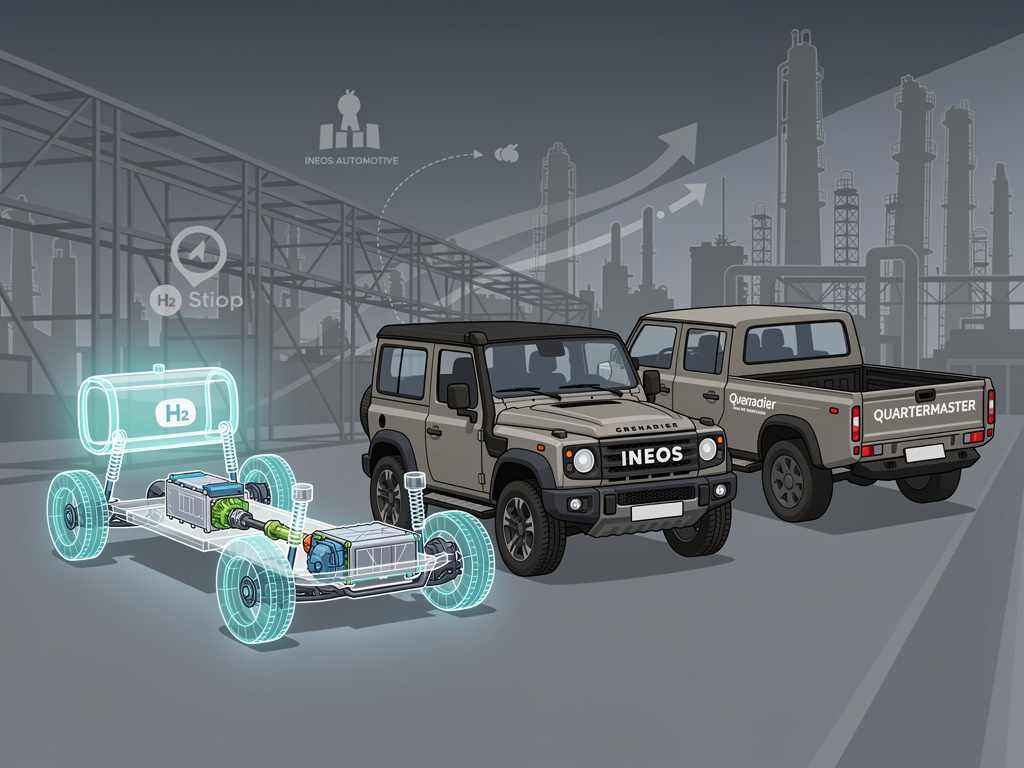
Perhaps the most closely watched aspect of Ineos Automotive’s future strategy is its approach to electrification. The company has been developing a hydrogen fuel cell variant of the Grenadier in partnership with Hyundai, which would leverage hydrogen’s advantages in range and refueling speed — critical considerations for vehicles that operate in remote areas far from charging infrastructure. Ratcliffe’s broader Ineos group has significant investments in hydrogen production, creating a potential industrial synergy that few automakers can replicate.
At the same time, Ineos has not ruled out battery-electric powertrains. The company has acknowledged that regulatory requirements in Europe and other markets will eventually necessitate zero-emission options, and the Hambach factory — which previously produced the Smart EQ ForTwo electric car — already has experience with EV production. The challenge for Ineos will be preserving the Grenadier’s off-road capability and range while accommodating the weight and packaging constraints of large battery packs. Industry analysts have noted that the body-on-frame architecture could actually be advantageous here, as it provides more flexibility for battery placement than a unibody design.
Competitive Pressures and the Road Ahead
Ineos enters the market at a time of intense competition in the premium off-road segment. Land Rover has revitalized the Defender nameplate with a modern, technology-laden vehicle that has become a runaway commercial success. Toyota continues to dominate the global off-road market with the Land Cruiser and Hilux. Mercedes-Benz’s G-Class remains the aspirational benchmark for luxury off-roaders. And in the electric space, newcomers like Rivian and legacy players like Ford (with the electric F-150 Lightning) are pushing the boundaries of what utility vehicles can be.
Yet Ineos has carved out a defensible niche by deliberately zigging where others have zagged. While competitors have loaded their vehicles with touchscreens, semi-autonomous driving features, and complex air suspension systems, the Grenadier offers mechanical simplicity and repairability as core selling points. This philosophy resonates strongly with a specific customer base — overlanders, farmers, military and government fleets, mining companies, and humanitarian organizations — that values reliability in environments where a software glitch or sensor failure could have serious consequences.
Ratcliffe’s Broader Industrial Vision
Understanding Ineos Automotive requires understanding the broader Ineos empire. The group, which generates revenues exceeding $60 billion annually from petrochemicals, oil and gas, and consumer products (including the Belstaff clothing brand), operates with an industrial logic that is fundamentally different from that of a traditional automaker. Ratcliffe has repeatedly stated that he views vehicle manufacturing as a natural extension of Ineos’s core competency: building complex industrial products at scale, with rigorous cost discipline and engineering pragmatism.
This industrial DNA manifests in Ineos Automotive’s operational decisions. The acquisition of the Hambach plant was a characteristically opportunistic move — buying a fully equipped factory at a fraction of replacement cost. The decision to source engines, transmissions, and axles from established Tier 1 suppliers rather than developing proprietary components reduced development risk and time to market. And the company’s lean corporate structure, with far fewer employees than a traditional OEM of comparable output, reflects Ineos’s broader culture of operational efficiency.
What Success Looks Like for a Startup Automaker
For Ineos Automotive, success will not be measured by the metrics that define mainstream automakers. The company is not trying to sell millions of vehicles or compete with Toyota on volume. Instead, its ambition is to build a sustainable, profitable business producing tens of thousands of vehicles per year for a global customer base that values capability, durability, and simplicity. If the Grenadier and Quartermaster can achieve the kind of cult following that the original Defender enjoyed — a vehicle that remained in production for nearly seven decades — Ratcliffe’s audacious bet will have paid off handsomely.
The coming years will be decisive. Ineos must continue to build brand awareness, expand its dealer network, address early quality issues that are inevitable with any new vehicle program, and navigate the transition toward electrified powertrains without losing the mechanical character that defines its products. The company has the financial resources, industrial expertise, and strategic patience to succeed. Whether the market ultimately rewards its uncompromising vision remains the central question — one that Sir Jim Ratcliffe, characteristically, seems to relish answering on his own terms.


 WebProNews is an iEntry Publication