
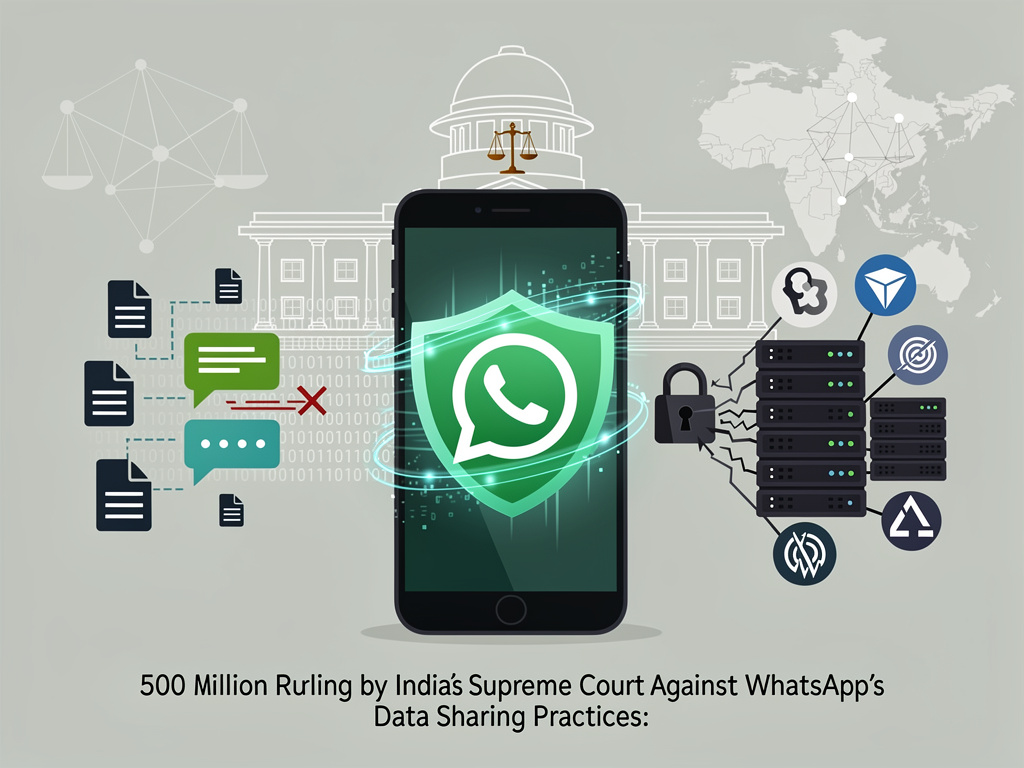
In a watershed moment for digital privacy rights in India, the Supreme Court has issued a stern rebuke to WhatsApp, categorically stating that the messaging platform “cannot play with the right to privacy” of Indian citizens. The ruling, which comes amid growing global scrutiny of Big Tech’s data practices, establishes significant precedent for how technology companies must handle user information in the world’s largest democracy and second-most populous nation.
The case centers on WhatsApp’s controversial 2021 privacy policy update, which sparked widespread concern about data sharing between the Meta-owned messaging service and its parent company. According to TechCrunch, the court’s decision marks a critical juncture in India’s ongoing efforts to regulate technology platforms and protect user data sovereignty. The ruling could have far-reaching implications not only for WhatsApp’s operations in India but for the broader technology sector’s approach to privacy in emerging markets.
The Supreme Court’s intervention follows years of contentious debate over WhatsApp’s data-sharing arrangements with Facebook, now Meta. The messaging platform, which boasts over 500 million users in India—its largest market globally—had attempted to implement a privacy policy that would allow extensive data sharing with its parent company for advertising and commercial purposes. Users were initially given an ultimatum: accept the new terms or lose access to the service, a move that triggered immediate backlash from privacy advocates, civil society organizations, and ultimately, regulatory authorities.
The Genesis of India’s Privacy Protection Framework
The court’s decision must be understood within the broader context of India’s evolving digital rights framework. The 2017 landmark Puttaswamy judgment established privacy as a fundamental right under the Indian Constitution, creating a legal foundation that has empowered courts and regulators to challenge technology companies’ data practices. This precedent has become the cornerstone of India’s approach to digital governance, influencing everything from the proposed Personal Data Protection Bill to regulatory actions against major platforms.
WhatsApp’s privacy policy controversy erupted in January 2021 when the company announced changes that would mandate data sharing with Facebook for users outside the European Union. Indian users, unlike their European counterparts protected by the General Data Protection Regulation (GDPR), faced a binary choice with significant implications for their digital privacy. The policy would have allowed Meta to access user metadata, including phone numbers, transaction data, IP addresses, and information about how users interact with businesses on the platform.
The Competition Commission of India (CCI) launched an investigation into the matter, examining whether WhatsApp’s policy update constituted an abuse of dominant position. Privacy advocates argued that the take-it-or-leave-it approach exploited WhatsApp’s market dominance, effectively coercing users into surrendering their privacy rights. The Ministry of Electronics and Information Technology also intervened, questioning WhatsApp’s compliance with Indian information technology rules and demanding explanations for the differential treatment of Indian users compared to their European counterparts.
Judicial Scrutiny and Corporate Accountability
The Supreme Court’s ruling addresses fundamental questions about corporate power, user consent, and the limits of digital surveillance. The court emphasized that privacy cannot be treated as a commodity to be traded for access to essential communication services. This principle challenges the prevailing business model of many technology platforms, which rely on extensive data collection and sharing to fuel targeted advertising and generate revenue.
Legal experts note that the ruling strengthens the hand of Indian regulators in future negotiations with technology companies. By establishing that privacy rights cannot be circumvented through terms of service agreements or market dominance, the court has created a framework that prioritizes user rights over corporate interests. This approach aligns India with jurisdictions like the European Union, which have taken aggressive stances on data protection, while distinguishing it from more permissive regulatory environments.
WhatsApp had defended its policy update by arguing that the changes primarily affected business communications and that personal messages remained protected by end-to-end encryption. The company maintained that metadata sharing was necessary to improve service quality, combat spam, and facilitate commerce on the platform. However, critics pointed out that metadata—information about who communicates with whom, when, and how often—can reveal sensitive patterns and relationships even when message content remains encrypted.
Implications for India’s Digital Economy
The ruling arrives at a critical moment for India’s digital economy, which has experienced explosive growth in recent years. The country has emerged as a crucial battleground for global technology companies, offering a massive user base and significant growth potential. However, this growth has been accompanied by increasing regulatory assertiveness, as Indian authorities seek to balance innovation with data sovereignty, national security, and user rights.
The decision could influence the trajectory of India’s long-debated Personal Data Protection Bill, which has undergone multiple revisions and remains pending in Parliament. Lawmakers and regulators now have judicial backing for stringent data protection requirements, potentially emboldening them to impose stricter obligations on technology platforms operating in India. This could include requirements for data localization, restrictions on cross-border data transfers, and enhanced user consent mechanisms.
For Meta, the ruling represents a significant setback in its efforts to integrate WhatsApp more deeply into its advertising ecosystem. The company has invested heavily in building WhatsApp’s business features, including payment services and catalog functionality for small businesses. These initiatives depend on data sharing to function effectively and generate revenue. The court’s decision may force Meta to develop alternative approaches that respect user privacy while still enabling commercial functionality.
Global Reverberations and Regulatory Trends
India’s assertive stance on digital privacy reflects a global trend toward greater regulation of technology platforms. Governments worldwide are grappling with questions about data governance, algorithmic transparency, and the appropriate balance between innovation and user protection. The European Union’s Digital Markets Act and Digital Services Act, the United Kingdom’s Online Safety Bill, and various U.S. state-level privacy laws all represent attempts to impose greater accountability on technology companies.
The Supreme Court’s ruling may embolden regulators in other developing nations to challenge Big Tech’s data practices. Many countries in Asia, Africa, and Latin America face similar dynamics: large user bases, rapid digital adoption, and concerns about data exploitation by foreign technology companies. India’s example demonstrates that emerging markets need not simply accept the terms dictated by Silicon Valley giants, but can assert their own standards for digital rights and privacy protection.
Privacy advocates have welcomed the decision as a vindication of their long-standing concerns about WhatsApp’s data practices. Organizations that challenged the policy update argue that the ruling establishes important principles about informed consent, user autonomy, and the limits of corporate power in the digital age. They contend that users should have meaningful choices about how their data is used, rather than facing coercive ultimatums from dominant platforms.
Technical and Operational Challenges Ahead
Implementing the court’s directive presents significant technical and operational challenges for WhatsApp. The company must now redesign its data architecture to ensure compliance with Indian privacy requirements while maintaining service quality and functionality. This may require developing India-specific versions of the platform, implementing additional consent mechanisms, or fundamentally restructuring how data flows between WhatsApp and other Meta properties.
The ruling also raises questions about enforcement and compliance monitoring. Indian regulators will need to develop mechanisms to verify that WhatsApp and other platforms are actually respecting user privacy in practice, not just in policy documents. This could involve regular audits, technical inspections, and transparency requirements that allow independent verification of data practices. The challenge lies in building regulatory capacity to oversee increasingly complex technical systems operated by sophisticated global corporations.
Industry observers note that the decision could accelerate the development of privacy-preserving technologies and business models. Companies may invest more heavily in techniques like federated learning, differential privacy, and on-device processing that enable useful functionality without centralized data collection. The competitive dynamics could shift in favor of platforms that can demonstrate genuine commitment to user privacy, potentially creating opportunities for new entrants that prioritize data protection from the outset.
The Road Ahead for Digital Governance
As India continues to refine its approach to digital governance, the WhatsApp ruling will serve as a touchstone for future regulatory actions and judicial decisions. The case demonstrates the judiciary’s willingness to intervene forcefully when fundamental rights are at stake, even against powerful global corporations. This judicial activism, combined with increasingly sophisticated regulatory frameworks, suggests that India is charting a distinctive path in digital policy—one that prioritizes user rights and data sovereignty while remaining open to technological innovation.
The decision’s impact will extend beyond WhatsApp to affect how all technology platforms operate in India. Companies will need to reassess their data practices, consent mechanisms, and business models to ensure compliance with evolving privacy standards. Those that adapt successfully may find opportunities in India’s growing digital economy, while those that resist could face regulatory sanctions, user backlash, and reputational damage.
For Indian users, the ruling represents a significant victory in the ongoing struggle for digital rights. It affirms that privacy is not merely a luxury for wealthy nations with strong regulatory frameworks, but a fundamental right that must be respected regardless of market dynamics or corporate interests. As digital services become increasingly central to daily life, work, and commerce, such protections will only grow more important. The Supreme Court’s message to WhatsApp—that it cannot play with privacy rights—resonates far beyond India’s borders, offering a template for how democracies worldwide might assert control over their digital futures.


 WebProNews is an iEntry Publication