
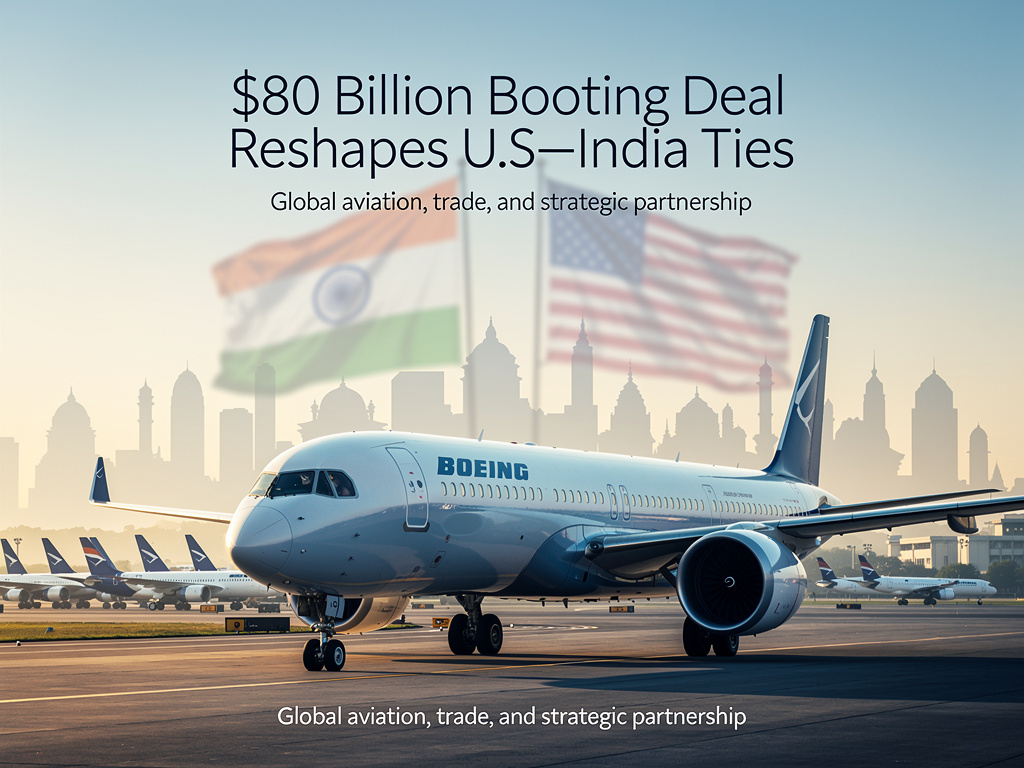
In what could become one of the largest single-country aircraft procurement commitments in aviation history, India is reportedly prepared to purchase up to $80 billion worth of Boeing aircraft as part of a sweeping trade agreement with the United States. The deal, if finalized, would represent a seismic shift in the commercial aviation order book and a diplomatic triumph for both Washington and New Delhi at a time when global trade alliances are being redrawn with extraordinary speed.
The reported commitment comes as India’s aviation sector is experiencing explosive growth, with domestic and international air travel surging on the back of a rapidly expanding middle class, increased urbanization, and aggressive airline expansion plans. According to CNBC, the aircraft purchases would be a centerpiece of a broader bilateral trade framework designed to reduce the trade imbalance between the two nations while cementing India’s position as a strategic partner of the United States in the Indo-Pacific region.
A Deal Born of Diplomatic Necessity and Commercial Ambition
The genesis of this potential mega-order lies at the intersection of geopolitics and commerce. The United States has long pressed India to open its markets more broadly to American goods and services, and the aviation sector has emerged as a natural arena for mutual benefit. India needs aircraft — lots of them — to meet what industry analysts project will be a tripling of domestic passenger traffic over the next two decades. Boeing, meanwhile, has been fighting to regain market share and restore its reputation after years of crisis stemming from the 737 MAX groundings, production quality issues, and intensifying competition from Airbus.
For Boeing, an $80 billion commitment from India would be nothing short of transformational. The Chicago-headquartered manufacturer has been under immense pressure from shareholders and regulators alike to demonstrate that it can deliver aircraft on time, maintain rigorous safety standards, and compete effectively against its European rival. A deal of this magnitude would bolster Boeing’s order backlog significantly and send a powerful signal to the market that the company remains a dominant force in wide-body and narrow-body commercial aviation.
What $80 Billion in Boeing Aircraft Actually Looks Like
Industry analysts estimate that an $80 billion order could encompass several hundred aircraft across multiple Boeing platforms. The likely candidates include the 737 MAX family, which remains Boeing’s best-selling narrow-body jet and is well-suited for India’s booming domestic routes; the 787 Dreamliner, a fuel-efficient wide-body that Indian carriers have increasingly favored for long-haul international expansion; and potentially the 777X, Boeing’s newest wide-body jet, which is expected to enter service in the coming years.
India’s airline industry has been on a historic ordering spree in recent years. Air India, following its privatization and acquisition by the Tata Group, placed a landmark order in 2023 for 470 aircraft from both Boeing and Airbus, valued at roughly $70 billion at list prices. IndiGo, the country’s largest carrier by market share, has also placed massive orders, predominantly with Airbus. The new $80 billion Boeing commitment, as reported by CNBC, would likely involve a combination of orders from multiple Indian carriers, potentially including Air India, IndiGo, SpiceJet, and Akasa Air, as well as possible government and defense-related acquisitions.
The Trade Deal Framework: Tariffs, Market Access, and Strategic Alignment
The aircraft purchases do not exist in a vacuum. They are part of a comprehensive trade deal that addresses longstanding friction points between the world’s largest and fifth-largest economies. The United States has historically criticized India’s high tariffs on a range of American products, from agricultural goods to electronics, while India has pushed back against what it views as restrictive U.S. immigration policies and barriers to Indian service exports.
Under the reported framework, India would agree to reduce tariffs on select American goods, expand market access for U.S. technology and energy companies, and make the Boeing purchases a headline commitment that demonstrates tangible economic benefit flowing back to the United States. In return, the U.S. would reportedly offer concessions on visa policies for Indian professionals, ease certain regulatory hurdles for Indian pharmaceutical exports, and deepen defense cooperation — including potential co-production arrangements for military aircraft and components on Indian soil.
Boeing’s Manufacturing and Supply Chain Implications
A deal of this scale would have profound implications for Boeing’s manufacturing operations and its vast network of suppliers. Boeing’s commercial aircraft production has been constrained in recent years by supply chain disruptions, labor shortages, and quality control challenges. Ramping up to fulfill an $80 billion Indian order — on top of existing commitments to airlines worldwide — would require Boeing to accelerate its production recovery plans and potentially invest in new manufacturing capacity.
Boeing has already been working to increase 737 MAX production rates toward a target of 38 aircraft per month, with ambitions to eventually reach 50 or more. The 787 Dreamliner line in South Carolina has similarly been ramping up after a prolonged period of reduced output. An Indian mega-order would add urgency to these efforts and could prompt Boeing to explore expanded partnerships with Indian manufacturers, aligning with Prime Minister Narendra Modi’s “Make in India” initiative.
India’s Aviation Infrastructure: Can It Keep Pace?
One of the critical questions surrounding such a massive aircraft acquisition is whether India’s aviation infrastructure can absorb hundreds of new planes. India’s airports have been undergoing rapid expansion, with new terminals, runways, and entirely new airports under construction across the country. The Noida International Airport near Delhi, the Navi Mumbai International Airport, and expansions at Bangalore’s Kempegowda International Airport are among the marquee projects designed to handle surging passenger volumes.
Yet challenges remain. Air traffic management systems, maintenance and repair facilities, and pilot training pipelines all need to scale in tandem with fleet growth. India currently faces a shortage of trained commercial pilots, and the country’s maintenance, repair, and overhaul (MRO) sector, while growing, still lags behind global leaders. Boeing has historically invested in pilot training programs in India and could deepen these commitments as part of the broader deal, creating a virtuous cycle of fleet growth and workforce development.
Airbus Watches From the Wings
The European aerospace giant Airbus will be watching these developments with keen interest — and no small degree of concern. Airbus has been the dominant player in India’s narrow-body market, with IndiGo’s massive A320neo family orders giving the Toulouse-based manufacturer a commanding presence on Indian tarmacs. An $80 billion Boeing commitment would represent a significant rebalancing of the competitive dynamics in one of the world’s fastest-growing aviation markets.
However, industry observers note that India’s appetite for aircraft is so enormous that both manufacturers stand to benefit. The International Air Transport Association (IATA) has projected that India will become the world’s third-largest aviation market by the end of this decade, and some forecasts suggest it could surpass even the United Kingdom and China in passenger numbers within 15 years. In that context, the Indian market may prove large enough to sustain record order books for both Boeing and Airbus simultaneously.
Geopolitical Dimensions: The Indo-Pacific Calculus
Beyond the commercial arithmetic, the deal carries unmistakable geopolitical significance. The United States has been actively courting India as a counterweight to China’s growing influence in the Indo-Pacific region. Defense cooperation between the two nations has deepened markedly in recent years, with India purchasing American military hardware including Apache helicopters, Chinook transport helicopters, and P-8 Poseidon maritime surveillance aircraft — all made by Boeing.
A massive commercial aviation deal would further intertwine the two economies and create structural incentives for continued strategic alignment. Every Boeing aircraft operating in India represents decades of parts, maintenance, and training relationships that bind the two countries together commercially. This is not lost on policymakers in either capital, and it is one reason why the aviation component of the trade deal has received such high-level attention from both the White House and the Prime Minister’s Office in New Delhi.
What Comes Next: Timelines, Deliveries, and Market Impact
While the headline figure of $80 billion is eye-catching, the practical reality of such a deal would unfold over many years. Aircraft deliveries from an order of this magnitude would likely be spread across a decade or more, given Boeing’s production constraints and the airlines’ own fleet planning timelines. Negotiations over pricing — which in the aviation industry routinely involves steep discounts from list prices — could also mean the actual cash value of the deal differs from the reported figure.
Nevertheless, the market impact would be immediate and significant. Boeing’s stock has historically responded favorably to large order announcements, and an $80 billion Indian commitment would likely provide a substantial boost. For India’s airlines, securing delivery slots with Boeing would give them greater leverage in negotiations with Airbus and provide fleet diversification benefits that reduce dependence on any single manufacturer. For the broader U.S.-India relationship, the deal would mark a new chapter in economic partnership — one measured not in diplomatic communiqués but in the roar of jet engines on runways from Mumbai to Minneapolis.


 WebProNews is an iEntry Publication