
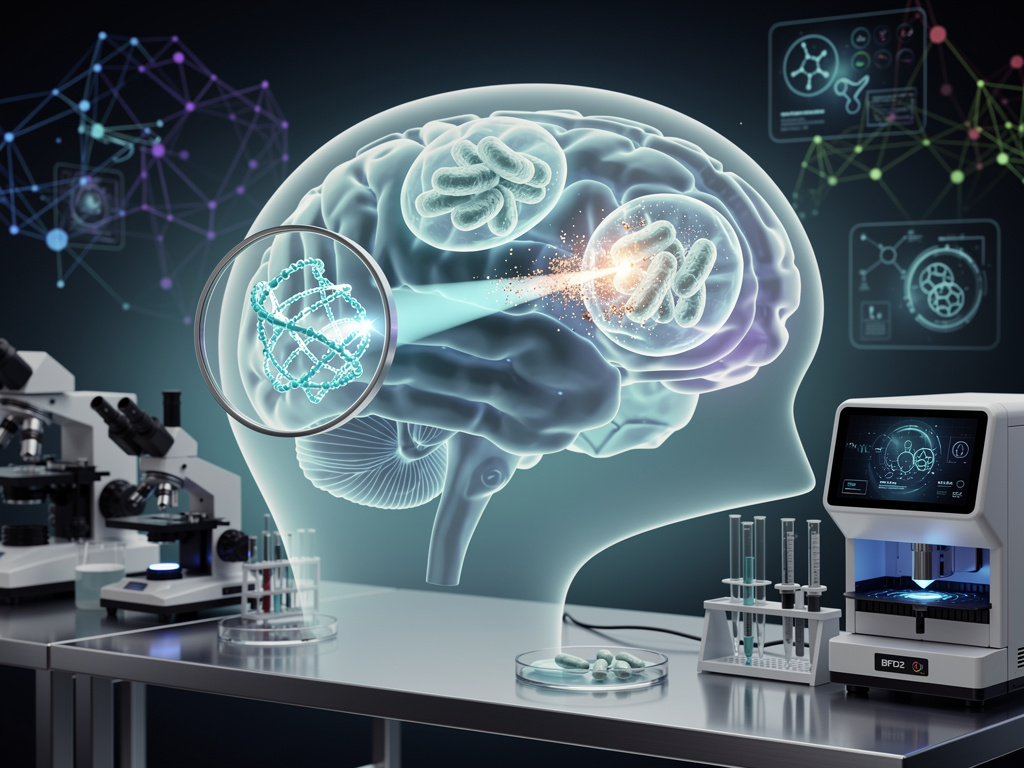
Unlocking the Mind’s Silent Invader: The Quest for a Parasite ‘Off Switch’
In the shadowy recesses of the human brain, a microscopic intruder has long evaded detection and elimination, infecting an estimated 40 million Americans without their knowledge. This parasite, known as Toxoplasma gondii, is not a rare exotic threat but a common stowaway, often acquired through undercooked meat or contact with cat feces. For years, scientists have grappled with its persistence, as it forms resilient cysts that current treatments struggle to eradicate, especially in the brain where the blood-brain barrier poses a formidable obstacle. But a recent breakthrough, detailed in a study from researchers at Indiana University School of Medicine, offers a glimmer of hope: the discovery of a protein that acts like an “off switch” for the parasite’s survival.
The research, led by parasitologist Rajshekhar Gaji, zeroed in on a protein called BFD2, which is crucial for the parasite’s ability to form those protective cysts. Without BFD2, Toxoplasma gondii cannot transition into its dormant, cyst-forming stage, rendering it vulnerable to the body’s immune defenses or existing drugs. This finding, published in the journal mBio, could pave the way for targeted therapies that disrupt the parasite’s lifecycle at a molecular level, potentially clearing it from the brain without the need for invasive procedures. As Gaji explained in an interview with ScienceAlert, the team was stunned to see parasites dying under the microscope when this protein was absent, highlighting its indispensable role.
Toxoplasma infections are typically asymptomatic in healthy adults, but they can wreak havoc in immunocompromised individuals or during pregnancy, leading to severe complications like encephalitis or congenital defects. The parasite’s cunning lies in its ability to manipulate host behavior subtly—studies in rodents show infected animals losing their fear of cats, aiding the parasite’s transmission. In humans, links have been drawn to behavioral changes, including increased risk-taking or even associations with schizophrenia, though these connections remain controversial and require further validation.
The Molecular Machinery Behind Persistence
Delving deeper into the science, the Indiana University team employed advanced genetic screening techniques to identify BFD2. By creating mutant strains of the parasite lacking various proteins, they observed that those without BFD2 failed to form bradyzoites—the slow-growing form that creates cysts. This disruption halts the parasite’s ability to hide from the immune system, making it a prime target for elimination. The discovery builds on prior work, such as efforts to engineer Toxoplasma for drug delivery, but shifts the focus toward eradication rather than exploitation.
Comparisons with other parasitic infections reveal parallels; for instance, malaria parasites also rely on specific proteins for dormancy. Yet Toxoplasma’s brain tropism sets it apart, demanding therapies that cross the blood-brain barrier without causing collateral damage. Experts like those at The Rockefeller University, in their annual review of intriguing discoveries, have highlighted similar advancements in neurodegeneration treatments, suggesting interdisciplinary potential. As noted in a Rockefeller University roundup, such molecular insights could intersect with broader neurological research.
The implications extend beyond individual health to public policy. With global infection rates estimated at one-third of the world’s population, particularly high in regions with poor sanitation, developing an “off switch” drug could reduce the burden on healthcare systems. Current treatments like pyrimethamine and sulfadiazine control acute infections but fail against cysts, leaving a reservoir that can reactivate during immunosuppression, as seen in HIV patients.
From Lab Bench to Potential Therapies
Translating this discovery into treatments involves hurdles, including ensuring the therapy’s specificity to avoid off-target effects on human cells. Gaji’s team is now screening for small molecules that inhibit BFD2, aiming for oral drugs that penetrate the brain. This approach mirrors strategies in oncology, where targeted inhibitors have revolutionized care for certain cancers.
Recent posts on X (formerly Twitter) reflect growing public interest, with users discussing the parasite’s behavioral impacts and sharing links to studies on its links to mental health. One post from a medical professional emphasized Toxoplasma’s role in physiological brain changes over a lifetime, garnering significant engagement and underscoring the need for awareness. Meanwhile, another highlighted engineered parasites for brain drug delivery, a concept that, while innovative, raises ethical questions about manipulating such organisms.
In parallel developments, a study in Phys.org echoed these findings, reporting on the unique control protein’s potential for better toxoplasmosis treatments. The article described how parasites lacking this protein were unable to survive, aligning perfectly with Gaji’s observations and suggesting a consensus in the field.
Broader Neurological Ramifications
Beyond toxoplasmosis, this research illuminates how parasites influence brain function through inflammation. A paper in ScienceDirect explores how such infections alter CNS activity, once thought immune-privileged, now recognized as vulnerable to inflammatory cascades that could exacerbate conditions like Alzheimer’s or depression.
Intriguingly, efforts to harness Toxoplasma for good have emerged. A Nature Microbiology study detailed engineering the parasite to deliver therapeutics across the blood-brain barrier, infecting one in three people worldwide yet remaining asymptomatic in most. This dual-edged sword—parasite as foe and potential ally—highlights the complexity of microbial interactions in the brain.
Public sentiment, as gauged from X discussions, mixes fascination with concern. Posts about spike protein accumulations in skull marrow, potentially linking to brain entry routes for pathogens, have sparked debates on infection pathways, though these claims require rigorous verification and should not be taken as definitive.
Challenges in Drug Development and Ethics
Developing BFD2 inhibitors faces pharmacological challenges, including bioavailability and toxicity. Preclinical models must simulate human brain infections accurately, a task complicated by species differences in immune responses. Collaborations with institutions like those featured in Hacker News discussions could accelerate innovation, where tech enthusiasts debate the feasibility of biohacking such parasites.
Ethically, the prospect of eradicating a widespread, often benign infection raises questions: Should we intervene in asymptomatic cases? Some argue for prophylactic treatments in high-risk populations, while others caution against unnecessary medicalization. This debate echoes historical controversies in vaccinology, where benefits must outweigh risks.
Moreover, global disparities in access to such therapies loom large. In developing countries, where infection rates soar, affordable drugs could transform public health, but intellectual property barriers might hinder distribution.
Intersections with Emerging Research
Recent news underscores the brain’s vulnerability to external influences. A ScienceDaily piece on “junk DNA” switches linked to Alzheimer’s reveals how genetic regulators in brain cells could parallel parasitic manipulations, suggesting overlapping mechanisms in neurodegeneration.
In neuroscience updates from ScienceDaily’s neuroscience section, inflammation’s role in brain function is a recurring theme, with parasitic infections contributing to this puzzle. Similarly, Earth.com reported on hidden DNA switches in brain support cells, influencing Alzheimer’s and potentially modulated by chronic infections like Toxoplasma.
X posts from researchers, such as those discussing vitamin C deficiency’s role in surviving parasite infections, add layers to the narrative, proposing evolutionary adaptations that favor intermittent nutrient shortages to combat invaders.
Future Horizons in Parasite Control
Looking ahead, integrating AI-driven drug discovery could expedite BFD2-targeted compounds. Virtual screening of molecular libraries, as used in COVID-19 research, might identify candidates swiftly.
Clinical trials would need to prioritize safety, starting with immunocompromised patients where benefits are clearest. Long-term studies on behavioral outcomes post-clearance could clarify Toxoplasma’s subtle influences, potentially reshaping psychiatry.
Interdisciplinary efforts, blending parasitology with neurology, promise richer insights. As highlighted in Nature, engineered parasites for brain delivery represent a bold frontier, but the “off switch” approach offers a more direct path to elimination.
Toward a Parasite-Free Brain
The journey from discovery to deployment is fraught with uncertainties, yet the BFD2 breakthrough marks a pivotal advance. By targeting the parasite’s core survival mechanism, researchers aim to not only treat but prevent the long-term sequelae of infection.
Community engagement, informed by platforms like X, can drive funding and awareness. Posts linking Toxoplasma to dormant HIV reactivation in the brain emphasize the stakes, urging accelerated research.
Ultimately, this work exemplifies the power of persistent scientific inquiry. As Gaji’s team continues their efforts, the dream of clearing our brains of this common parasite inches closer to reality, potentially enhancing cognitive health for millions. With ongoing studies and collaborations, the next decade could see transformative therapies emerge, redefining our battle against microbial intruders in the mind.


 WebProNews is an iEntry Publication