
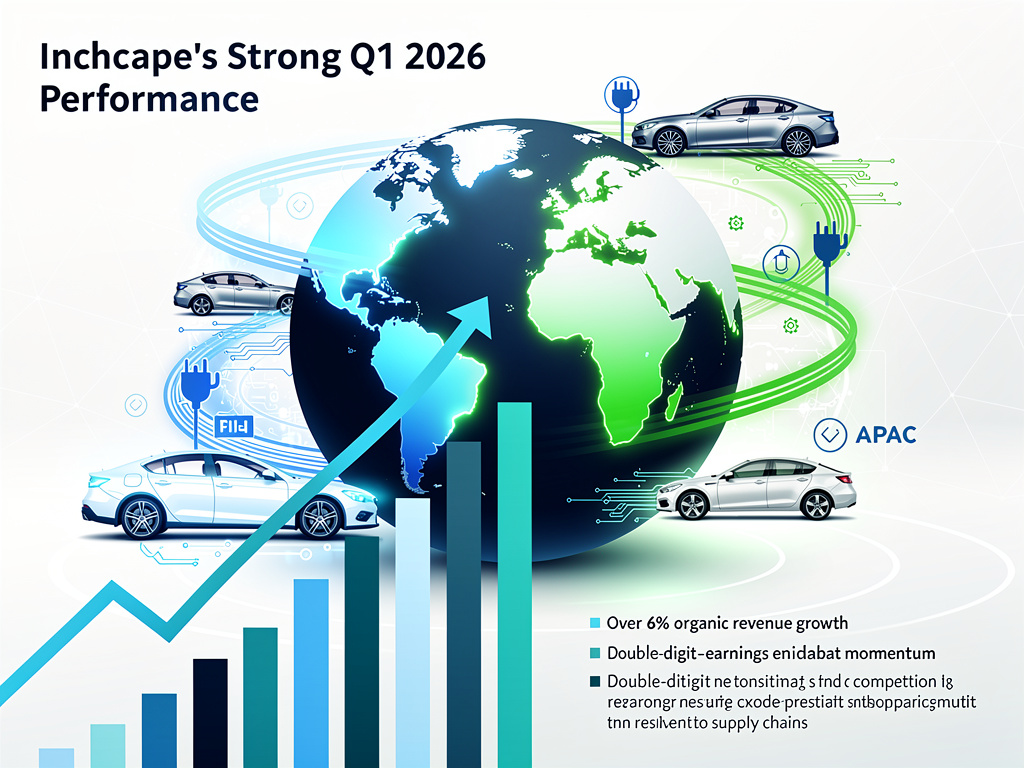
Inchcape plc posted organic revenue growth of 6% in the first quarter of 2026, pushing reported sales to £2.3 billion. That’s against soft comparators from a year earlier. The numbers, released April 30, underscore CEO Duncan Tait’s steady hand on a business navigating Asia’s headwinds and global supply strains.
Organic growth stemmed from scaling recent distribution contract wins, market share grabs, and strength in core brands. Inchcape’s volumes rose 9%, outpacing the 6% total industry volume growth across its markets. Americas delivered strong expansion amid supportive conditions. Europe and Africa outperformed again, boosted by the Q3 2025 bolt-on acquisition in Iceland. APAC lagged, hit by Australia’s intensifying competition and brand supply phasing. Yet management actions there press on.
“During Q1, we saw continued good momentum in the Americas and Europe & Africa, offsetting a weaker APAC performance,” Duncan Tait said in the trading update. He highlighted optimization efforts—cost controls, tighter OEM ties, pushes in parts and finance-insurance. No direct hit from Middle East tensions so far. Logistics snags in Europe and Africa? Immaterial. Consumer demand holds firm.
Tait’s optimism isn’t blind. Back in March, Inchcape’s full-year 2025 results showed £9.1 billion in revenue, flat organically at 1%, but resilient 6.2% operating margins at constant currency. Adjusted basic EPS climbed 13%. Free cash flow conversion hit 104% of adjusted profit after tax. ROCE stood at 29%. The company wrapped a £250 million buyback—snapping up 9% of its equity—and launched a fresh £175 million program. Dividend per share rose 13% to 32.3 pence.
Americas and Europe & Africa drove record profits. APAC improved in the second half but needed fixes. Ten new contracts landed, like GAC AION in Greece and XPENG in Colombia. A small Iceland deal opened a fresh market. Exits? Geely in minor Americas spots, and BYD’s Belux in-sourcing.
For 2026, guidance holds: organic volume growth near the low end of 3%-5%, H2-skewed; margins around 6%; cash conversion near 100%; EPS up more than 10%. “We remain on track to meet our 2026 guidance of EPS growth of more than 10%, in line with our medium term target,” Tait affirmed.
But. Asia’s premium car demand softened. Consumers there got rattled by world events, as Reuters reported in March. Middle East flare-ups—think U.S.-Iran strikes, Hormuz closures—delayed some Japan-to-Europe shipments by weeks. Tait called it manageable. Most Europe-bound cars come from local plants. Latin America routes dodge the mess via India, Japan, China.
Tait laid out his broader case for cheer in a Fortune commentary that same day. The auto sector churns through new-energy vehicles, Chinese brands’ global push (U.S. aside), online buying shifts, supply perils. Industry spews 15% of global greenhouse gases. Transition? Must be consumer-led. Regulators miss that.
“If you go back five or six years, people thought the electric vehicle future would happen by 2030—the industry got that wrong,” Tait wrote. Hybrids, EVs, even pricey hydrogen—all needed. Chinese competition squeezes brands now. But long-term? Good for everyone. Consumers kick off searches on Google. Automakers must master AI chats like ChatGPT, Perplexity.
Supply chains groan. Middle East woes. Rare earth fights, like Nexperia’s late-2025 chip spat. Echoes of 2021’s semiconductor crunch. Cars pack tech everywhere—infotainment, mirrors, lights.
Partnerships shine. Toyota-BMW on hydrogen. Ford-Renault for Europe’s small cars. Hino-Mitsubishi Fuso merger cuts R&D costs. “It’s not getting any easier in 2026, but there are certainly opportunities for growth and one lies in industry partnerships,” Tait noted. Winners build what buyers crave. Not mandates.
Inchcape thrives on this flux. As a distributor—not maker—it sidesteps some OEM pains. Diversified across 40 countries, 48 OEM partners. Recent wins like Volvo in Ecuador, Deepal in Barbados keep the pipeline humming. Buyback progress: £27 million repurchased by late April. Bolt-ons beckon.
Q1 reiterated the playbook. Strong capital discipline. Americas’ H2 seasonality, APAC fixes— they’ll weight profits later. Macro fog? Inchcape stays agile with OEMs.
Tait’s view: exciting times. Competition fuels innovation. Consumers win. Mobility powers economies, families. Inchcape’s scaled model—cash-rich, low leverage at 0.4x net debt/EBITDA—positions it to grab share. Asia tests resolve. Global ties test supply smarts. But execution delivers.
Shares dipped post-FY results on APAC clouds. Q1 lifted them. Analysts eye H2 delivery. If Tait’s right—and numbers back him—Inchcape’s bet pays off big.


 WebProNews is an iEntry Publication