
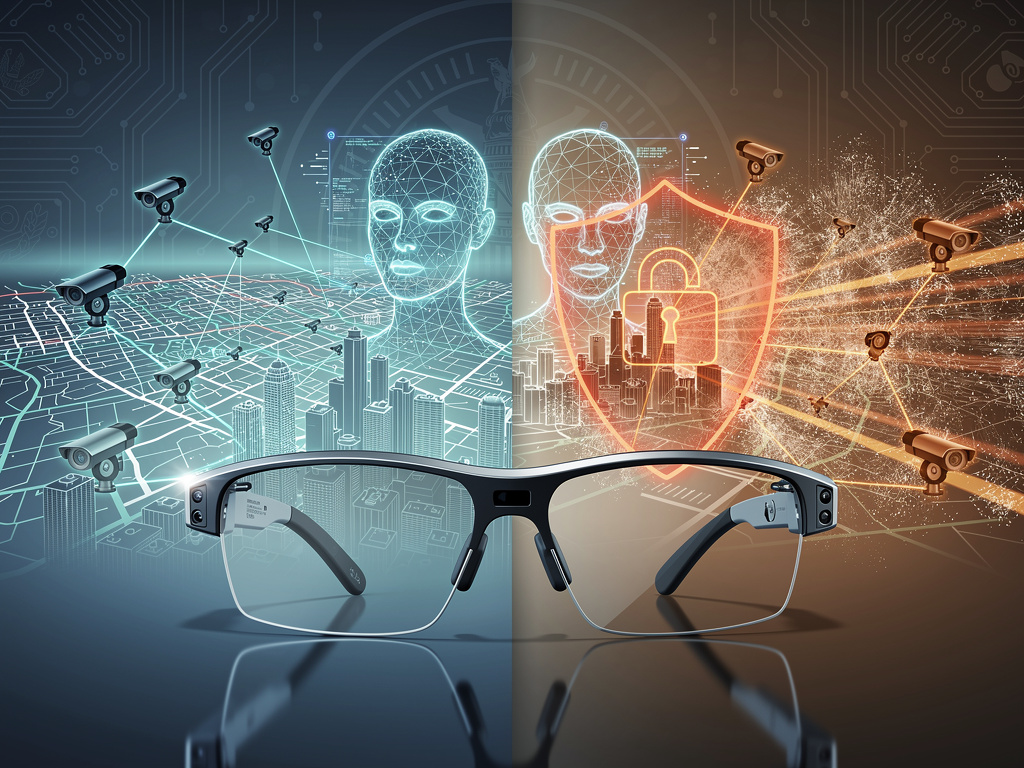
Immigration and Customs Enforcement wants its own pair of smart glasses. The devices would feed data straight into the agency’s Mobile Fortify app, letting officers identify people with a glance rather than fumbling with a phone.
The revelation comes from a detailed report in 404 Media. A Department of Homeland Security official and another attendee at a recent conference described the plans to the publication’s Joseph Cox. The glasses, still in early exploration, aim to supplement an existing system that already scans faces and queries vast government databases in seconds.
But the ambition runs deeper. Budget documents show the Department of Homeland Security has requested $7.5 million in fiscal year 2027 to develop operational prototypes. Those glasses would deliver real-time biometric identification directly in the field. Documents reviewed by The Hill place the project under the Science and Technology Directorate’s Research, Development and Innovation line. The stated goal: equip agents with instant access to information during encounters, transport, detention and removal operations.
The timing aligns with the Trump administration’s push for mass deportations. Prototypes could appear as early as the first quarter of 2027. And the scope extends beyond immigration targets. Officials speak of biometric technology at every phase of enforcement. One former Customs and Border Protection commander told The Hill the faster agents know who they face, the safer everyone stays. “It could be somebody with a criminal background. It could be somebody just looking for a better way of life,” Jason Owens said. “The sooner they can figure that out and make that determination, the better.”
Yet critics see something else. They see a tool that could scan bystanders without warning. They see the end of anonymity on American streets. Cody Venzke, an attorney with the American Civil Liberties Union, warned in the same article that such technology, once built, can be turned on anyone. “This technology, once it’s built, can be weaponized by whoever happened to win the last election.”
Mobile Fortify itself marks a sharp break from past practice. The app lets officers point a phone camera at a face and pull matches from databases holding hundreds of millions of images. 404 Media first exposed its use last year. Since then, agents have deployed it more than 100,000 times, according to a lawsuit filed by Illinois and Chicago. The system draws from passport records, visa files, border photos and state driver’s license data. Results appear almost instantly. Officers then decide whether to detain.
Accuracy questions linger. Earlier pilots of similar facial recognition at airports showed higher error rates for people of color. False positives carry real consequences when the outcome is handcuffs or deportation proceedings. Privacy advocates point to another risk. Once faces enter the system, they stay there. The glasses would accelerate that collection. They would turn routine street encounters into biometric checkpoints.
DHS insists it follows the law. A spokesperson told The Hill that no funds have been formally committed yet for smart glasses and that the agency constantly assesses technology needs while staying “within the full scope of the law.” The budget language, however, leaves little doubt about direction. It calls for “innovative hardware” that enables biometric identification of people in the country illegally. The project sits inside the Border Security and Immigration Mission Center focused on detention and removal.
Reports of agents already wearing commercial smart glasses add urgency. Biometric Update documented sightings of Meta’s Ray-Ban smart glasses on ICE and Border Patrol personnel in multiple states during 2025 operations. Agents used them to record video and photograph the public. Three Democratic senators pressed Meta for answers on its facial recognition roadmap, citing those incidents. The overlap raises an obvious question. Why build custom hardware if off-the-shelf options exist?
The answer appears to lie in control and integration. Commercial glasses come with consumer privacy policies and limited customization. Government-designed versions could tie directly into classified databases, display augmented overlays, and avoid third-party data sharing. They could also capture gait analysis alongside facial data. Some budget documents mention up to 75 million records in biometric repositories. The glasses would query those in real time.
Concerns extend beyond immigrants. Legal residents, citizens, and protesters could find themselves scanned during large gatherings or traffic stops. One leaked analysis cited by Futurism in April warned that the push, framed as targeting undocumented individuals, would affect all Americans, especially those exercising First Amendment rights. The glasses would make such surveillance invisible. No raised phone. No obvious camera. Just a federal officer looking in your direction.
Technology companies stand ready to bid. Leidos, already deeply involved in DHS biometric systems like the Automated Biometric Identification System, appears well positioned. The Science and Technology Directorate has funded multimodal collection kits and face-template re-enrollment projects. Smart glasses fit neatly into that portfolio. They represent the logical next step after handheld apps.
But history offers caution. Every previous expansion of biometric tools at the border eventually migrated inward. What began as airport face matching now appears on city streets. What started as voluntary traveler programs now supports enforcement databases. The glasses would complete that migration. They would put powerful identification capability on the face of every agent.
Advocates have called for congressional oversight. House Homeland Security Committee members requested briefings after the budget request surfaced. Funding could still be redirected. Yet the political momentum favors expansion. Executive orders demand faster removals. Budget justifications tie the glasses to public safety and operational excellence.
So the work proceeds. Engineers will prototype. Databases will grow. Agents will test. And the line between border enforcement and domestic surveillance will blur further. The glasses themselves may look ordinary. Their effect would not. One glance could trigger a lifetime record. One match could change a person’s day, or their future.
Privacy officers inside DHS have raised internal flags before on similar programs. External watchdogs like the Electronic Frontier Foundation and EPIC continue to demand transparency and audits. Whether those voices slow the rollout remains uncertain. The prototype schedule points to early 2027. By then, the technology may already feel inevitable to those building it.
One thing is clear. The era of passive observation ends when agents wear computers on their faces. The question now is how far the vision extends, and who decides the rules once the glasses ship.


 WebProNews is an iEntry Publication