
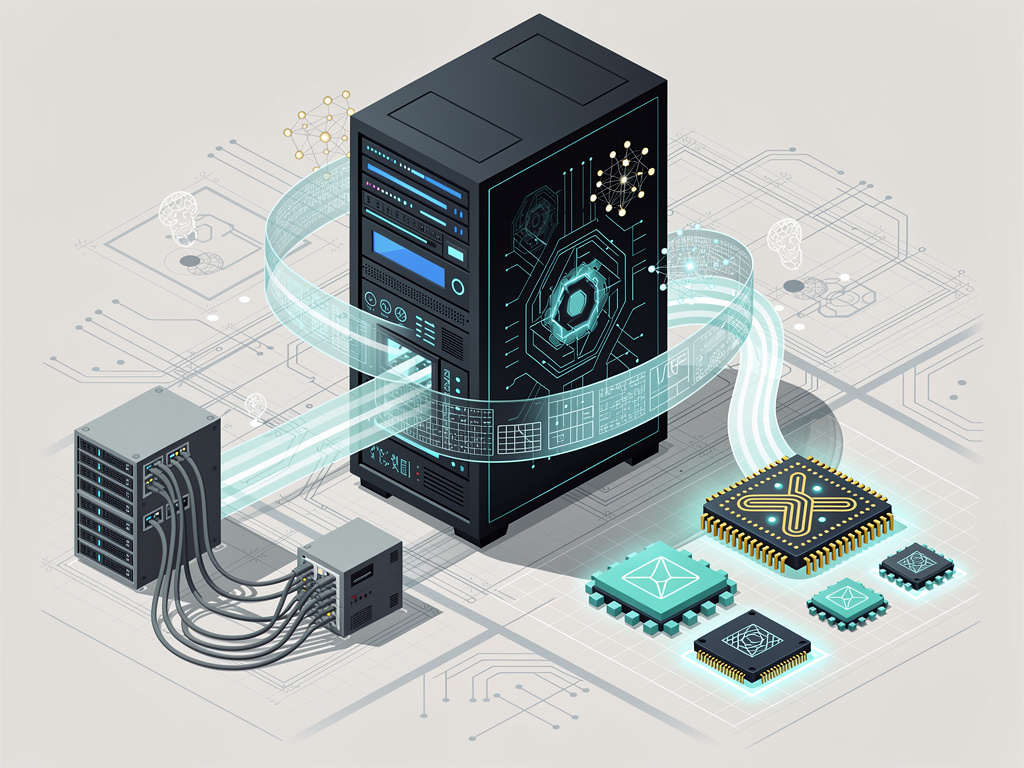
For decades, IBM’s mainframes have been the silent backbone of global finance, insurance, and government. Banks process trillions of dollars through them daily. Airlines route millions of passengers. Tax authorities calculate obligations for entire nations. These machines are not glamorous. They are not trendy. But they are indispensable—and IBM just made the most consequential bet on their future in a generation.
The announcement, made at IBM’s annual Think conference, is deceptively simple in its framing: IBM will bring its mainframe software stack to Arm-based processors and infuse it with artificial intelligence capabilities. But the implications run deep through enterprise computing, chip architecture politics, and the rapidly shifting economics of AI infrastructure.
According to The Next Web, IBM plans to make its mainframe software—including its transaction processing, database, and middleware layers—available on Arm architecture by 2027. This isn’t a port of some peripheral tool. It’s the core of what makes a mainframe a mainframe: the software that handles millions of transactions per second with near-zero downtime. IBM is effectively decoupling that software from its proprietary hardware for the first time in the platform’s six-decade history.
That’s a staggering move.
IBM’s mainframe business, built around its z-series processors, has long operated on a vertically integrated model. You wanted the software? You bought the hardware. You wanted the reliability? You paid the premium. This model generated enormous margins and locked customers into upgrade cycles that could stretch across decades. The z16, IBM’s current mainframe, starts at prices that would make even seasoned IT executives wince. But organizations kept paying because the cost of migration—rewriting millions of lines of COBOL, retraining staff, re-architecting workflows—was almost always higher than the cost of staying.
Now IBM is voluntarily loosening that grip. Why?
The answer is twofold: Arm’s ascendancy and AI’s gravitational pull. Arm-based chips, originally designed for mobile devices, have stormed into the data center over the past five years. Amazon Web Services builds its own Arm-based Graviton processors. Microsoft has its Cobalt chips. Google has Axion. Ampere Computing sells Arm server chips to cloud providers and enterprises alike. These processors offer compelling performance-per-watt ratios, and their architecture is increasingly favored for the dense, parallel workloads that AI demands.
IBM sees the writing on the wall. If mainframe workloads can only run on proprietary z-series silicon, they risk becoming stranded assets as the rest of the enterprise computing world migrates toward Arm and accelerated computing architectures. By bringing its software to Arm, IBM ensures that its most valuable intellectual property—the transactional middleware, the CICS and IMS systems, the Db2 databases—remains relevant regardless of what chip architecture wins the next decade.
And then there’s AI. IBM isn’t just porting old software to new chips. It’s weaving AI capabilities directly into the mainframe software stack. The company announced that its Granite AI models, developed by IBM Research, will be embedded into mainframe operations for tasks like anomaly detection, workload optimization, and automated code modernization. That last point matters enormously. One of the biggest barriers to mainframe modernization has always been the sheer volume of legacy COBOL code—estimated at 800 billion lines still in production globally. IBM’s AI tools aim to help translate, refactor, and modernize that code at a pace that human programmers simply cannot match.
Ross Mauri, who leads IBM’s mainframe division, framed the strategy in practical terms during the Think conference. The goal, he explained, is to meet customers where they are—not force them into binary choices between legacy systems and cloud-native architectures. Many of IBM’s largest mainframe clients have spent years running hybrid environments, with mainframes handling core transactions while cloud platforms manage front-end applications and analytics. The Arm initiative acknowledges that hybrid reality and extends it.
But skeptics have reason to pause. IBM has a complicated history with platform transitions. The company’s pivot from hardware to services under Lou Gerstner in the 1990s was successful. Its subsequent pivot to cloud under Ginni Rometty was far less so, culminating in the $34 billion acquisition of Red Hat in 2019—a deal that current CEO Arvind Krishna has worked hard to justify. The mainframe-on-Arm strategy represents yet another inflection point, and execution risk is real.
Porting mainframe software to a different instruction set architecture is not trivial. The z-series processors have specialized hardware features—cryptographic accelerators, decimal floating-point units, transactional memory support—that mainframe software exploits heavily. Replicating that performance on Arm will require significant engineering effort, and potentially new Arm chip designs with custom extensions. IBM has said it’s working with Arm Holdings on this, but details remain sparse.
There’s also the competitive dimension. If IBM’s mainframe software runs on commodity Arm hardware, what stops a hyperscaler from offering “mainframe-as-a-service” on its own Arm chips? IBM would capture software licensing revenue, sure, but it would lose the hardware margins that have long been the mainframe division’s profit engine. The company appears to be betting that software and services revenue will more than compensate—a bet that echoes Microsoft’s successful transition to cloud-based Office 365 subscriptions from on-premises licenses.
The AI angle strengthens IBM’s position here. By embedding proprietary AI models into the mainframe software stack, IBM creates differentiation that’s harder for competitors to replicate. A hyperscaler can build Arm chips. It can run Linux. But it can’t easily reproduce decades of domain-specific AI training on mainframe operational data—the patterns of transaction failures, the signatures of security breaches, the optimization heuristics for batch processing windows. That institutional knowledge, encoded in AI models, becomes IBM’s moat.
The timing aligns with broader industry trends. According to recent reporting, enterprise spending on AI infrastructure is accelerating sharply in 2025, with organizations prioritizing AI integration into existing mission-critical systems rather than building entirely new AI-native platforms. IBM’s approach—bringing AI to the mainframe rather than replacing the mainframe with AI—resonates with the conservative instincts of CIOs in banking, insurance, and government, who cannot afford the downtime or risk of wholesale platform replacement.
Arm Holdings, for its part, stands to benefit enormously. The mainframe market is small in unit volume but massive in strategic importance. Having IBM validate Arm architecture for the most demanding enterprise workloads sends a powerful signal to the rest of the industry. It also opens a new licensing revenue stream for Arm, which collects royalties on every chip built using its designs. Arm CEO Rene Haas has been vocal about expanding the company’s footprint in enterprise and data center computing, and the IBM partnership represents a significant win on that front.
Not everyone is convinced the market is ready. Some enterprise architects argue that the mainframe’s value proposition is inseparable from its integrated hardware-software design. The z-series processors aren’t just fast—they’re designed from the transistor level up to support the specific reliability and security guarantees that mainframe customers demand. Running mainframe software on general-purpose Arm chips, even very good ones, may not deliver the same five-nines availability that banks and governments require. IBM will need to prove otherwise, and that proof will take years of production deployments, not just benchmark results.
There’s a generational workforce issue at play too. The engineers who understand mainframe systems deeply are aging out of the workforce. Younger developers overwhelmingly prefer cloud-native tools, open-source languages, and modern development environments. By making mainframe software accessible on Arm—and by extension, more compatible with modern DevOps toolchains and cloud deployment models—IBM is trying to make the mainframe approachable for a new generation of technologists who might otherwise never touch one.
So where does this leave IBM’s stock story? Wall Street has been cautiously optimistic about IBM under Krishna’s leadership. The Red Hat acquisition is finally delivering growth. The consulting business has stabilized. And the company’s AI narrative—centered on its watsonx platform and Granite models—has gained credibility, if not the hype of competitors like Nvidia or Microsoft. The mainframe-on-Arm announcement adds another chapter to that narrative: IBM as the company that bridges legacy and future, that makes AI practical for the enterprises that actually run the world’s critical infrastructure.
The 2027 timeline gives IBM roughly two years to deliver. That’s aggressive for a platform transition of this magnitude, but not unreasonable given that much of the underlying software modernization work—containerization, API exposure, microservices decomposition—has been underway for several years already. IBM’s LinuxONE platform, which runs Linux on z-series hardware, has served as a proving ground for many of these concepts.
What happens next will depend on execution, customer appetite, and the broader trajectory of AI hardware economics. If Arm-based chips continue their march into the data center—and every indication suggests they will—IBM’s early move to embrace the architecture could look prescient. If the transition stumbles, or if customers balk at the complexity, it could become another cautionary tale of a legacy technology company trying to reinvent itself one more time.
Either way, the decision has been made. IBM is no longer tethering its most important software franchise to a single chip architecture. For a company that has built mainframes since 1964, that’s not just a product announcement. It’s an admission that the future of enterprise computing will be defined by software intelligence, not hardware exclusivity. And in that future, IBM intends to be indispensable—on whatever silicon its customers choose to run.


 WebProNews is an iEntry Publication