
GOYANG, South Korea—The trajectory of José Muñoz’s career defies conventional automotive industry wisdom. A nuclear engineer by training who once missed trains in Madrid because he didn’t own a car, Muñoz now helms one of the world’s largest automakers during perhaps the most turbulent period in modern trade history. As Hyundai Motor’s first non-Korean chief executive, the 60-year-old Spanish-American dual national is orchestrating a $26 billion American manufacturing expansion while simultaneously pivoting the 55-year-old South Korean conglomerate toward robotics, artificial intelligence, and flying vehicles.
The stakes couldn’t be higher. According to The Wall Street Journal, Hyundai reported a 22% decline in net income for 2025, battered by President Trump’s tariffs on imported vehicles including Korean-made Hyundais. Yet the company achieved record global revenue, selling more than four million vehicles worldwide—including roughly one million in the United States, representing a 39% increase since Muñoz joined the company in 2019. The dichotomy illustrates the paradox facing global automakers: unprecedented sales volumes undermined by geopolitical uncertainty and protectionist trade policies.
Muñoz’s response to this volatility reveals a management philosophy forged through decades navigating corporate tumult. Rather than retreating, he’s accelerating. “We’re focusing on accelerating,” Muñoz told the Journal regarding Hyundai’s massive U.S. investment plan. “The sooner the better, so we can enjoy our investments.” This aggressive timeline aims to insulate Hyundai from tariff exposure by localizing production, transforming the company from an importer of Korean-manufactured vehicles into a major American manufacturer. By 2030, Muñoz targets 80% of U.S.-sold Hyundais to be American-made, nearly double the current proportion.
The Tariff Tightrope and Trump’s Unpredictable Trade Policy
President Trump’s mercurial approach to international trade has created unprecedented planning challenges for multinational corporations. Just three months after the United States and South Korea negotiated to lower tariffs from 25% to 15%, Trump threatened on a Monday in early 2025 to restore the higher rate, according to reporting from The Wall Street Journal. For Hyundai, which has met with Trump on multiple occasions, these policy reversals represent both existential threat and strategic opportunity.
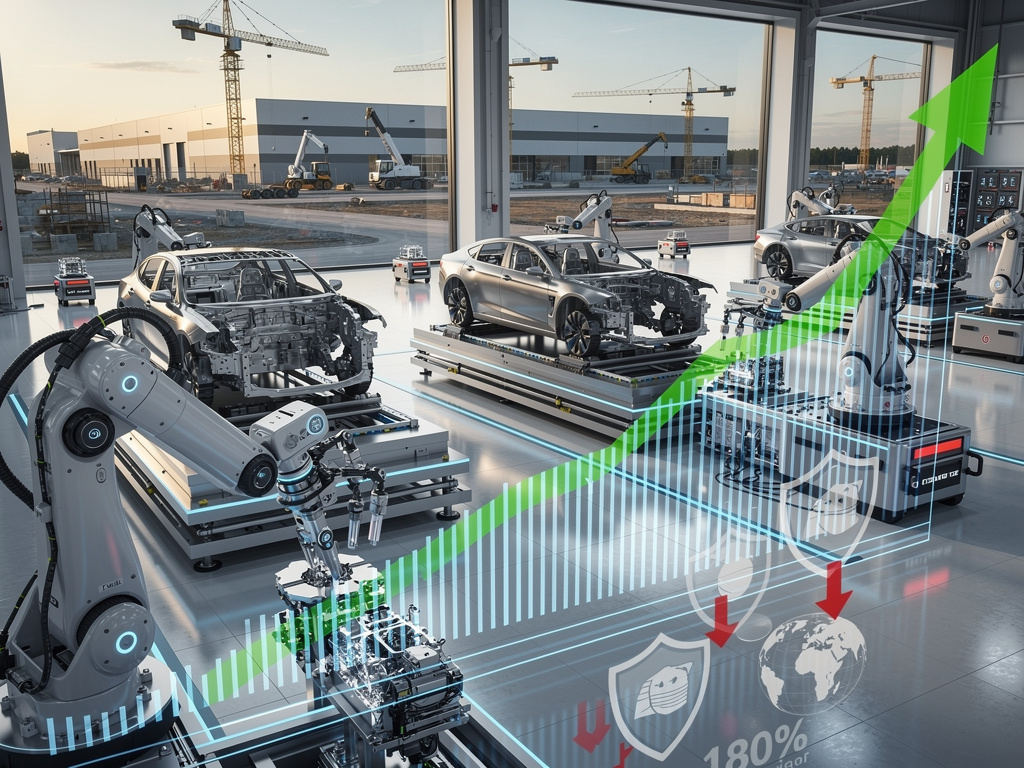
Muñoz maintains that Trump understands Hyundai’s commitment to American manufacturing, a belief grounded in the company’s substantial capital deployment. The $26 billion investment encompasses multiple manufacturing facilities, including the “Metaplant” complex in Georgia where Hyundai plans to deploy its Atlas humanoid robots beginning in 2028. This facility represents more than traditional automotive manufacturing—it’s a testbed for integrating advanced robotics, artificial intelligence, and next-generation production methodologies that could redefine vehicle assembly.
The September 2024 immigration raid at a battery-production plant jointly operated by Hyundai and LG Energy Solution underscored the operational complexities of this American expansion. U.S. immigration authorities detained more than 300 South Koreans at the Georgia construction site, many possessing specialized technical expertise critical to the facility’s completion. Although none were direct Hyundai employees, their detention threatened project timelines. Muñoz confirmed in his interview that the “vast majority” of detained workers obtained new visas and returned to Georgia, with the plant scheduled to open in the first half of 2025.
From Nuclear Reactors to Robot Dogs: An Unconventional Path to the C-Suite
Muñoz’s journey to Hyundai’s executive suite began in 1980s Spain, where he earned a Ph.D. in nuclear engineering and worked in the country’s nuclear energy sector. His entry into the automotive industry was accidental and romantic—literally. After repeatedly missing the final train home in Madrid due to his lack of personal transportation, a friend urged him to buy a car and introduced him to a saleswoman. “This dealer became my wife,” Muñoz recalled in the Journal interview. Her recommendation that he consider a career in automotive sales proved prescient.
His automotive career progressed through roles at Daewoo Motors, the now-defunct Korean carmaker, and Nissan, where he served as a top lieutenant to Carlos Ghosn during that executive’s tenure transforming the Japanese automaker. When Muñoz joined Hyundai in 2019 as global chief operating officer overseeing U.S. sales, the company was already experiencing momentum with popular models like the Tucson sport-utility vehicle. Together with sister brand Kia, Hyundai controlled approximately 10% of the American market, trailing only General Motors, Toyota, and Ford. Globally, the Hyundai-Kia partnership held third place behind Toyota and Volkswagen.
Muñoz’s elevation to CEO represents a watershed moment not just for Hyundai but for South Korean corporate culture. According to Park Ju-gun, CEO of Leaders Index, a Seoul-based corporate research firm, Muñoz is the only foreigner ever to serve as chief executive of a company among South Korea’s top 30 business groups. This appointment by Euisun Chung—Hyundai Motor Group’s executive chair and grandson of the company’s founder—signals recognition that navigating global markets, particularly the critical U.S. market, requires leadership attuned to Western business practices and cultural expectations.
Cultural Revolution: Breaking Hierarchies in Korea’s Rigid Corporate Structure
South Korean corporate culture, known for its rigid hierarchies and deference to seniority, has historically insulated executives from uncomfortable truths and stifled bottom-up innovation. Muñoz recognized this structural impediment as potentially fatal in an era demanding rapid adaptation. His solution: regular unscripted town halls, an unusual practice in South Korean business. When he addressed roughly 1,000 local sales employees early in 2025 in Goyang, a Seoul suburb, aides had prepared Korean translations of his English-language speech for display on large screens. Muñoz scrapped the prepared remarks, grabbed a microphone, invited an interpreter on stage, and delivered an impromptu address emphasizing that 2026 couldn’t be “just another year of business as usual.”
Initially, these town halls met silence when question time arrived—a predictable response in a culture where challenging superiors risks career consequences. Muñoz implemented a simple incentive: the first person to ask a question sometimes receives a day off work. This gamification of participation gradually eroded reticence, creating forums for genuine dialogue between management and employees across organizational levels.
Despite not speaking fluent Korean, Muñoz has created internal terminology blending Korean expressions with management philosophy. He coined “PM squared,” combining “pali, pali” (quickly) and “miri, miri” (in advance)—two common Korean phrases. This linguistic bridge demonstrates cultural adaptation while maintaining urgency around execution speed and proactive planning. The phrase has entered Hyundai’s internal vocabulary, representing Muñoz’s imprint on corporate culture.
The Robotics Pivot: From Boston Dynamics to Humanoid Workers
Hyundai’s 2021 acquisition of a controlling stake in Boston Dynamics, the robotics company famous for viral videos of its agile robot dogs, signaled ambitions extending far beyond traditional automotive manufacturing. The company has deepened this commitment under Muñoz’s leadership, positioning robotics as central to its identity transformation. “Hyundai should become ‘a tech company, mobility company’ that ‘happens to sell cars,'” Muñoz declared while speaking at a Hyundai studio in a Seoul suburb, where one of the company’s yellow robot dogs—named “Spot” and designed primarily for industrial work sites—roamed a showroom floor alongside luxury vehicles.
The Atlas humanoid robot, unveiled at a Las Vegas trade show in January 2025, represents the culmination of this robotics investment. According to The Wall Street Journal, Atlas can twist its head, torso, and joints 360 degrees and autonomously replace its own batteries at charging stations. These industrial robots are scheduled for deployment in Hyundai’s Georgia Metaplant facilities beginning in 2028, where they’ll work alongside human employees in vehicle assembly and manufacturing processes.
The stock market’s response to Hyundai’s robotics push validates Muñoz’s strategic bet. When the company showcased Atlas in January, Hyundai’s stock price skyrocketed, gaining 80% in just one month. This market enthusiasm suggests investors view Hyundai’s diversification beyond traditional automotive manufacturing as value-creating rather than distracting—a critical endorsement as the company allocates substantial capital to these moonshot projects.
The Nvidia Partnership: AI-Powered Manufacturing and Autonomous Vehicles
Hyundai’s partnership with artificial intelligence leader Nvidia represents another pillar of Muñoz’s technology-first strategy. The collaboration involves deploying 50,000 Blackwell chips—Nvidia’s latest AI accelerator architecture—to make Hyundai’s manufacturing processes smarter and bring real-time AI functions to both vehicles and robots. This massive chip deployment positions Hyundai among the largest industrial users of cutting-edge AI hardware, comparable to major technology companies rather than traditional automakers.
The Nvidia partnership extends beyond factory automation. Real-time AI functions in vehicles promise enhanced autonomous driving capabilities, predictive maintenance, personalized user experiences, and over-the-air updates that continuously improve vehicle performance. For Hyundai’s robots, AI enables adaptive learning, allowing machines to optimize movements, anticipate maintenance needs, and collaborate more effectively with human workers. This integration of AI across manufacturing and products represents the convergence Muñoz envisions—where Hyundai’s identity as a “tech company” becomes indistinguishable from its automotive heritage.
The strategic logic is compelling: as vehicles become increasingly software-defined and autonomous, the technical capabilities required to manufacture them converge with those needed to develop advanced robotics. Hyundai’s simultaneous push into both domains creates potential synergies in AI development, sensor technology, battery systems, and manufacturing processes. Whether these synergies materialize sufficiently to justify the capital investment remains an open question, but Muñoz’s bet is that future mobility companies must master these technologies or risk obsolescence.
Dual-Track Strategy: Hybrids for America, EVs for China
Muñoz’s product strategy reflects sophisticated market segmentation, acknowledging that different regions require fundamentally different approaches. In the United States, where consumer resistance to fully electric vehicles persists and charging infrastructure remains incomplete, Hyundai plans to double its hybrid model offerings to more than 18 by 2030 while slowing the transition to pure EVs. This pragmatic approach contrasts sharply with competitors who’ve committed to aggressive EV timelines only to scale back amid weak demand.
China presents an entirely different competitive environment. The world’s largest automotive market has embraced electric vehicles with government support, extensive charging infrastructure, and fierce domestic competition from companies like BYD, NIO, and XPeng. Muñoz recently traveled to China, where Hyundai plans to introduce some 20 new EV models. His assessment of these visits reveals humility uncommon among Western executives: “While in the past I was going to China to teach them about competition,” Muñoz acknowledged, “now I go to learn.”
This admission recognizes China’s emergence as the global leader in EV technology, battery production, and digital vehicle features. Chinese automakers have pioneered innovations in battery chemistry, autonomous driving software, and integrated digital ecosystems that Western manufacturers are now scrambling to match. For Hyundai, succeeding in China requires not just localized production but genuine technological innovation competitive with domestic leaders who benefit from massive scale, government support, and rapid iteration cycles.
The American Manufacturing Imperative: Localizing to Survive
Muñoz’s push to manufacture 80% of U.S.-sold Hyundais domestically by 2030 represents more than tariff mitigation—it’s an irreversible strategic commitment. “Once you make a commitment to make a factory, and then you have the factory up and running, there is no way back,” he told the Journal. This permanence creates both opportunity and risk. If U.S. demand remains strong, domestic production provides cost advantages, supply chain resilience, and political goodwill. If demand falters or trade policies shift favorably toward imports, Hyundai’s fixed investments in American manufacturing could become stranded assets.
The Georgia Metaplant complex exemplifies this commitment’s scale. Beyond traditional assembly lines, the facility will integrate robotics, AI-powered quality control, and advanced battery production through the LG Energy Solution partnership. The plant’s design as a “Metaplant” suggests modular, flexible manufacturing capable of adapting to different vehicle platforms and powertrains—critical flexibility as consumer preferences shift between hybrids, EVs, and traditional internal combustion engines.
Hyundai’s American expansion also carries symbolic weight. As a South Korean company investing heavily in U.S. manufacturing while Japanese and German competitors maintain more globally distributed production, Hyundai positions itself as aligned with American industrial policy priorities. This political capital could prove valuable in future trade negotiations, regulatory discussions, or government procurement opportunities. Muñoz’s multiple meetings with President Trump suggest active cultivation of this relationship, though the president’s unpredictability means no amount of investment guarantees favorable treatment.
Flying Cars and Mobility’s Uncertain Future
Among Muñoz’s more speculative bets are flying cars—urban air mobility vehicles that promise to revolutionize transportation in congested metropolitan areas. While the Journal article mentions this ambition, the practical timeline and investment scale remain unclear. Multiple companies, including established aerospace manufacturers and startups, are pursuing electric vertical takeoff and landing (eVTOL) aircraft, but regulatory approval, infrastructure requirements, and public acceptance present formidable barriers.
Hyundai’s advantage in this emerging sector stems from its expertise in electric powertrains, battery systems, and mass manufacturing—capabilities that translate more directly to eVTOL production than traditional aerospace experience. The company could leverage its automotive supply chain, quality control processes, and global distribution network to manufacture flying vehicles at scales and price points unachievable by smaller competitors. However, the sector remains pre-commercial, with no clear path to profitability or regulatory certification for most designs.
This diversification into speculative mobility concepts reflects Muñoz’s conviction that Hyundai must explore multiple futures simultaneously. In an industry facing disruption from electrification, autonomy, shared mobility, and potentially aerial transportation, placing bets across multiple technologies hedges against uncertainty. Whether flying cars prove viable or join the long list of overhyped transportation innovations remains unknowable, but Hyundai’s resources allow experimentation that smaller competitors cannot afford.
Stock Market Enthusiasm and Investor Skepticism
The 80% stock price surge following the Atlas robot demonstration illustrates investor enthusiasm for Hyundai’s technology pivot, but sustainability of this valuation remains questionable. Technology companies command higher multiples than traditional automakers because investors expect faster growth, higher margins, and network effects that create competitive moats. Whether Hyundai can achieve similar characteristics through robotics and AI, or whether the stock appreciation represents temporary excitement, will become clear as the company reports financial results from these new divisions.
The 22% net income decline in 2025, despite record revenue, demonstrates the financial pressure Hyundai faces. Tariffs directly impact profitability on imported vehicles, while massive capital investments in American manufacturing, robotics development, and AI partnerships depress near-term earnings. Investors betting on Hyundai’s transformation must accept years of depressed profitability as the company builds capabilities in new domains while maintaining competitiveness in traditional automotive markets.
Muñoz’s challenge involves managing this transition without alienating investors who expect automotive-level returns or disappointing those anticipating technology-company growth. The dual identity he articulates—”a tech company, mobility company that happens to sell cars”—must eventually translate into financial performance that justifies technology valuations. If robotics and AI remain small divisions subsidized by profitable automotive operations, the transformation narrative collapses and the stock reprices accordingly.
Competitive Pressures and Industry Transformation
Hyundai’s transformation occurs amid industry-wide upheaval as traditional automakers, technology companies, and Chinese manufacturers compete across multiple dimensions simultaneously. Tesla demonstrated that automotive companies could command technology valuations, but its recent struggles illustrate the difficulty sustaining that positioning. Traditional competitors like General Motors, Ford, and Volkswagen are pursuing similar strategies, investing in EVs, autonomous driving, and software capabilities while managing legacy operations.
Chinese manufacturers pose perhaps the greatest competitive threat. Companies like BYD have achieved massive scale in EV production with vertically integrated battery manufacturing, enabling cost structures Western competitors struggle to match. Chinese automakers are also advancing rapidly in autonomous driving software, digital vehicle features, and AI integration—precisely the domains where Hyundai seeks differentiation. If Chinese manufacturers successfully expand beyond their domestic market, they could pressure Hyundai globally on both cost and technology.
Hyundai’s advantages include established global distribution, brand recognition in key markets, and financial resources to invest in multiple technologies simultaneously. The company’s partnership with Kia provides scale benefits while maintaining brand differentiation. However, these advantages matter only if Hyundai successfully executes its technology transformation while maintaining automotive competitiveness—a dual mandate that has proven difficult for most traditional manufacturers attempting similar pivots.
The Leadership Test: Can an Outsider Transform Korean Corporate Culture?
Muñoz’s tenure ultimately tests whether an outsider can fundamentally transform a major South Korean conglomerate’s culture and strategy. His appointment by Euisun Chung signals recognition that change requires external perspective, but implementation depends on thousands of employees embracing new approaches that challenge traditional hierarchies and risk-averse decision-making. The town halls, “PM squared” philosophy, and unscripted communications represent cultural interventions, but their depth remains uncertain.
South Korean business history offers few precedents for successful foreign leadership of major conglomerates. The country’s corporate culture evolved through rapid industrialization under founder-led chaebols, creating deeply embedded practices resistant to change. Muñoz’s nuclear engineering background, automotive industry experience across multiple companies and cultures, and personal story as an accidental entrant to the industry provide unconventional credentials that may enable fresh thinking unencumbered by automotive orthodoxy.
The coming years will reveal whether Muñoz’s aggressive timeline for American manufacturing, robotics deployment, and technology transformation proves prescient or overambitious. His bet that acceleration—getting factories operational and investments productive sooner—provides the best defense against tariff uncertainty and competitive pressure reflects urgency appropriate to the industry’s disruption. Whether Hyundai emerges as a technology-enabled mobility leader or remains a successful but traditional automaker depends substantially on execution of the vision Muñoz articulates with conviction but must deliver amid unprecedented uncertainty.
Manufacturing Renaissance or Stranded Assets?
The $26 billion American investment represents Hyundai’s largest geographic bet, concentrating resources in a market characterized by political volatility, mature demand, and intense competition. The irreversibility Muñoz acknowledges—”there is no way back” once factories are operational—creates path dependency that could prove advantageous or constraining depending on how trade policy, consumer preferences, and competitive dynamics evolve. If American manufacturing costs remain competitive and tariffs persist, the investment appears prudent. If trade liberalization resumes or automation eliminates labor cost advantages, the fixed investments could underperform.
The integration of robotics into these facilities attempts to address this uncertainty by creating manufacturing flexibility and efficiency that justifies domestic production regardless of trade policy. If Atlas robots and AI-powered systems substantially reduce labor costs while improving quality and flexibility, Hyundai’s American plants could achieve cost structures competitive with any global location. This technological solution to a political problem represents the convergence of Muñoz’s dual strategy—using robotics and AI investments to enable geographic diversification that mitigates trade risk.
However, robotics deployment at scale in automotive manufacturing remains largely unproven. While robots have assembled vehicles for decades, humanoid robots performing diverse tasks alongside human workers represent a significant technological leap. The 2028 deployment timeline for Atlas robots in the Georgia Metaplant provides limited time to develop, test, and refine these systems before commercial production begins. Delays or performance shortfalls could undermine the facility’s economic viability, turning Muñoz’s moonshot into a cautionary tale about overambitious technology bets.
The Tariff Gambit: Political Risk as Strategic Catalyst
President Trump’s tariff threats, while creating near-term financial pressure, may ultimately accelerate transformations that benefit Hyundai long-term. Without tariff pressure, the company might have maintained more globally distributed production, preserving optionality but limiting scale in any single market. Forced localization in the crucial American market creates committed presence that could yield political influence, supply chain advantages, and customer perception benefits beyond pure economics.
The immigration raid on the Georgia battery plant, while disruptive, revealed vulnerabilities in Hyundai’s execution that could be addressed before more critical project phases. The resolution—obtaining proper visas for specialized workers—established processes for future skilled labor importation while demonstrating the company’s ability to navigate U.S. immigration bureaucracy. These operational lessons learned during construction could prevent more costly disruptions during production ramp-up.
Muñoz’s confidence that Trump “understood Hyundai’s commitment to the U.S.” reflects either genuine insight from their meetings or strategic optimism necessary to maintain employee and investor confidence. The president’s Monday threat to restore 25% tariffs just months after negotiating lower rates suggests that understanding may not translate to predictable policy. Hyundai’s strategy must therefore succeed regardless of Trump’s decisions—a difficult design criterion that forces resilience into planning assumptions and investment decisions.
The Nuclear Engineer’s Calculated Reaction
Muñoz’s nuclear engineering background may provide unexpected advantages navigating the current environment. Nuclear engineering requires managing extreme complexity, planning for low-probability catastrophic scenarios, and maintaining safety margins amid uncertainty—skills directly applicable to leading a global automaker during trade wars and technological disruption. His career transition from nuclear reactors to automotive sales to corporate leadership demonstrates adaptability and willingness to embrace radical change, qualities essential for the transformation he’s orchestrating.
The personal narrative—from engineer who didn’t own a car, to meeting his wife through a vehicle purchase, to leading a major automaker—provides authentic storytelling that humanizes corporate strategy. In an era where CEO communication increasingly matters for employee engagement and public perception, Muñoz’s unconventional background and willingness to share personal details create connection that traditional automotive executives often lack. This communication skill may prove as valuable as strategic vision in mobilizing Hyundai’s global workforce behind ambitious transformation.
As Hyundai navigates the collision of trade protectionism, technological disruption, and cultural transformation, Muñoz’s leadership faces tests that will define both his tenure and the company’s trajectory for decades. The $26 billion American bet, robotics pivot, and cultural evolution represent synchronized gambles that must succeed together—partial victories in one domain cannot compensate for failures in others. Whether this nuclear engineer turned automotive executive can orchestrate such comprehensive transformation while maintaining profitability and competitiveness will determine if Hyundai emerges as a mobility technology leader or remains a successful but traditional automaker navigating an industry in flux. The answer will shape not just one company’s future, but provide a case study in whether traditional manufacturers can successfully reinvent themselves for an uncertain technological and geopolitical era.


 WebProNews is an iEntry Publication