
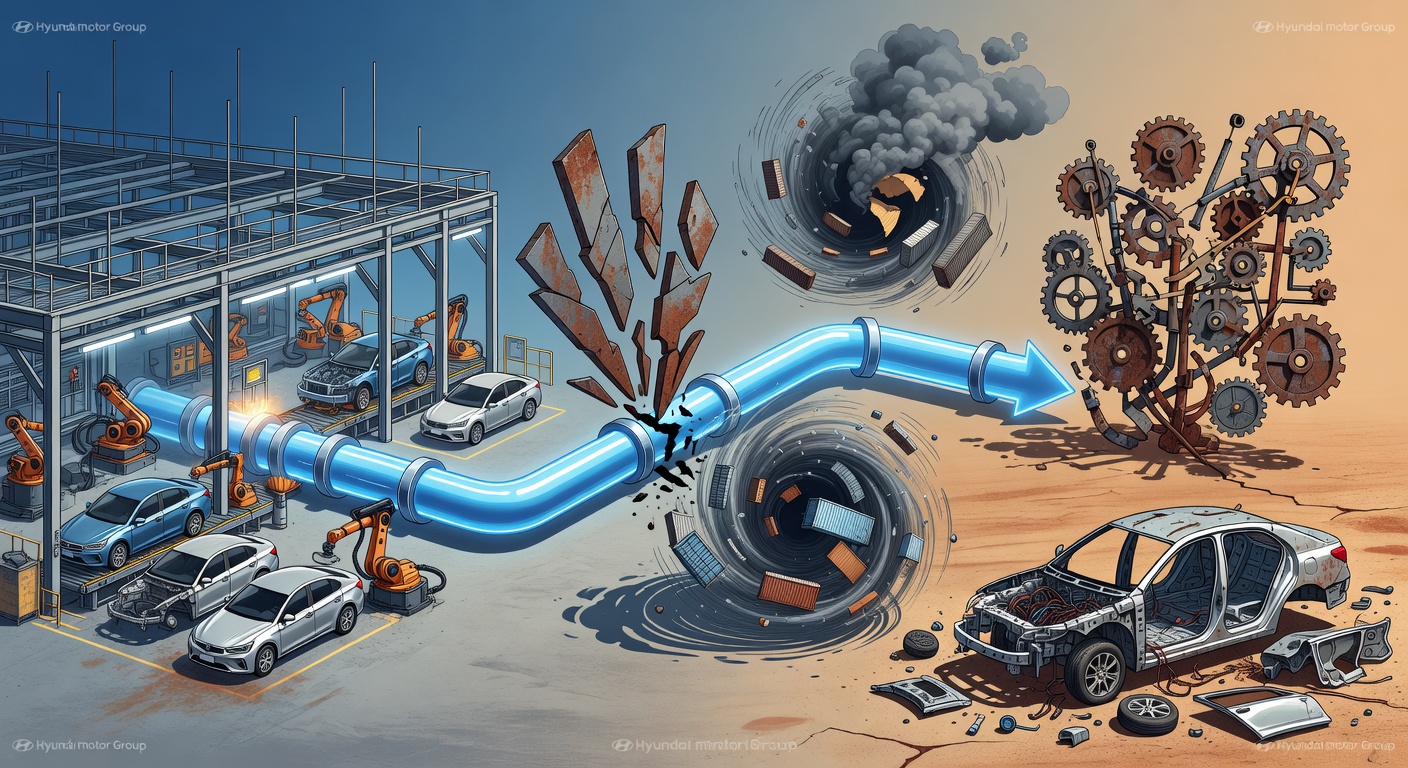
Hyundai Motor Group poured more than $21 billion into American manufacturing over the past three years, building a sprawling electric vehicle and battery complex in Georgia, expanding engine production in Alabama, and laying plans for a steel plant to feed its U.S. operations. The South Korean automaker did everything Washington asked. It wasn’t enough.
Now the company finds itself squeezed between a 25% tariff on all imported vehicles, retaliatory trade barriers rippling across the globe, and a Middle East conflict threatening to disrupt shipping lanes that carry components from dozens of suppliers scattered across Asia and Europe. Hyundai’s predicament is a case study in how even the most aggressive localization strategies can’t fully insulate a global manufacturer from the compounding risks of 2025’s fractured trade order.
According to Yahoo Finance, Hyundai warned investors that escalating conflict in the Middle East — particularly disruptions to Red Sea shipping routes — could further strain supply chains already under pressure from U.S. tariffs. The company flagged the risk during its latest earnings guidance, noting that Houthi attacks on commercial vessels have forced some cargo ships to reroute around the Cape of Good Hope, adding weeks and significant cost to deliveries of parts and finished vehicles.
The timing is brutal.
Hyundai and its affiliate Kia together sold more than 1.7 million vehicles in the United States last year, making America their single largest market outside South Korea. But roughly half of those vehicles are still manufactured overseas — in Ulsan, South Korea; in Chennai, India; in Nosovice, Czech Republic. Every one of those imports now carries a 25% tariff under the auto-specific duties President Trump imposed in April 2025, on top of whatever reciprocal tariffs apply to the country of origin.
The financial hit has been immediate. Hyundai’s first-quarter operating profit fell 4.3% year-over-year to 3.63 trillion won ($2.53 billion), according to Reuters, even as revenue rose modestly on higher average selling prices. The company declined to issue full-year guidance, an unusual move that analysts interpreted as a sign of deep uncertainty about how tariff policy will evolve over the remainder of the year.
José Muñoz, Hyundai Motor’s global CEO who also serves as head of its North American operations, has been blunt about the challenge. “We are not going to be able to absorb 25% tariffs,” he told reporters at the New York Auto Show in April, as reported by CNBC. “Nobody can.” Muñoz said Hyundai would look at a combination of price increases, cost reductions, and production shifts to manage the impact, but acknowledged there’s no painless path forward.
And yet Hyundai is better positioned than most foreign automakers, precisely because of those massive investments in Georgia. The company’s Metaplant America facility in Ellabell, Georgia — a $7.6 billion complex that began producing its first vehicles in late 2024 — is ramping up output of the Ioniq 5 electric SUV and will eventually build multiple EV models. Hyundai also committed $5.8 billion to a joint battery manufacturing venture with LG Energy Solution at the same site, and announced a $1.3 billion expansion of its existing Alabama engine and transmission plant.
But here’s the problem: even vehicles assembled in the United States contain thousands of components sourced globally. Engines from South Korea. Semiconductors from Taiwan. Wiring harnesses from Mexico. Battery cells from China. The 25% tariff on finished vehicles is only one layer of cost pressure. A separate 25% tariff on imported auto parts, set to take effect on May 3, 2025, threatens to raise production costs for every vehicle Hyundai builds on American soil, according to reporting by The Associated Press.
This is the paradox of modern automotive manufacturing. No car is truly made in one country anymore. A single vehicle can contain parts from 30 or more nations, assembled through supply chains that took decades to optimize for cost and quality. Tariffs don’t just tax the final product — they tax the entire web of production.
Hyundai has been working to increase domestic content in its U.S.-built vehicles, but the process takes years. Stamping dies must be tooled. Supplier contracts must be renegotiated. New factories must be built — not just by Hyundai, but by the hundreds of tier-one and tier-two suppliers who provide everything from seat foam to brake rotors. The company told investors it aims to source 50% of parts for its Georgia-built vehicles from North American suppliers by 2026, up from roughly 30% at launch.
That still leaves half the parts coming from overseas. Subject to tariffs.
The Middle East dimension adds another variable entirely. Houthi militants in Yemen have been attacking commercial shipping in the Red Sea and Gulf of Aden since late 2023, initially targeting vessels with perceived links to Israel but increasingly hitting ships indiscriminately. The attacks have forced major container lines — including Maersk, MSC, and Hapag-Lloyd — to divert vessels around the southern tip of Africa, adding 10 to 14 days to Asia-Europe transit times and significantly increasing freight costs.
For Hyundai, which ships finished vehicles and components from South Korea through the Suez Canal to European and East Coast U.S. ports, the disruption is material. Longer shipping times mean higher inventory carrying costs, greater exposure to demand fluctuations, and increased risk of parts shortages that can shut down assembly lines. The company’s logistics costs rose an estimated 15% in the first quarter compared to the same period last year, according to analyst estimates compiled by Yahoo Finance.
So Hyundai faces a two-front war: tariffs making its imports more expensive and shipping disruptions making them slower and less reliable. The combination is forcing the company to accelerate its localization timeline while simultaneously managing a transition to electric vehicles that is itself fraught with uncertainty about consumer demand, battery supply, and charging infrastructure.
The broader auto industry is watching closely. Toyota, which has far deeper U.S. manufacturing roots than Hyundai, nonetheless imports roughly 50% of the vehicles it sells in America and faces similar tariff exposure. Volkswagen, BMW, and Mercedes-Benz are even more dependent on imports. Among Korean automakers, Kia — which shares platforms and supply chains with Hyundai — operates a single U.S. assembly plant in West Point, Georgia, but imports the majority of its lineup from South Korea and Mexico.
Detroit’s Big Three aren’t immune either. General Motors, Ford, and Stellantis all import significant volumes from Mexico and Canada, which face their own tariff complications under the renegotiated USMCA framework. Ford CEO Jim Farley warned in April that tariffs on auto parts alone could cost the company $1.5 billion annually, as reported by Reuters. Ford subsequently suspended its full-year financial guidance — just as Hyundai did.
The pattern is striking. One automaker after another declining to forecast its own future. That’s not caution. That’s an industry admitting it can’t model the risks it faces.
For Hyundai specifically, the Georgia investment was supposed to be the answer. When the company announced the Metaplant in May 2022, it was responding to the Inflation Reduction Act’s requirements that EVs be assembled in North America to qualify for federal tax credits. Hyundai moved fast — faster than most analysts expected — breaking ground within months and beginning trial production in late 2024. The plant’s location in Bryan County, Georgia, was chosen partly for its proximity to the Port of Savannah, one of the busiest container ports on the East Coast, which would facilitate the import of components during the ramp-up phase.
But the IRA’s tax credit rules have themselves become a moving target. The Treasury Department has repeatedly revised the rules governing battery component sourcing and critical mineral requirements, creating uncertainty about which vehicles will qualify for the full $7,500 consumer credit. Hyundai’s Ioniq 5, built in Georgia with LG battery cells, qualified for a partial credit in early 2025, but the company has been working to secure the full credit by increasing the share of battery materials sourced from the U.S. or free-trade-agreement countries.
Then there’s consumer demand. EV sales in the U.S. grew roughly 10% in 2024, a slowdown from the 50%-plus growth rates of 2022 and 2023. High interest rates, range anxiety, and the sheer cost of electric vehicles relative to comparable gas-powered models have tempered enthusiasm. Hyundai’s own EV sales have been a bright spot — the Ioniq 5 and Ioniq 6 have earned strong reviews and sold well relative to competitors — but the company is planning for a scenario where the EV transition takes longer than originally projected.
Muñoz has signaled that Hyundai will continue producing hybrid vehicles for the U.S. market well into the 2030s, hedging against the possibility that battery-electric adoption plateaus. The company recently confirmed plans to bring a hybrid version of the popular Tucson SUV to the U.S., supplementing its existing hybrid Santa Fe. It’s a pragmatic move, but it complicates the manufacturing picture further — hybrid powertrains require different components than either pure EVs or conventional gas engines, adding complexity to an already strained supply chain.
Wall Street has taken notice of the mounting pressures. Hyundai’s U.S.-listed shares fell roughly 18% between early April and mid-May 2025, underperforming both the S&P 500 and the broader auto sector. Analysts at Morgan Stanley downgraded the stock in late April, citing “an unprecedented convergence of trade policy risk, input cost inflation, and demand uncertainty,” according to a research note reviewed by this publication.
But not everyone is bearish. Some analysts argue that Hyundai’s aggressive U.S. investment positions it to gain market share as competitors struggle with higher import costs. If tariffs persist — and there’s every indication they will — automakers with domestic production capacity will have a structural advantage over those shipping finished vehicles from overseas. Hyundai’s Georgia plant, once fully ramped, could produce up to 300,000 vehicles annually. That’s a significant buffer.
The question is whether Hyundai can survive the transition period — the months or years between now and when its U.S. operations reach full capacity with a sufficiently localized supply chain. During that window, the company will be paying tariffs on imported vehicles it can’t yet build domestically, tariffs on imported parts for vehicles it does build domestically, and premium shipping costs to route those parts around a war zone.
It’s an expensive window.
Hyundai’s response has been to move on multiple fronts simultaneously. The company announced in early May that it would accelerate the second phase of its Georgia plant expansion, pulling forward production of additional models including a new electric SUV based on the Genesis GV70 platform. It’s also negotiating with U.S.-based parts suppliers to establish new production lines closer to its assembly operations, though many of those suppliers are themselves dependent on imported raw materials.
On the shipping front, Hyundai Motor Group’s logistics arm, Hyundai Glovis, has been chartering additional car carrier vessels and exploring alternative routing strategies, including increased use of Pacific routes to West Coast ports followed by rail transport to East Coast distribution centers. The approach adds cost but reduces exposure to Red Sea disruptions.
And politically, Hyundai has been working to strengthen its position in Washington. The company’s $21 billion investment commitment — frequently cited by Georgia Governor Brian Kemp and other Republican officials as evidence that Trump-era trade policy is attracting foreign investment — gives it significant leverage in lobbying for tariff exemptions or phase-in periods. Hyundai has joined other automakers in requesting that the Commerce Department grant exclusions for specific components that cannot be sourced domestically, though the administration has so far been reluctant to grant broad relief.
The irony is thick. Hyundai invested billions in America partly because of policy signals from Washington — the IRA, “Buy American” rhetoric, promises of a more favorable regulatory environment for companies that manufacture on U.S. soil. Now those same political forces have produced tariffs that penalize the company for the parts of its supply chain it hasn’t yet moved to America. The message from Washington is contradictory: come here, but also, we’ll tax you while you’re getting here.
Other governments are responding in kind. South Korea has been negotiating directly with the Trump administration for tariff relief, arguing that Korean automakers’ U.S. investments should earn them preferential treatment. The European Union has prepared retaliatory tariffs on American goods. China has imposed its own counter-tariffs on U.S. agricultural and industrial exports. The cascading retaliation threatens to reduce global trade volumes and slow economic growth worldwide — which would, in turn, reduce demand for the very vehicles Hyundai is investing to build.
For industry insiders, the Hyundai story illustrates a fundamental tension in modern industrial policy. Governments want companies to localize production, but global supply chains can’t be restructured overnight. The transition requires years of capital investment, supplier development, workforce training, and regulatory alignment. Tariffs imposed during that transition don’t accelerate it — they make it more expensive and more chaotic.
Hyundai will almost certainly emerge from this period as a stronger American manufacturer. Its Georgia complex, when fully operational, will be one of the most advanced automotive production facilities in the world. Its battery joint venture with LG will supply cells not just for Hyundai and Kia vehicles but potentially for other automakers as well. The company’s commitment to the U.S. market is real and substantial.
But the path from here to there runs through a minefield of tariffs, shipping disruptions, policy uncertainty, and demand volatility. Hyundai has the balance sheet to absorb short-term losses — it ended 2024 with more than $25 billion in cash and equivalents. Not every competitor can say the same. The companies that survive this period of dislocation will be those with the deepest pockets, the most flexible supply chains, and the most disciplined capital allocation.
Hyundai is betting it’s one of them. The next 18 months will determine whether that bet pays off — or whether $21 billion bought the company a front-row seat to a trade war it can’t win.


 WebProNews is an iEntry Publication