
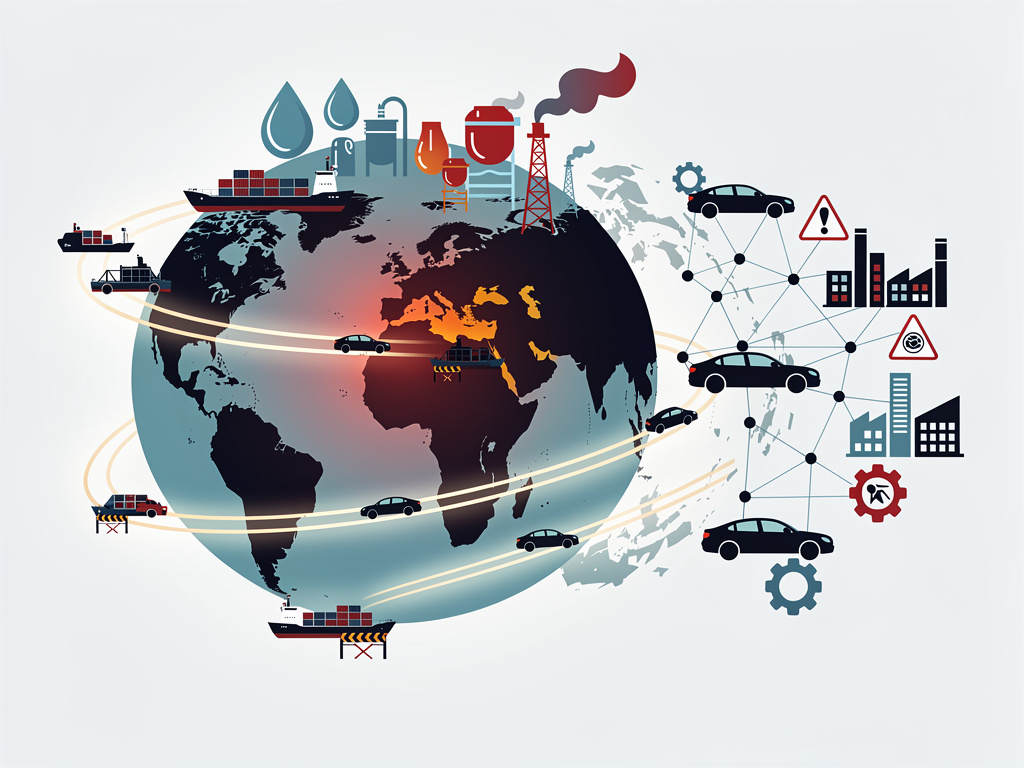
Hyundai Motor Group, the world’s third-largest automaker, has issued one of the starkest corporate warnings yet about the potential fallout from escalating conflict in the Middle East. The South Korean conglomerate told investors that a broader regional war could disrupt critical shipping lanes, spike energy costs, and send shockwaves through an already fragile global automotive supply chain.
The warning wasn’t buried in boilerplate risk disclosures. It was front and center.
According to Yahoo Finance, Hyundai flagged the Middle East situation as a material concern during its latest earnings commentary, noting that any disruption to the Strait of Hormuz or the Red Sea corridor could have cascading effects on raw material availability, shipping costs, and vehicle delivery timelines. The company joins a growing chorus of multinational corporations that are no longer treating geopolitical instability as a background variable but as a primary operational threat.
For an industry that spent the last four years recovering from pandemic-era chip shortages, this is unwelcome territory. And yet, here it is.
The Geography of Risk: Why the Middle East Matters to Automakers
The Middle East sits at the crossroads of global commerce in ways that extend far beyond oil. Roughly 20% of the world’s petroleum passes through the Strait of Hormuz, a narrow chokepoint between Iran and Oman. The Red Sea and Suez Canal corridor, meanwhile, handles approximately 12% of global trade, including components and finished vehicles moving between Asia and Europe. When Houthi militants began targeting commercial shipping in the Red Sea in late 2023 and into 2024, the effects rippled outward immediately — rerouting vessels around the Cape of Good Hope added two weeks and tens of thousands of dollars in fuel costs per voyage.
Hyundai has particular exposure. The company ships vehicles and parts across multiple continents from manufacturing hubs in South Korea, India, the Czech Republic, and the United States. Its logistics network depends on maritime routes that thread directly through conflict-prone waters. A wider war — one involving direct confrontation between Israel and Iran, or the closure of the Strait of Hormuz — would represent a fundamentally different scale of disruption than anything the industry has faced since the 2011 Fukushima disaster.
Energy prices are the most obvious transmission mechanism. Oil above $100 a barrel would raise input costs for petrochemical-derived materials like plastics, synthetic rubber, and coatings that are embedded in every modern vehicle. But the secondary effects could be worse: insurance premiums for vessels transiting contested waters have already surged, and a full-blown regional conflict could make certain routes commercially unviable.
That’s not hypothetical. It’s already happening at smaller scale.
Major shipping companies including Maersk and Hapag-Lloyd rerouted vessels away from the Red Sea months ago. According to Reuters, the diversions have added significant cost and complexity to supply chains that were only just beginning to normalize after the COVID era. For automakers operating on just-in-time inventory models — where parts arrive at assembly plants hours before they’re needed — even modest shipping delays can halt production lines.
Hyundai’s warning reflects a hard-won lesson the auto industry learned during the semiconductor crisis: supply chain resilience isn’t just about having backup suppliers. It’s about understanding that a single geopolitical event thousands of miles from your factory can shut it down.
The Broader Corporate Reckoning With Geopolitical Risk
Hyundai isn’t alone in raising the alarm. Toyota, Volkswagen, and Stellantis have all referenced Middle East instability in recent filings and investor communications, though none have been quite as explicit as Hyundai in characterizing the threat. The difference may be partly structural — Hyundai’s heavy reliance on Korean manufacturing means its outbound logistics are disproportionately dependent on Asian shipping lanes that pass near or through the conflict zone.
But it’s also a reflection of a broader shift in how corporations are thinking about risk. For decades, geopolitical analysis was something defense contractors and oil majors worried about. Consumer-facing companies treated it as noise. That era is over. The Russia-Ukraine war upended European energy markets and forced automakers to scramble for alternative nickel and palladium supplies. U.S.-China tensions have reshaped semiconductor sourcing strategies. And now the Middle East threatens to add another layer of volatility to an industry already contending with the massive capital demands of the electric vehicle transition.
The timing couldn’t be worse for Hyundai specifically. The company has been investing aggressively in its U.S. footprint, including a $7.6 billion EV and battery manufacturing complex in Georgia. Those investments are designed in part to reduce exposure to exactly the kind of transoceanic supply chain risks that a Middle East conflict would amplify. But the Georgia plant isn’t fully operational yet, and in the interim, Hyundai remains dependent on global shipping for a significant share of its U.S. vehicle supply.
There’s also the demand side to consider. Higher energy prices function as a tax on consumers, reducing disposable income and dampening appetite for big-ticket purchases like new cars. If oil prices spike and stay elevated, the knock-on effect on auto sales — particularly in price-sensitive segments — could be substantial. Hyundai, which has built much of its market share on value-oriented vehicles, would feel that pressure acutely.
So what can automakers actually do about it?
Some are accelerating efforts to regionalize production — building cars closer to where they’re sold to reduce dependence on long-distance shipping. Others are stockpiling critical components, reversing the just-in-time orthodoxy that dominated manufacturing for decades. A few are exploring alternative shipping routes, though the options are limited and expensive. And nearly all are investing in scenario planning that treats geopolitical disruption not as a tail risk but as a base case.
Hyundai’s public acknowledgment of the Middle East threat is significant precisely because it signals that the company’s leadership views the risk as material enough to warrant investor attention. Corporate executives don’t flag geopolitical scenarios in earnings calls for fun. They do it to manage expectations — and to lay the groundwork for explaining future earnings misses if the worst comes to pass.
The auto industry has spent the post-pandemic years rebuilding margins and clearing order backlogs. Profits at Hyundai, Kia, Toyota, and others have been strong, buoyed by pricing power and pent-up demand. But that favorable environment is fragile. A single geopolitical shock — a missile striking a tanker in the Strait of Hormuz, a broader Iranian military mobilization, an expansion of the Israel-Hamas conflict into a multi-front regional war — could unravel months of recovery in weeks.
Investors have largely shrugged off these warnings so far. Hyundai’s stock has performed well in 2024, and auto sector valuations broadly reflect optimism about the EV transition and strong consumer demand. But markets have a tendency to price geopolitical risk at zero right up until the moment they price it at infinity.
Hyundai’s warning is a reminder that the distance between those two states is shorter than most people think. The question isn’t whether Middle East instability will affect global automakers. It’s how much, how fast, and whether anyone is truly prepared for what comes next.


 WebProNews is an iEntry Publication