
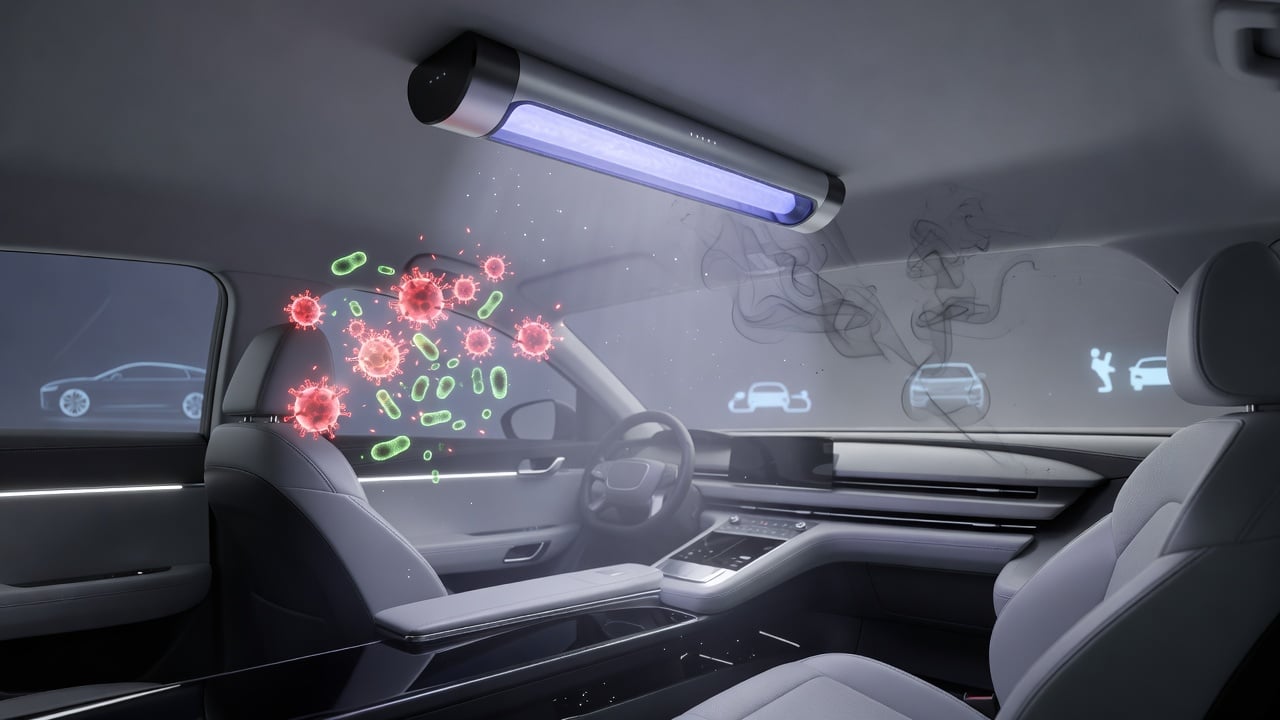
Hyundai Motor and Kia have introduced a system that bathes vehicle interiors in a specific band of ultraviolet light. Passengers stay put. Pathogens do not. The companies call it Plasma Care UVC. They unveiled the technology on June 24, 2026, positioning it as the first of its kind for occupied car cabins.
Conventional UVC light sits in the 255 to 280 nanometer range. It works well inside glove boxes or empty rooms. Direct exposure risks harm to skin and eyes. Far-UVC changes the equation. The 200 to 230 nanometer wavelengths carry enough energy to shatter microbial DNA. Yet they stop at the outer keratin layer of human skin. They never reach living cells beneath. Bacteria and viruses lack that shield.
The difference matters. A lot. Hospitals and schools already deploy similar wavelengths in occupied spaces. Automakers faced tighter constraints. Cabins pack electronics. They shake. Temperatures swing. Passengers sit inches from the source. Hyundai and Kia responded with a compact plasma lamp. LEDs struggle to hit the precise band reliably. Plasma delivers it consistently. Engineers added an optical filter for extra safety. They optimized size and power draw. They hardened components against vibration and heat.
Tests followed a deliberate path. The Korea Testing Laboratory placed the system inside an 8-cubic-meter chamber built to mimic a vehicle interior. Airborne viruses dropped 96.8 percent after 30 minutes. Hyundai Motor Company press release reported the figure directly from certified partners.
Component tests went deeper. Researchers at Seoul National University’s Agriculture and Life Sciences Venture Center exposed pneumonia-causing bacteria to the light. Counts fell 99.9 percent in 30 seconds. Complete elimination came at 60 seconds. The results arrived under controlled lab conditions yet reflected real cabin targets.
Real-vehicle validation sealed the data. The Korea Automotive Technology Institute installed the hardware in a Kia PV5 electric van. After 40 minutes of operation, E. coli levels dropped 99.9 percent. The figure came from surface and air sampling across the cabin. The Drive noted the chamber measured roughly 282 cubic feet, aligning closely with the PV5’s interior volume.
Odor reduction followed as a secondary benefit. Microorganisms produce many of the volatile compounds that make a car smell stale or worse. Destroy the source and the smell fades without chemical sprays or fragrances. That appeals in shared mobility, ride-hailing fleets, and autonomous shuttles where cleaning cycles shrink between users.
Han Joo Jang serves as senior research engineer for Hyundai and Kia’s MPV and small-vehicle interior team. He stated the intent plainly. “Plasma Care UVC was developed for use in open vehicle cabin environments with passengers, moving beyond conventional sanitization methods that are limited to enclosed areas. We expect it to serve as a valuable cabin hygiene solution that delivers a more pleasant mobility experience across future mobility scenarios, including autonomous driving and purpose-built vehicles.” The quote appears in the original Hyundai release and was carried by Repairer Driven News.
But the system does not solve every problem. Light travels in straight lines. Shadows under seats or inside crevices may receive less exposure. Some microbes can activate repair mechanisms after sublethal doses. The technology therefore supplements thorough cleaning rather than replaces it. The Next Web highlighted those practical limits in its coverage published hours after the announcement.
Development traces back years. Earlier Hyundai air-quality efforts focused on filtration and ionization. The 2019 intelligent air-purification system targeted pollutants but left biological contamination largely untouched. Plasma Care UVC shifts focus. It treats the entire volume of air and exposed surfaces in real time. Yet the companies stress its research status. No production timeline exists. Further validation against international safety standards continues.
Interest has grown quickly. Recent coverage from Engadget on July 1, 2026, speculated that future models might reduce reliance on air fresheners altogether. The article noted the potential for fleets and purpose-built vehicles first. School shuttles, delivery vans, and robotaxis stand to gain most. A video released with the announcement showed the PV5 configured as a children’s shuttle and a mobile fruit vendor. Both scenarios demand frequent, reliable hygiene without constant manual intervention.
Plasma Care UVC arrives at a moment when cabin air quality draws fresh scrutiny. Post-pandemic habits linger. Regulatory pressure on interior materials and allergens increases. Electric vehicles with sealed cabins amplify the need for active treatment. HEPA filters capture particles but leave viruses and bacteria untouched once airborne or on surfaces. Ultraviolet adds a direct inactivation step.
Challenges remain technical and commercial. Lamp lifespan under constant automotive duty cycles needs proving. Power consumption must stay modest for electric range. Cost must fit mass-market vehicles or premium trims. Regulatory bodies will examine eye and skin exposure data over thousands of hours. The optical filter helps. Real-world durability tests will decide acceptance.
Still, the performance numbers impress. Ninety-six point eight percent virus reduction in half an hour. Near-complete bacterial kill in under a minute in lab settings. Measurable results inside an actual van. Those metrics exceed many existing aftermarket purifiers. They suggest a path toward vehicles that maintain their own hygiene between professional detailings.
Hyundai and Kia plan continued testing. They aim to meet global certifications before any launch. When it arrives, the system could appear first in dedicated PBV platforms rather than standard passenger cars. The PV5 demonstrations point that direction. Shared autonomous pods represent an obvious early fit. Frequent passenger turnover demands consistent sanitation without downtime.
Automotive suppliers watch closely. UV component makers see new demand. Cabin material producers may adapt surfaces to reflect or transmit the wavelengths more effectively. Software teams will integrate activation logic. Drivers might tap a dashboard icon before picking up riders. Or the system could run quietly in the background during idle periods.
The announcement carries echoes of past incremental cabin improvements. Ionizers, activated-carbon filters, and photocatalytic coatings each promised cleaner air. Few delivered measurable biological impact inside moving vehicles with people aboard. Plasma Care UVC attempts a bigger leap. It treats the space as a semi-sterile environment even while occupied. Success depends on translating lab gains into everyday reliability.
One fact stands out. The technology does not mask odors. It removes their biological origin. That distinction separates it from fragrance emitters that simply compete with bad smells. For families, commuters, and fleet operators tired of mystery stains and lingering scents, the promise holds appeal. Whether it reaches showrooms in two years or five will depend on the rigor of remaining validation. The foundation, however, looks solid. Data from independent Korean institutes supports the claims. The engineering adaptations address real cabin constraints. And the safety profile of far-UVC rests on established scientific literature.
Hyundai and Kia have placed a marker. Other automakers will respond with their own approaches, whether through improved filtration, photocatalytic materials, or competing light wavelengths. The race to cleaner cabins has a new benchmark. One that works while you sit inside. And one that targets the microbes instead of the symptoms.


 WebProNews is an iEntry Publication