
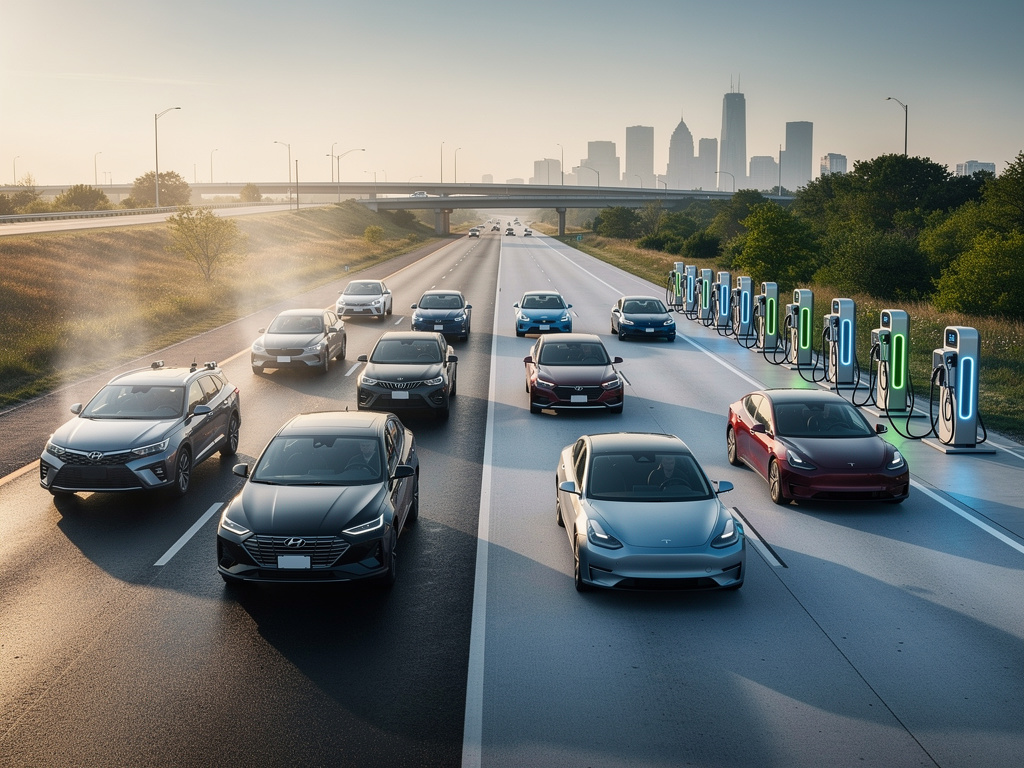
Bridging the Gap: How Hybrids Are Steering America’s Shift to Electric Mobility
In the evolving world of automotive technology, hybrid vehicles are emerging as a crucial bridge between traditional gasoline-powered cars and the fully electric future. As the United States grapples with fluctuating consumer preferences, policy changes, and infrastructure challenges, hybrids offer a pragmatic solution that balances environmental goals with practical realities. Recent data indicates a surge in hybrid sales, even as pure electric vehicle (EV) adoption faces headwinds from expiring subsidies and range anxiety concerns.
Automakers are increasingly pivoting toward hybrids to meet stringent federal fuel economy standards and consumer demands for efficiency without the full commitment to battery-only propulsion. This shift is not merely a stopgap; it’s reshaping the industry’s approach to electrification. For instance, companies like Ford and Honda are doubling down on hybrid models for 2026, prioritizing fuel efficiency and affordability amid slowing EV sales momentum.
The expiration of federal EV incentives at the end of September 2025 has amplified this trend. While EV sales dipped in the final quarter of that year, hybrids captured a larger market share, providing automakers with a buffer against regulatory penalties and market volatility.
The Surge in Hybrid Popularity
Industry analysts point to hybrids as a way to gradually acclimate consumers to electrified driving. Unlike pure EVs, hybrids combine internal combustion engines with electric motors, offering the familiarity of gas stations alongside the benefits of electric assistance. This dual nature addresses key barriers such as limited charging infrastructure and higher upfront costs associated with full EVs.
According to reports from CNBC, automakers are reconsidering hybrids to avoid costly penalties tied to fuel economy rules. This strategic recalibration is evident in surging sales figures, with hybrids reaching record highs in the U.S. market.
Posts on X, formerly known as Twitter, reflect growing consumer interest, with users noting that hybrids are bridging the gap to full electrification by offering better fuel economy and lower emissions without the need for extensive charging networks.
Policy and Market Dynamics
The policy environment plays a pivotal role in this transition. With the end of EV subsidies, buyers are turning to hybrids as a more accessible entry point into greener driving. BloombergNEF’s Electric Vehicle Outlook highlights how electrification trends are influenced by shared mobility and autonomous driving, but hybrids are filling the immediate void left by policy shifts.
In Europe, similar dynamics are at play, where the European Commission has eased timelines for phasing out internal combustion engines, as detailed in a Yahoo Finance article. This global context underscores America’s own challenges, where EV adoption has plateaued while hybrids accelerate.
Ford’s announcement of significant charges related to retreating from an aggressive EV strategy illustrates the financial pressures driving this pivot. The company, along with others, is refocusing on hybrids to maintain profitability and market share.
Consumer Sentiment and Adoption Trends
Consumer behavior is a key driver in this shift. Surveys and social media discussions reveal that many Americans view hybrids as a practical compromise, especially in regions with sparse charging stations. A post from Car Dealership Guy on X noted that hybrids reached 10.8% of U.S. vehicle sales in Q3 2024, a record high, with 21% of buyers considering them for their next purchase.
This sentiment aligns with broader market data. The Los Angeles Times reports that hybrid sales are surging as automakers adjust their strategies, predicting that more than half of some dealers’ business could soon be hybrids.
Critics, however, argue that hybrids perpetuate dependence on fossil fuels. One X user highlighted potential drawbacks, such as carrying heavy batteries that degrade over time and undersized engines, combining disadvantages of both internal combustion and electric systems.
Technological Advancements in Hybrids
Advancements in hybrid technology are making these vehicles more appealing. Modern hybrids boast improved battery efficiency, regenerative braking, and seamless integration of gas and electric powertrains. These innovations reduce emissions and enhance performance, making them a stepping stone to EVs.
In India, as explored by EY India, hybrids are transforming the auto sector by bridging to full EVs, with calls for lower taxes to boost adoption. Similar incentives could accelerate U.S. growth.
Comparisons between electric and hybrid cars in 2026, as outlined in Analytics Insight, break down costs, range, and practicality, showing hybrids often win on affordability and versatility for everyday use.
Global Comparisons and Lessons
Looking abroad provides valuable insights. Norway’s car sales hit 96% electric in 2025, according to Reuters, demonstrating what’s possible with robust infrastructure and incentives. In contrast, America’s hybrid surge reflects a more gradual path.
China faces its own challenges, with potential closures of unprofitable EV brands amid market realignment, as reported by Drive. This highlights the risks of over-reliance on pure EVs without hybrid intermediaries.
Autoblog notes that Ford and Honda are all-in on hybrids for 2026, emphasizing their role in providing fuel efficiency and broader appeal as EV momentum slows, per Autoblog.
Challenges in the EV Transition
Despite their benefits, hybrids face hurdles. The need for dual power systems can increase complexity and maintenance costs. Moreover, as EV technology advances, hybrids might be seen as outdated. Yet, current trends suggest they are essential for a smooth transition.
CNBC’s analysis indicates that Detroit automakers are refocusing on gas-guzzling trucks while admitting policies drove EV pushes more than consumer demand, as in CNBC‘s recent piece on EV realism.
X posts predict that by 2025, 25% of new vehicles will be electrified, with hybrids and plug-ins comprising 15%, signaling a decline in pure gas engines to 75%.
Economic Impacts and Industry Strategies
Economically, the hybrid boom supports jobs in manufacturing and supply chains adapted from traditional autos. Automakers are investing in hybrid production to comply with emissions standards without the full risk of EV-only lineups.
A Slashdot discussion, drawing from Slashdot, questions whether hybrids are truly aiding the EV transition, citing Bloomberg’s note on expiring subsidies and hybrid sales growth outpacing EVs in late 2025.
Dealers like those quoted in the Los Angeles Times are bullish, expecting hybrids to dominate sales as they move the needle on emissions and familiarize consumers with electric components.
Environmental Considerations
From an environmental standpoint, hybrids reduce overall emissions compared to pure gas vehicles, though less than EVs. They serve as a transitional tool, encouraging adoption of low-emission habits.
Bloomberg Green on X mentioned that with EV incentives gone, hybrids are keeping electrification plans afloat, aligning with broader sustainability goals.
Critiques on X suggest hybrids might delay full EV adoption by offering a comfortable middle ground, potentially slowing infrastructure development.
Future Projections and Innovations
Looking ahead, projections for 2026 see hybrids hitting nearly 17% of U.S. sales, up from 15% in 2025, as EV sales recover slowly. Innovations like improved plug-in hybrids could blur lines further, offering EV-like experiences with gas backups.
CarGurus predictions shared on X forecast hybrids making up one in six new car sales, driven by better technology and emission reductions.
Mandates in places like Canada, aiming for 100% zero-emission vehicles by 2035, echo U.S. ambitions but highlight the role hybrids play in ramping up.
The Role of Infrastructure
Infrastructure remains a bottleneck. Expanding charging networks is crucial for EV growth, but hybrids mitigate this by not requiring them exclusively. This allows time for grid upgrades and station proliferation.
In the U.S., hybrids are helping maintain momentum toward electrification without alienating consumers wary of range limitations.
As one X user pondered, unless charging speeds and battery densities advance massively, hybrids could dominate new car sales, underscoring their enduring appeal.
Strategic Shifts by Automakers
Major players are adapting. General Motors, Hyundai, and Ford are watching 2026 closely, with strategies leaning on hybrids to test market waters, per CNBC insights.
The pivot accelerated in 2025 as incentives faded, with buyers seeking low-friction options like hybrids for fuel savings and reduced environmental impact.
Ultimately, hybrids are not just a temporary fix; they represent a strategic evolution in America’s journey toward sustainable transportation, blending legacy systems with emerging technologies to foster widespread acceptance.


 WebProNews is an iEntry Publication