
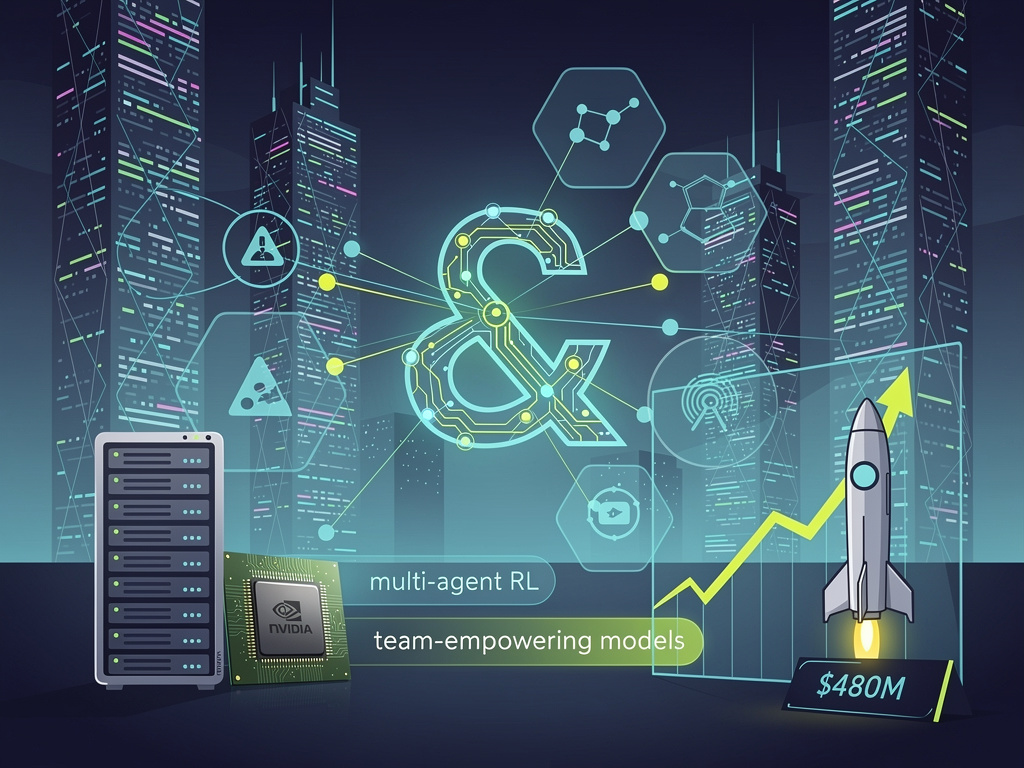
In the high-stakes arena of artificial intelligence, a trio of former researchers from xAI, Anthropic, and OpenAI has launched Humans&, a startup betting that the path to transformative AI lies not in solitary superintelligence but in masterful group orchestration. Just three months after its quiet formation, the San Francisco-based company secured a staggering $480 million seed round at a $4.48 billion valuation, drawing backing from Nvidia, SV Angel, GV, Jeff Bezos, and others. CEO Eric Zelikman, who contributed to xAI’s Grok, envisions AI as “connective tissue” binding humans and machines in collaborative efforts.
The funding, led by SV Angel’s Ron Conway and co-founder Georges Harik—Google’s seventh employee—signals investor faith in Humans&’s audacious pivot. “The model will coordinate with people, and other AIs where appropriate, to allow people to do more and bring them together,” Zelikman told Reuters. This mega-seed, among the largest ever, underscores a frenzy for elite AI talent amid compute wars, even as the startup has no product yet.
Elite Pedigree Fuels Frontier Ambitions
Humans&’s founding team reads like an AI all-star roster. Alongside Zelikman, co-founders include Andi Peng, who advanced Anthropic’s Claude through reinforcement learning and post-training; Yuchen He, an ex-OpenAI researcher who worked on xAI’s Grok; and Stanford professor Noah Goodman, with stints at DeepMind. Harik, architect of Google’s early ad systems like AdWords, brings product savvy. The initial 20-person squad pulls from Meta, Reflection, AI2, and MIT.
“I entered the field of AI to build technology that empowers humans,” Peng posted on X, critiquing autonomous AI trends. She left Anthropic after demos of Claude laboring solo for hours, saying, “That was never my motivation. I think of machines and humans as complementary.” Zelikman echoed this in a November 2025 X post: “humanity’s biggest challenges won’t be solved by ai thinking for 1000 hours… but by many collaborating humans, and ai that understands them.”
The company’s manifesto rejects job-replacing automation, aiming instead to amplify teams—from enterprises to families—via a foundation model tuned for social intelligence, per TechCrunch.
From Chatbots to Collaborative Nervous Systems
Current large language models excel at one-off queries but falter in sustained, multi-party workflows. Humans& targets this gap with a new architecture emphasizing long-horizon reinforcement learning (RL) and multi-agent RL. “We’re trying to train the model in a different way that will involve more humans and AIs interacting and collaborating together,” co-founder He told TechCrunch. The system will retain memories of users’ skills, motivations, and needs to balance group dynamics.
Unlike plug-ins for Slack or Notion, Humans& seeks to own the collaboration layer, potentially supplanting them. Zelikman described group decisions—like logo selection—as tedious rooms full of clashing views; their AI would synthesize opinions proactively, asking colleague-like questions grounded in context. “It feels like we’re ending the first paradigm of scaling… now we’re entering the second wave where the average consumer is trying to figure out what to do with all these things,” Peng said.
Product and model development co-evolve, with a launch eyed early this year, per The New York Times. This human-plus-AI “central nervous system” aligns with LinkedIn founder Reid Hoffman’s call to leverage AI for knowledge-sharing and meetings.
Training Paradigms Shift to Multi-Agent Realms
Humans& departs from question-answering scaling laws, prioritizing communication over code or retrieval. Training incorporates human-AI interactions for planning, acting, revising, and follow-through—demanding vast compute, hence Nvidia’s stake. “We believe this is going to be a generational company… fundamentally change how we interact with these models,” Zelikman asserted to TechCrunch.
Risks loom large: soaring training costs, talent raids by Meta and OpenAI, and compute shortages. The startup has rebuffed acquisition overtures, betting on independence. X discussions highlight buzz, with users like @czech_pawel noting, “Human in the loop will be very important.”
In a market where median AI seeds hit $4.6 million, Humans&’s haul—rivaling Unconventional AI’s $475 million—reflects a talent premium, as Crunchbase News observed.
Navigating Rivals in the Collaboration Race
Competitors abound: Anthropic’s Claude Cowork, Google’s Gemini in Workspace, OpenAI’s multi-agent pitches, and Granola’s $43 million note-taking app. Humans& differentiates via foundational retraining for innate social savvy, not bolted-on features. “Today’s AIs focus on the 1:1 setting… but real work involves multiple people,” Zelikman posted on X.
Broad applications span enterprise decision-making to consumer family coordination. As AI shifts from chat to agents, workflows lag—Humans& aims to bridge that, empowering users amid tool proliferation. Bloomberg called the raise “an unusually large haul for a young startup,” tying it to Nvidia’s AI investment spree.
Investor roster—Emerson Collective, Anne Wojcicki, Marissa Mayer—bolsters credibility. X founder reactions, like @lennysan’s pod on RL frontiers, contextualize the push.
Investor Frenzy and Bubble Warnings
The round eclipses norms, following Thinking Machines Lab’s $2 billion seed. “Nvidia has become the AI industry’s venture capital arm,” per analysts, with 67 deals in 2025. Yet skeptics decry valuation bubbles; Hacker News threads question pre-product premiums.
Humans& plans Nvidia hardware-software ties for scale. Zelikman announced the venture on X: “rethink how we build ai, to empower people to accomplish more together.” Peng added: “creating a future where people are both connected to and collaborate with each other would… require big, bold efforts.”
As AI hype peaks, Humans&’s human-first thesis challenges replacement narratives, positioning coordination as the unlock for hybrid economies.


 WebProNews is an iEntry Publication