
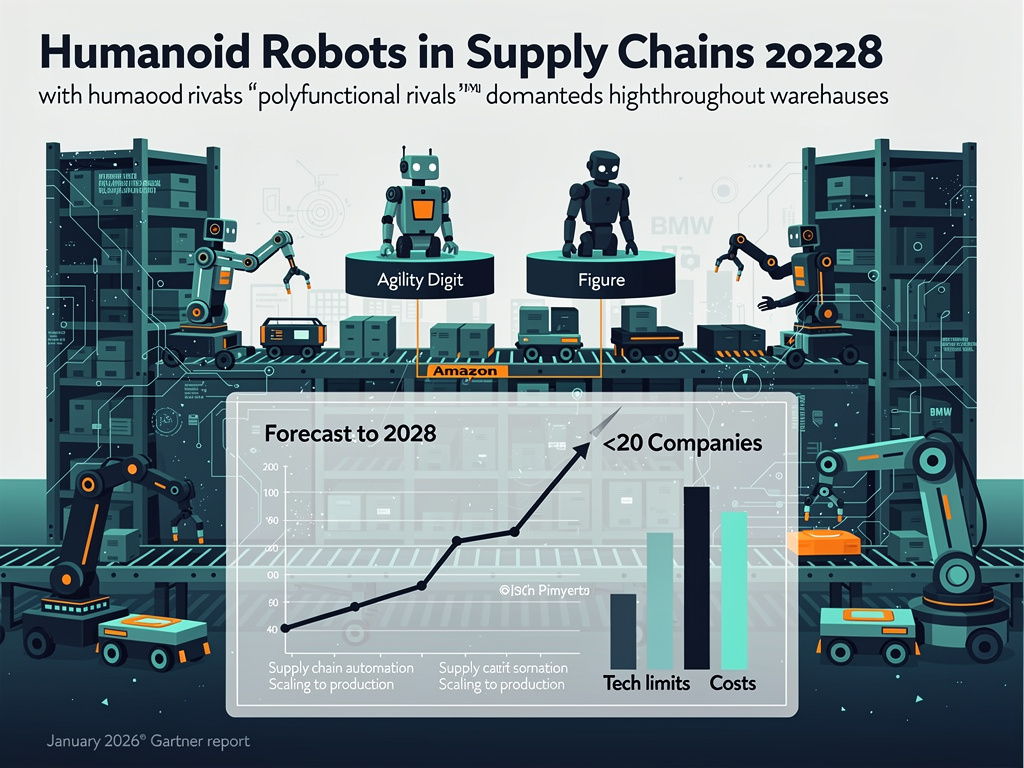
In a stark assessment released January 21, 2026, Gartner predicts that through 2028, fewer than 100 companies will advance humanoid robot proofs of concept beyond initial experimentation, with only under 20 scaling to production in supply chain and manufacturing operations. Most deployments, the firm warns, will remain confined to tightly controlled settings, far from the chaotic, high-velocity floors of modern warehouses. This forecast tempers the hype surrounding bipedal machines from startups like Agility Robotics and Figure AI, even as pilots proliferate.
Gartner’s Sobering Forecast
Gartner’s report, detailed in its newsroom press release, highlights technological immaturity as the core issue. ‘The promise of humanoid robots is compelling, but the reality is that the technology remains immature and far from meeting expectations for versatility and cost-effectiveness,’ said Abdil Tunca, Senior Principal Analyst in Gartner’s Supply Chain practice, as quoted in Technology Magazine. Current models falter in dexterity for mixed-SKU picking, trailer unloading, and exception handling amid unpredictable human traffic.
High costs exacerbate the problem. Upfront prices for units like Agility’s Digit hover around $250,000, per industry estimates in Standard Bots, with maintenance and energy demands eroding returns. Battery life limits shifts to hours, not full days, in energy-hungry legged designs. Integration with legacy warehouse management systems adds friction, as noted in Gartner’s advice for pilot validation before scaling.
Barriers to Breakthrough
Caleb Thomson, Senior Director Analyst at Gartner, emphasized economics: ‘For the majority of companies that will need to prioritize robots that maximize throughput-per-dollar invested, we expect polyfunctional robots to be the superior solution,’ according to DC Velocity. Polyfunctional alternatives—wheeled bases with telescopic arms—offer faster speeds, lower energy use, and seamless feature upgrades, dominating dynamic operations through 2028.
Energy constraints plague bipedal humanoids. Legged locomotion guzzles power; a Digit charges at a 4:1 work-to-charge ratio, per analyses in Artic Sledge. Safety lags too—collision avoidance and human intent detection remain unreliable in crowded aisles, confining pilots to semi-segregated zones, as McKinsey outlined in its October 2025 report on crossing the chasm to deployment.
Workforce readiness poses another hurdle. Gartner urges robotics competency centers for change management, data analysis, and cybersecurity, as Modern Materials Handling reported in its 2026 warehouse robotics outlook. Without reskilling, one in 20 supply chain managers overseeing robots by 2030 risks failure, per earlier projections.
Pilot Pioneers Push Limits
Agility Robotics leads commercial trials. Digit, now in paid pilots with GXO Logistics—moving 100,000 totes at Spanx factories—and Amazon, handles tote transport in structured paths, per Business Insider’s November 2025 coverage and Agility updates echoed in WINS Solutions. Production ramps at RoboFab aim for thousands annually, but full autonomy eludes unstructured tasks.
Figure AI’s Figure 02 and 03 test at BMW’s Spartanburg plant, executing 20-hour shifts for part handling, as Humanoids Daily reported in 2025. Apptronik’s Apollo expands at Mercedes, focusing on bin-handling. Boston Dynamics’ electric Atlas, unveiled at CES 2026, ships initial fleets to Hyundai and Google DeepMind for sequencing, per the company’s CES announcement.
Tesla’s Optimus Gen 3 prototypes target internal factory use in late 2025, with external pilots in 2026 at $20,000-$30,000 cost, Elon Musk stated in Q3 2025 earnings. Yet delays in hand design shifted timelines, Humanoid Press noted in 2025 archives.
Polyfunctional Rivals Race Ahead
Gartner’s polyfunctional preference shines in current wins. Wheeled manipulators scan, inspect, and move with higher uptime, integrating effortlessly. Bain & Company’s 2025 report on humanoids from demos to deployment advises pilots for ROI validation, data readiness, and hurdles like battery life—gating factors behind intelligence gains.
Amazon’s 750,000-robot fleet, mostly non-humanoid, replaces 24 packers per unit at $1 million ROI in two years, X posts from industry watchers highlight. Teradyne’s Stretch and Berkshire Grey’s systems optimize high-density storage, as Robotics 24/7 covered in 2025 trends.
Regulatory gaps persist. McKinsey stresses bridges in safety, standards, and cybersecurity for scaling. China’s NDRC warned of bubbles in 2025, with pilots dominating despite funding floods.
Strategic Paths Forward
Gartner counsels outcome-driven pilots targeting bottlenecks, not headcount cuts. Collaborate with providers, monitor iteratively, and foster innovation cultures. ‘Pursue pilot programs to validate feasibility before committing to full-scale deployment,’ the firm advises in Robotics Tomorrow.
Bain echoes: Identify workflows like tote handling or palletizing where humanoids edge non-humanoids. IDTechEx forecasts 2026-2027 takeoffs in automotive, spilling to logistics by 2028. Yet 95% of pilots fail without addressing clarity and control, per X discussions on Gartner data.
For insiders, the verdict is clear: Humanoids augment in niches, but warehouses demand throughput now. Polyfunctionals deliver; bipedals evolve. By 2028, 20 trailblazers may crack production, reshaping select operations amid labor crunches.


 WebProNews is an iEntry Publication