
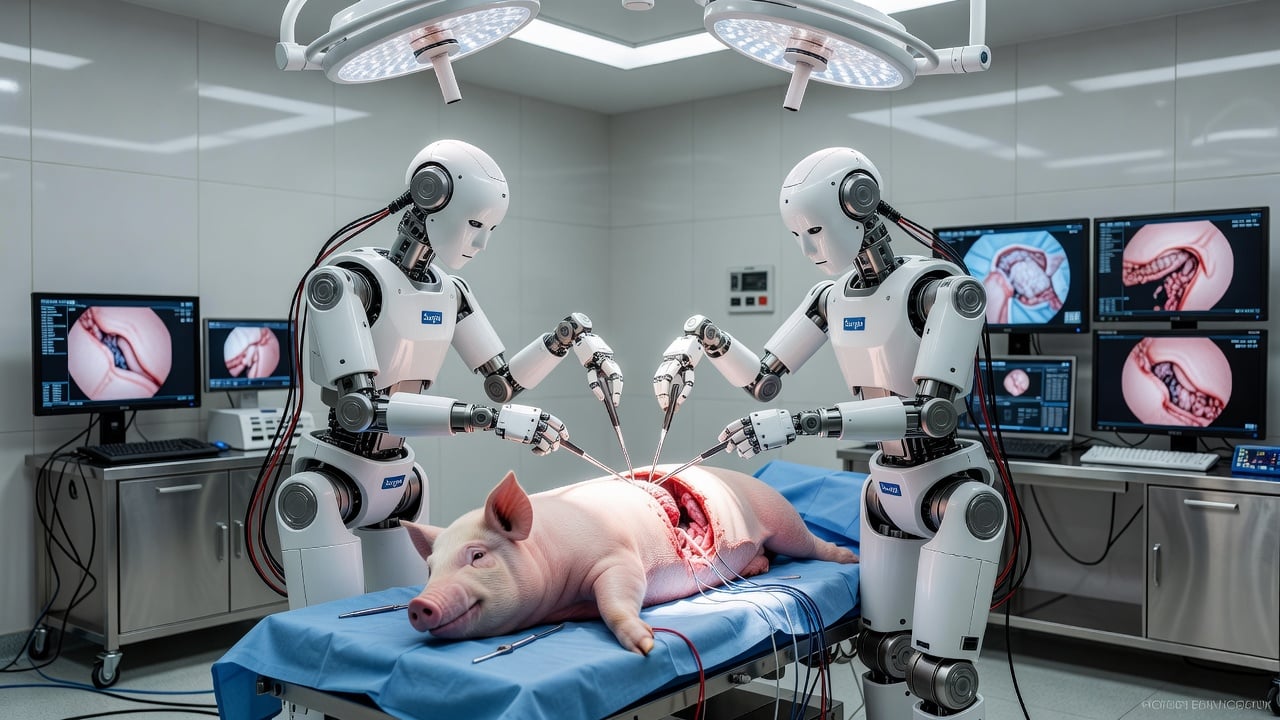
Surgeons at the University of California San Diego have taken a major step forward. They guided two teleoperated humanoid robots through laparoscopic gallbladder removals on live pigs. The procedures mark the first time such machines carried out surgery on living subjects.
One operation paired a humanoid with a human surgeon acting as assistant. The other relied entirely on two humanoids working together. Both succeeded in the preclinical trial. Results appeared July 8 in Nature.
The robots stand five feet tall. They weigh 60 pounds. Compact and mobile, they move around the operating room with surprising ease. Researchers nicknamed them Surgie. They used off-the-shelf Unitree G1 platforms fitted with custom adapters for laparoscopic tools. UC San Diego Today detailed the setup.
Michael Yip served as senior author. He leads work at UCSD’s ARClab in the Department of Electrical and Computer Engineering. “This study shows that humanoid robots have a viable future in the field of surgery,” Yip said. He added that remotely operated and autonomous versions “have real potential for amplifying access to critical surgeries to which patients would otherwise not have access. This can help address the healthcare crisis not only in the United States, but also worldwide.”
Other team members echoed the optimism. Shanglei Liu, a surgeon, noted the system’s practicality. “It’s a fraction of the cost and it takes a fraction of the space in an operating room,” he told reporters. Nikita Thareja expressed pleasant surprise. “We were surprised at how well Surgie meshed with our workspace and workflow.” Ryan Broderick, another surgeon, highlighted the collaboration. “This achievement reflects the power of bringing engineers and surgeon innovators together.”
The trial unfolded at UCSD’s Center for the Future of Surgery. Surgeons sat at consoles and directed the robots through standard laparoscopic ports. Procedures required pauses for recalibration. Times stretched longer than conventional methods. One took hours instead of the typical 30 minutes. Yet success rates held. Blood loss stayed low. The animals recovered as expected.
Latency posed a clear obstacle. Delays between controller input and robot motion reached hundreds of milliseconds. Ideal systems need under 150 milliseconds for safety. Arm reach also limited performance. The humanoids’ 450-millimeter span falls short of human arms. Surgeons compensated with careful positioning and extra practice.
These constraints matter. Current da Vinci systems from Intuitive Surgical dominate the market. They cost far more, often $500,000 or higher, and occupy dedicated space. The UCSD approach uses general-purpose hardware that costs roughly $13,500 per base unit. Versatility stands out. A single platform could fetch tools, hold cameras, or clean between cases. It might one day travel to remote clinics, disaster zones, or even spacecraft.
Technical Foundations and Early Results
The team built a custom teleoperation framework called LapSurgie. It translates human movements into precise robot actions while handling standard instruments. Benchtop tests showed positioning errors under one millimeter. Dry-lab exercises with surgeons of varying experience produced high task-completion rates above 90 percent. The live porcine cholecystectomies confirmed real-world feasibility.
Yet the paper stresses limits. “Our study provides an evidence-based assessment of current humanoid abilities and limitations for surgical applications, highlighting both their promise and key technical challenges that must be addressed before clinical deployment,” the authors wrote in Nature. Latency, dexterity gaps, and safety around human staff top the list.
Recent coverage adds context. Ars Technica reported yesterday that experts view full autonomy as distant. Teleoperation serves as the practical bridge. The article notes higher cognitive load for operators compared with specialized systems. Motion constraints force frequent adjustments.
Still, momentum builds. LEM Surgical showcased its own surgical humanoid at CES earlier this year, per reports from Surgical Robotics Technology. Industry observers track 2026 trends that favor soft-tissue applications and lower-cost platforms. MedTech Dive highlighted expanding competition and improved outcomes in related fields.
UCSD researchers see a hybrid future. Humanoids won’t replace surgeons soon. They could ease workloads, extend reach to underserved areas, and standardize certain tasks. Imagine a rural hospital where one specialist oversees multiple robot-assisted cases. Or a forward operating base where machines handle initial trauma care.
Challenges remain substantial. Calibration must become automatic. Latency must drop through better networks or edge computing. Safety protocols need rigorous validation before any human patient sees the inside of a robot’s gripper. Regulatory paths will prove long.
Even so, the barrier has been crossed. Two humanoids removed gallbladders from living animals under remote human direction. The footage shows instruments moving with deliberate care. Endoscopic views reveal clean dissections. Pigs tolerated the longer operative times without complication.
The work builds on decades of robotic surgery. Early systems like da Vinci offered enhanced vision and tremor filtration. They still required on-site experts. Humanoids promise mobility and adaptability that fixed-arm platforms lack. Their human-like form fits existing rooms and tools without wholesale redesign.
Yip’s team plans further tests. They aim to reduce recalibration frequency and improve control algorithms. Integration with artificial intelligence for shared autonomy sits on the horizon. One robot might anticipate a surgeon’s next move and position itself accordingly.
Broader questions linger. How will hospitals train staff for these systems? Who bears liability when a robot errs? What happens to surgical skill if machines handle routine portions? These issues will occupy ethicists, administrators, and policymakers in coming years.
For now, the achievement stands on its own. Engineers and surgeons at one California university demonstrated that general-purpose humanoids can perform real operations. The precedent is set. Access, cost, and flexibility may improve as a result. Patients in distant places could gain options previously out of reach. That outcome alone justifies continued investment.
Progress rarely arrives in straight lines. Recalibrations and latency hiccups remind everyone that this remains early work. Yet the robots moved. They cut. They clipped. They succeeded. The operating room of tomorrow looks a little more crowded with mechanical colleagues. And surgeons, for the first time, have proof that those colleagues can carry their weight.


 WebProNews is an iEntry Publication