
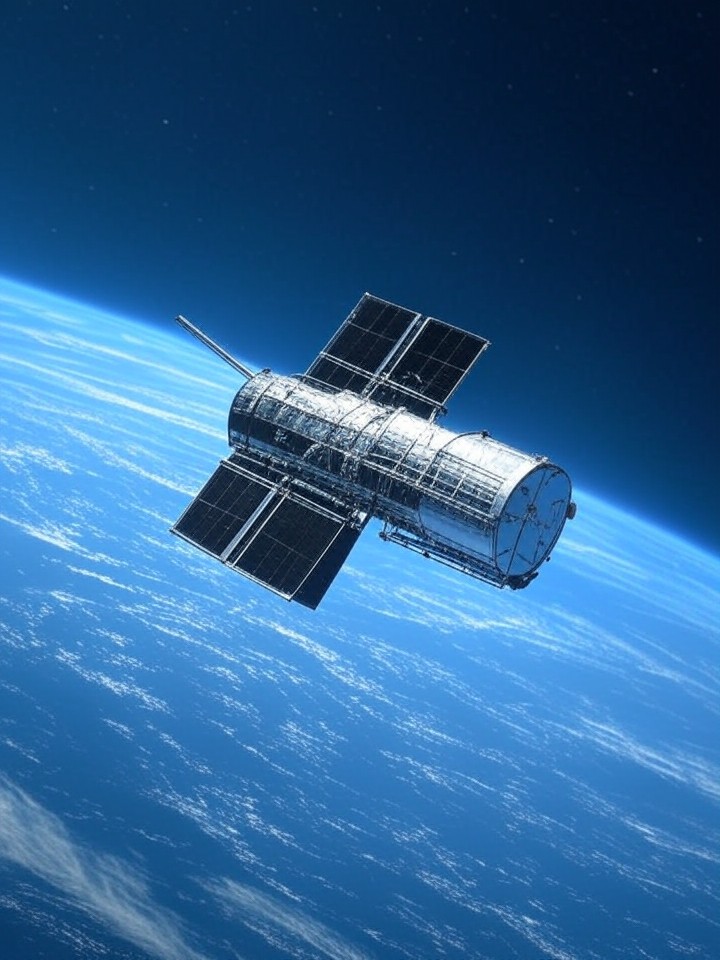
Orbit’s Twilight: The Hubble Telescope’s Inevitable Descent and What It Means for Astronomy’s Future
The Hubble Space Telescope, a cornerstone of modern astronomy since its launch in 1990, is inching closer to the end of its operational life. As atmospheric drag slowly pulls it downward, experts are refining predictions about when this iconic instrument will plunge back to Earth. Recent analyses suggest that without intervention, Hubble could reenter the atmosphere as early as 2029, though the median forecast points to 2033. This timeline has sparked discussions among scientists, engineers, and policymakers about the telescope’s legacy and the void it might leave in space observation.
Solar activity plays a pivotal role in these projections. The sun’s 11-year cycles influence atmospheric density, which in turn affects the drag on orbiting objects like Hubble. Current elevated solar flux levels—higher and more prolonged than anticipated—have accelerated the decay of its orbit. According to data from the Hubble Reentry Tracker website, the best-case scenario extends Hubble’s life to around 2040, while the worst case brings reentry as soon as 2029. These fluctuations make precise predictions challenging, but they underscore the urgency of planning for the post-Hubble era.
NASA’s Goddard Space Flight Center, which oversees Hubble’s operations, has been monitoring the telescope’s altitude closely. Launched into a low Earth orbit, Hubble has benefited from periodic servicing missions in the past, including boosts to higher altitudes during space shuttle visits. The last such mission occurred in 2009, and since the shuttle program’s retirement, no further reboosts have been performed. This leaves Hubble vulnerable to the whims of solar weather, with its orbit gradually decaying.
Accelerating Factors in Orbital Decay
Increased solar activity isn’t the only factor at play. The telescope’s own mass and shape contribute to how drag affects it. At about 11,600 kilograms, Hubble experiences significant atmospheric resistance, especially as its altitude dips below 500 kilometers. Recent posts on X from astronomy experts, including updates from the American Astronomical Society’s 247th meeting, highlight a less than 10% chance of reentry before December 2029, with the median date pegged at August or September 2033. These insights, shared by figures like Jeff Foust, emphasize the probabilistic nature of these forecasts.
Efforts to model Hubble’s trajectory have evolved over the years. A 2020 study published in ScienceDirect provided an early reentry analysis, estimating timelines based on then-current data. That paper noted the telescope’s storied history and its contributions to understanding the universe, but it also warned of the inevitable uncontrolled reentry if no action is taken. Fast-forward to 2026, and updated models incorporate real-time solar flux data, painting a picture of a potentially swifter descent.
The implications of an earlier reentry are profound for ongoing scientific projects. Hubble continues to deliver groundbreaking observations, such as its recent discovery of a new type of cosmic object dubbed “Cloud 9,” a failed galaxy rich in dark matter but devoid of stars, as reported in a Space.com article from just days ago. Losing Hubble prematurely could disrupt long-term studies of distant galaxies, exoplanets, and cosmic phenomena that require its unique ultraviolet and near-infrared capabilities.
Historical Context and Past Interventions
Hubble’s journey has been marked by triumphs over adversity. Initially plagued by a flawed mirror that blurred its images, the telescope was repaired during a 1993 shuttle mission, transforming it into the powerhouse it is today. Subsequent servicing missions in 1997, 1999, 2002, and 2009 not only fixed instruments but also elevated its orbit, countering drag. These efforts, detailed in a timeline on Space.com, extended Hubble’s lifespan far beyond initial expectations.
Without the space shuttle, alternative reboost options have been explored. In 2023, NASA and SpaceX discussed a daring plan involving the Polaris program to potentially service and raise Hubble’s orbit, as covered in a Forbes article. However, no concrete mission has materialized, leaving the telescope to rely on its remaining gyroscopes for stability. NASA’s recent updates, including a June 2024 transition to a one-gyro operating mode posted on X by the official Hubble account, demonstrate ongoing efforts to maximize its science output despite hardware limitations.
The absence of a reboost mission raises questions about resource allocation in space exploration. With NASA’s focus shifting toward the James Webb Space Telescope and future projects like the Nancy Grace Roman Space Telescope, Hubble’s fate seems sealed. Yet, advocates argue that extending its life could provide complementary data, bridging gaps in observational capabilities that newer telescopes might not fully cover.
Current Operational Status and Challenges
As of early 2026, Hubble remains operational, capturing high-resolution images free from atmospheric distortion. Its Wikipedia entry, last updated in 2025, describes it as one of NASA’s Great Observatories, with a 2.4-meter mirror enabling observations across multiple spectra. Recent health checks, such as the restoration to three-gyro operations in April 2024, also shared via X, indicate the spacecraft is in good condition, but gyro failures have periodically halted science activities.
Atmospheric drag variations, driven by solar cycles, continue to complicate forecasts. A post on X from the Xplora account, referencing STScI presentations at the AAS 247 conference, reiterates the low probability of reentry before 2029 and the median around 2033. This aligns with a Daily Galaxy article published just a day ago, which warns that Hubble could disappear sooner than expected due to these factors.
Beyond technical challenges, there’s the human element. Astronomers worldwide depend on Hubble for time-sensitive research. The telescope’s timeline on NASA Science chronicles its revolutionary observations, from the Hubble Deep Field to measurements of the universe’s expansion rate. An abrupt end could curtail ongoing programs, forcing a scramble to reallocate observation time to other facilities.
Potential Reentry Scenarios and Risks
When reentry does occur, it won’t be without risks. Hubble’s size means not all components will burn up in the atmosphere; surviving debris could pose hazards if it lands in populated areas. NASA’s protocols for uncontrolled reentries aim to minimize such dangers, but the unpredictability of the exact time and location adds complexity. The Hubble Reentry Tracker site notes that without action, the telescope will eventually succumb, with estimates varying widely due to solar variability.
Private sector involvement offers a glimmer of hope. A recent Ars Technica piece reports that former Google CEO Eric Schmidt plans to fund a Hubble replacement, potentially accelerating the development of successor telescopes. This could mitigate the impact of Hubble’s loss, ensuring continuity in space-based astronomy.
Meanwhile, discussions at events like the 2026 “Super Bowl of Astronomy”—the AAS meeting, as described in another Space.com story—are shaping the future. Debates on next-generation telescopes and data from distant exoplanets highlight the community’s preparedness, even as Hubble’s orbit decays.
Legacy and the Path Forward
Hubble’s contributions are immeasurable, having reshaped our understanding of the cosmos. From confirming the existence of black holes to imaging the Pillars of Creation, its data has fueled countless discoveries. As a Gizmodo article from two days ago suggests, the telescope could be “dead” in three years, but a privately funded alternative might emerge as a silver lining.
Looking ahead, the integration of Hubble’s data with that from newer observatories will be crucial. The Space Telescope Science Institute continues to process Hubble’s observations, ensuring its legacy endures. Posts on X from NASA Hubble in late 2023 and 2024 detail recoveries from gyro issues, showcasing the resilience of the operations team.
Ultimately, Hubble’s descent serves as a reminder of the finite nature of space missions. As solar flux pushes timelines forward, the astronomy community must innovate to fill the gap. Whether through reboost missions or new telescopes, the drive to explore persists, building on Hubble’s foundational work.
Evolving Predictions and Community Response
Refinements in reentry modeling are ongoing. The Slashdot story from January 11, 2026, titled “How Many Years Left Until the Hubble Space Telescope Reenters Earth’s Atmosphere,” aggregates community discussions on these timelines, linking back to sources like the Hubble Reentry Tracker. It echoes the sentiment that while predictions vary, the trend points to an earlier-than-expected end.
Industry insiders are already pivoting. Investments in private telescopes, as noted in the Ars Technica report on Schmidt’s initiative, could democratize access to space observations. This shift might decentralize astronomy, reducing reliance on government-funded projects like Hubble.
In parallel, NASA’s broader activities, such as the Crew-11 mission updates on NASA’s blog, indicate a bustling space program that could eventually encompass Hubble’s salvation or replacement. The International Space Station’s medical updates from the same source remind us of the human stakes in space operations.
Broader Implications for Space Policy
The Hubble situation influences space debris policies. With thousands of satellites in orbit, managing reentries is a growing concern. Hubble’s case could set precedents for how agencies handle aging assets, potentially leading to international agreements on controlled deorbits.
Economically, the telescope’s end might spur innovation in the commercial space sector. Companies like SpaceX, with their reboost proposal history, stand to gain from servicing contracts. This could foster a new era of in-orbit maintenance, extending the lives of valuable assets.
As we monitor Hubble’s status, the blend of nostalgia and forward-thinking defines the narrative. Its descent isn’t just an end but a catalyst for advancement in astronomical pursuits.


 WebProNews is an iEntry Publication