
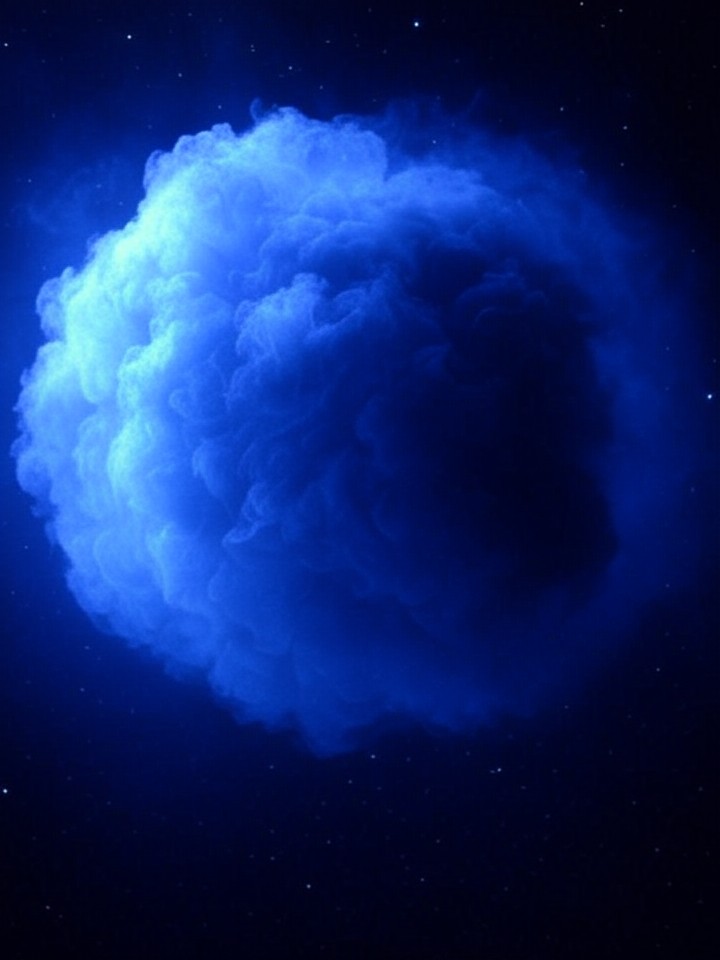
In the vast expanse of the universe, astronomers have long chased the elusive shadows of dark matter, that invisible scaffold holding galaxies together. Now, a recent discovery has thrust a peculiar object into the spotlight, challenging our understanding of cosmic evolution. Dubbed Cloud-9, this enigmatic entity appears to be a starless cloud of gas anchored by a massive halo of dark matter, potentially representing the skeletal remains of a galaxy that never fully formed. Detected through NASA’s Hubble Space Telescope, the find has sparked excitement among researchers, who see it as a window into the early universe’s failed experiments in galaxy building.
The story begins with observations near the galaxy M94, where radio telescopes first hinted at an anomaly—a region of space that seemed to defy expectations. Detailed scrutiny by Hubble revealed no visible stars, only a diffuse cloud of hydrogen gas enveloped in darkness. This object, estimated to span hundreds of thousands of light-years, is dominated by dark matter, which makes up over 99.9% of its mass, according to initial analyses. Scientists describe it as a “failed galaxy,” a relic from the universe’s infancy that accumulated dark matter and gas but never ignited the stellar furnaces needed for star formation.
The implications are profound for cosmology. Dark matter, which constitutes about 27% of the universe’s mass-energy content, is typically inferred through its gravitational effects on visible matter. Cloud-9 offers a rare, isolated laboratory where dark matter’s influence can be studied without the interference of stars or other luminous bodies. Researchers suggest it may confirm theories about how dark matter halos form the cradles for galaxies, yet in some cases, fail to gather sufficient baryonic matter to proceed to star birth.
Unveiling the Ghostly Structure
To grasp Cloud-9’s significance, consider the standard model of galaxy formation. In the early universe, dark matter clumped under gravity, creating halos that drew in gas clouds. These would cool, condense, and spark star formation, eventually birthing galaxies like our Milky Way. But Cloud-9 seems arrested in this process—a dark matter halo that pulled in gas but lacked the density or conditions to form stars. As reported in a recent article by Futurism, scientists are “weirded out” by what they’ve termed “cosmic bones,” likening the object to the skeletal framework of a galaxy that never fleshed out.
Further details emerge from NASA’s own announcements. The space agency highlights that Cloud-9 is gas-rich yet starless, a remnant of early galaxy formation observed through Hubble’s advanced imaging. This aligns with simulations predicting the existence of such “dark galaxies” or failed proto-galaxies, which could number in the billions across the cosmos but remain undetected due to their invisibility in optical light. The discovery near M94, about 14 million light-years away, makes it one of the closest examples, allowing for detailed follow-up observations.
Astronomers involved in the study emphasize the object’s pristine nature. Unlike mature galaxies tainted by billions of years of stellar activity, Cloud-9 preserves chemical signatures from the universe’s dawn. Its hydrogen gas shows minimal heavy elements, suggesting it has remained untouched since the Big Bang’s aftermath. This purity could help refine models of cosmic reionization, the era when the first stars lit up the universe, dispersing the fog of neutral gas.
Theoretical Underpinnings and Challenges
Delving deeper, theoretical physicists are buzzing about how Cloud-9 constrains dark matter models. If dark matter is composed of weakly interacting massive particles (WIMPs) or axions, as many hypothesize, such a structure could reveal interaction strengths through its stability. Posts on X from astronomy enthusiasts and experts alike reflect this intrigue, with users noting that the object’s asymmetric shape—far from a perfect spherical halo—challenges simplistic simulations. One post likened it to a “phantom zone” in gravitational terms, hinting at primordial imprints that defy standard expectations.
Comparisons to other dark matter-dominated objects abound. For instance, ultra-diffuse galaxies like Dragonfly 44 have been studied for their high dark matter content, but they still host some stars. Cloud-9 takes this to an extreme, with no detectable stellar population, making it a stronger candidate for a truly “dark” galaxy. As detailed in a piece from ScienceAlert, it’s seen as a galaxy “arrested during early development,” providing evidence for hierarchical galaxy formation where small halos merge into larger ones, but some linger as ghosts.
Yet, challenges in confirming Cloud-9’s nature persist. Is it truly starless, or are faint stars hidden below detection thresholds? Upcoming observations with the James Webb Space Telescope could peer deeper into infrared wavelengths, potentially unveiling any embryonic stellar activity. Moreover, gravitational lensing studies might map the dark matter distribution more precisely, testing whether it matches cold dark matter predictions or hints at alternatives like fuzzy dark matter.
Observational Breakthroughs and Tools
The Hubble Space Telescope’s role cannot be overstated. Its high-resolution imaging pierced the veil around M94, revealing Cloud-9’s faint gas emissions. NASA’s science division, in a release on their site, describes the object as the “first of a new type,” a starless, gas-rich cloud tied to early universe remnants. This builds on prior Hubble discoveries, such as dark matter threads connecting galaxy clusters, observed by telescopes like Subaru, which have mapped cosmic web filaments spanning millions of light-years.
Integrating multi-wavelength data has been key. Radio observations initially flagged the hydrogen gas, while optical and ultraviolet data from Hubble confirmed the absence of stars. This synergy underscores the importance of collaborative astronomy, where space-based and ground-based instruments complement each other. For industry insiders, this highlights investment opportunities in next-generation telescopes, like the proposed High Definition Space Telescope, which could survey for more Cloud-9-like objects.
Beyond Hubble, X-ray observatories like Chandra have identified similar “bones” in our own galaxy—elongated structures near the Milky Way’s center, fractured by pulsars. While not directly related, these findings illustrate a broader pattern of dark matter scaffolding in various cosmic environments, from galactic cores to intergalactic voids.
Broader Implications for Cosmology
Expanding the view, Cloud-9 could reshape our grasp of the universe’s mass budget. If such failed galaxies are common, they might account for a significant portion of “missing” baryons—ordinary matter predicted by Big Bang nucleosynthesis but unobserved in stars and gas. A CNN report notes that this celestial object “could reveal the secrets of dark matter,” potentially altering how astronomers model galaxy evolution and the cosmic web.
In the context of ongoing debates, Cloud-9 supports the lambda cold dark matter model, yet its existence raises questions about why some halos fail while others thrive. Factors like gas cooling rates, feedback from nearby galaxies, or even primordial magnetic fields might play roles. Researchers are already planning simulations to replicate Cloud-9’s conditions, using supercomputers to test variables in virtual universes.
For particle physicists, this discovery amplifies the hunt for dark matter particles. Experiments at the Large Hadron Collider and underground detectors like LUX-ZEPLIN could find correlates if Cloud-9’s properties point to specific particle masses or interactions. The object’s distance and isolation make it an ideal target for future gravitational wave detectors, which might sense ripples from ancient mergers involving similar structures.
Future Horizons and Unanswered Questions
As excitement builds, astronomers are on what one Space.com article calls “Cloud 9,” punning on the discovery’s name. The site details how this “failed galaxy” packed with dark matter and gas but no stars represents a new cosmic relic, discovered amid routine Hubble surveys. Follow-up with ground-based radio arrays like the Very Large Array could measure the gas dynamics, revealing rotational curves dominated by dark matter.
Speculation abounds on X, where posts discuss Cloud-9 as a “ghost galaxy” confirming theories of starless building blocks from the early universe. Some users tie it to broader findings, like dark matter threads in the Coma Cluster, emphasizing the interconnectedness of cosmic structures.
Ultimately, Cloud-9 embodies the universe’s unfinished symphonies—regions where potential went unrealized. Its study could unlock secrets of dark energy’s interplay with dark matter, influencing cosmic expansion rates. As one New York Times piece describes it, this starless cloud is “a pristine relic of the cosmos that is almost as old as time itself,” inviting deeper probes into the shadows that shape our reality.
Echoes from the Early Universe
Pushing further, consider Cloud-9’s role in understanding reionization. The early universe was a foggy place until ultraviolet light from the first stars ionized neutral hydrogen. A starless cloud like this might preserve pockets of that pre-reionization gas, offering chemical fossils for spectrographic analysis. Live Science reports that Hubble has uncovered this “dark and rare ‘failed galaxy’ unlike anything seen before,” emphasizing its potential to rewrite textbooks on cosmic dawn.
Industry implications extend to technology transfer. Advances in adaptive optics and AI-driven data analysis, honed on discoveries like this, could benefit fields from medical imaging to climate modeling. For investors, funding in astrophysics yields dividends in computational power and sensor tech.
Moreover, Cloud-9 challenges anthropocentric views of the cosmos. In a universe teeming with failed experiments, it reminds us that not every dark matter halo becomes a star-studded galaxy. This perspective fuels philosophical debates on cosmic fine-tuning, where slight parameter tweaks might yield vastly different universes.
Pioneering New Observations
Looking ahead, missions like the Nancy Grace Roman Space Telescope promise wide-field surveys to hunt for more Cloud-9 analogs. Combined with Euclid’s dark energy mapping, these could catalog a population of dark galaxies, quantifying their contribution to the universe’s structure.
On X, sentiment reflects optimism, with posts hailing the find as a breakthrough in dark matter research. Users share threads simplifying the science, from basic summaries to detailed model predictions, fostering public engagement.
In essence, Cloud-9 stands as a beacon—or rather, a shadow—illuminating the unseen forces governing the cosmos. As research progresses, it may well redefine our place in an ever-mysterious universe, one dark cloud at a time.


 WebProNews is an iEntry Publication