
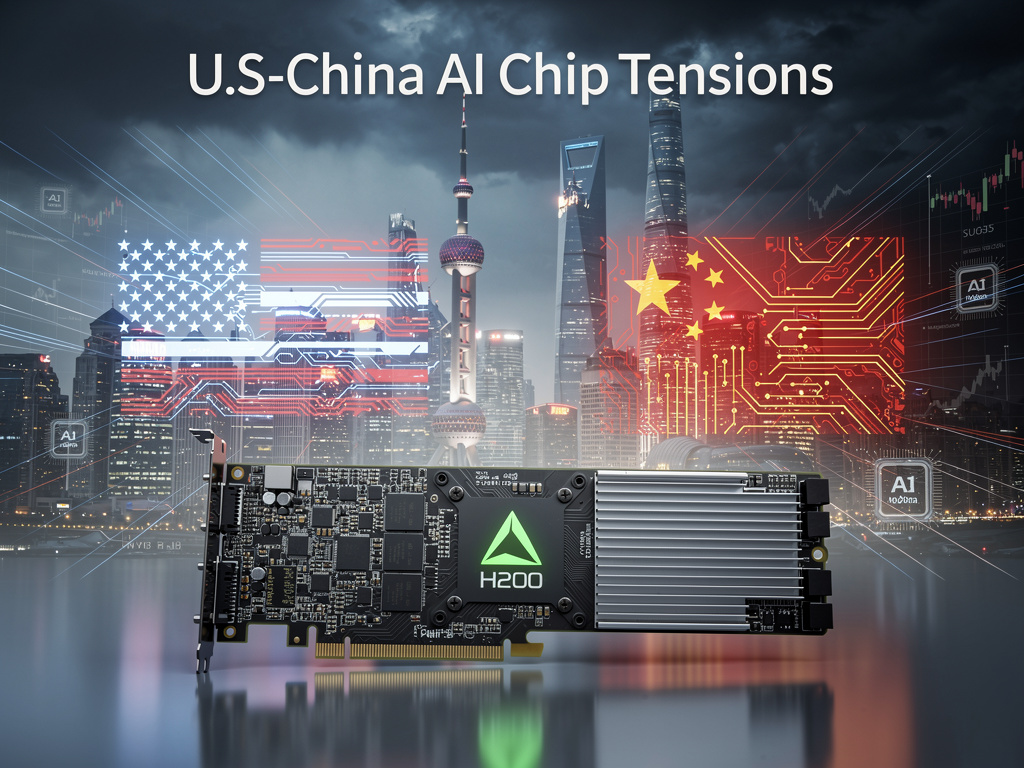
Nvidia Corp. CEO Jensen Huang’s arrival in Shanghai marks a pivotal moment in the company’s efforts to revive sales of its advanced AI chips in the world’s second-largest economy. Huang, known for his leather jacket and relentless travel schedule, touched down amid annual celebrations with Nvidia’s China employees, as first reported by Reuters. The visit comes as the U.S. chip designer awaits Beijing’s nod to sell its powerful H200 processors, already cleared by Washington but stalled at Chinese customs.
Chinese outlet Tencent News spotted Huang touring Nvidia’s new Shanghai office on Friday, where he exchanged thoughts with staff and recapped 2025 milestones, according to Global Times. This routine Lunar New Year kickoff hides deeper tensions: Nvidia faces mounting pressure from domestic rivals like Huawei Technologies Co. and regulatory scrutiny over H200 imports. Sources indicate Huang’s itinerary extends to Beijing, Shenzhen, and Taiwan, potentially including buyer meetings to iron out supply snags.
Huang’s repeated China trips— at least three in 2025, including a July sit-down with the commerce minister—underscore the market’s gravity. China accounted for 13% of Nvidia’s fiscal 2025 revenue via compliant H20 chips before sales cratered to near zero after Beijing’s de facto block in August, per Reuters.
Flashpoint of the H200 Chip
The H200, Nvidia’s second-most potent AI accelerator behind Blackwell, sits at the heart of U.S.-China tech friction. U.S. President Donald Trump reversed prior bans in December 2025, greenlighting exports with strings: 50% shipment caps versus domestic volumes, third-party audits, approved buyers only, plus a 25% tariff and White House revenue cut, as detailed by Barchart. Yet Chinese customs halted early Hong Kong shipments without notice, catching Nvidia off-guard.
Huang addressed this at CES 2026 in Las Vegas, noting “very high” Chinese demand and that “H200s are flowing” post-approval. “My expectation is that we’re not expecting any press releases or any large declarations… If the purchase orders come, it’s because they’re able to place purchase orders,” he said, per Reuters. Nvidia CFO Colette Kress echoed that Washington is “working feverishly” on licenses, though timelines remain murky.
To hedge risks, Nvidia now demands full upfront payments from Chinese buyers, ramping H200 output via Taiwan Semiconductor Manufacturing Co. for over two million units slated for 2026 delivery, according to Reuters.
U.S. Policy Swings Reshape Trade Flows
Trump’s pivot followed Huang’s lobbying of Republicans, arguing curbs fail to slow China’s AI ascent while ceding ground to locals. Nvidia booked a $1 billion charge in 2025 for unsold inventory amid tightened controls since 2022. Recent reports suggest Beijing gave “in-principle” okay to giants like Alibaba Group Holding Ltd. for H200 buys, hinting at imminent import clearance, via Anadolu Agency.
Huang’s Shanghai stop signals a “vote with the feet” for China, where AI chip needs could hit hundreds of billions annually by decade’s end, per company estimates cited in Yahoo Finance. Beijing’s calculus weighs domestic champions against import reliance, using approvals as trade leverage.
Competition intensifies: Huawei’s Ascend series and startups erode Nvidia’s dominance, prompting Huang’s urgency. Global Times analyst Lü Xiang noted Huang’s fears that Nvidia tech could lag in China within years.
China’s Domestic Push Accelerates
While demand persists, Beijing deliberates: outright ban to bolster locals, phased curbs, or bargaining chip versus Washington. Nvidia excluded China from forecasts despite a $500 billion AI backlog through 2027, per Yahoo Finance. Resumed H200 flows could supercharge results, with inventory staged in Hong Kong.
Huang’s tour highlights Nvidia’s balancing act: U.S. security hawks decry sales aiding rivals, yet exclusion risks market evaporation. Past H20 sales proved compliant chips’ viability, but H200’s potency elevates stakes. Sources say Huang eyes logistical talks with buyers, per CNBC.
Broader itinerary—Shanghai party January 24, Beijing Nvidia event Monday—positions Huang for influence amid customs limbo. Nvidia declined comment, focusing optics on employee morale amid uncertainty.
Strategic Ramifications for Nvidia
For investors, purchase orders signal breakthrough; absence prolongs void. Huang’s CES optimism belies risks: paused orders from Chinese firms, per Quartz, and rivals’ gains. Yet ramped production and upfront cash fortify Nvidia against delays.
China’s AI boom—data centers, robotics—fuels needs, but self-reliance drives alternatives. Huang’s visits affirm commitment, potentially yielding meetings with officials. As Trump-era policies evolve, H200 saga tests tech trade detente.
Nvidia’s China odyssey reflects AI’s geopolitical core: chips as power brokers, where CEOs like Huang navigate bans, approvals, and tariffs to claim vast prizes.


 WebProNews is an iEntry Publication