
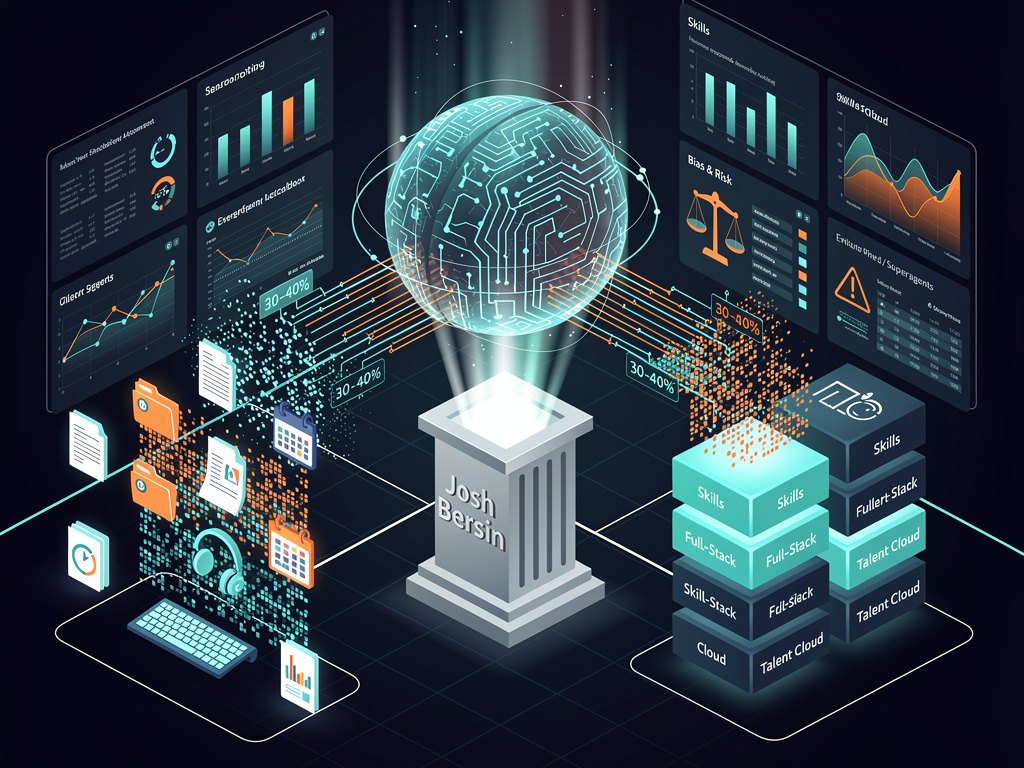
In the opening days of 2026, Human Resources stands at the cusp of its most profound overhaul since the advent of computerized payroll systems. Josh Bersin, founder of The Josh Bersin Company, declares in his manifesto ‘The Great Reinvention of Human Resources Has Begun’ that Enterprise AI is propelling HR from administrative drudgery to a strategic powerhouse. ‘We are now entering a transformational time. Starting in 2026, the HR profession is undergoing a massive, AI-driven reinvention,’ Bersin writes, spotlighting ‘Superagents’—autonomous AI systems that orchestrate entire processes like global onboarding and talent acquisition.
HR’s evolution spans five decades, employing over 40 million people worldwide across hundreds of roles, from payroll clerks to DEI specialists. Legacy systems from Workday, Oracle, and SAP have managed workflows but demanded endless manual tweaks amid federated structures adapting to regional variances, such as hiring engineers in Singapore versus Germany. Bersin argues this complexity, compounded by new demands like hybrid work and pay equity, is ripe for AI disruption. A PR Newswire release on January 21 echoes this, noting HR teams will restructure and accelerate AI adoption as Superagents automate core functions.
The catalyst is Enterprise AI’s shift from personal assistants to multi-functional agents, akin to autonomous vehicles prioritizing passenger outcomes over driver efficiency. ‘The purpose of a car is to optimize the mobility of the passengers, not to make the driver’s work easier,’ Bersin analogizes. Tools like Galileo, an AI agent from The Josh Bersin Company, already map 250+ HR jobs, enabling queries that automate 30-40% of roles such as interview schedulers and helpdesk assistants.
Superagents Reshape HR Operations
Real-world deployments underscore the speed: an insurance giant uses Superagents for targeted hiring, an airline for onboarding, and a pharma firm for sales training, slashing timelines while boosting results. Chipotle leverages AI for faster hiring and scheduling to drive revenue, while Boeing applies it to training and talent mobility for production gains. These cases, detailed in Bersin’s piece, signal HR’s employee-to-staff ratio surging from 100:1 to potentially 400:1 as AI absorbs tactical loads.
Yet automation sparks evolution, not elimination. HR job postings rose 60% in five years, outpacing many fields. Routine positions yield to ‘full-stack’ professionals blending strategy, culture, and AI orchestration. ‘The first is a value creator and demands human skills; the second is an administrative function, which should be automated as much as possible,’ Bersin distinguishes HR’s dual nature. His 2026 Imperatives report, accessible via Galileo, outlines 11 mandates for this era.
Beyond Bersin, industry voices amplify the momentum. HR Dive’s January 6 analysis of five trends shaping HR in 2026 stresses distinguishing AI utility from hype: ‘Experimenting with AI will not be enough on its own,’ says Yahoo’s chief people officer Lisa Moore. Skills development and culture remain paramount amid ‘culture atrophy’ from relentless change.
Skills-First Hiring Meets AI Precision
Skills-based hiring dominates 2026 forecasts, with AI validating competencies over credentials. Cangrade’s 2026 Hiring Outlook reveals year-round recruiting demands skill verification to curb mis-hires, identifying 26 buzzwords like AI ethics and workforce fluidity. Eightfold’s predictions foresee HR shifting to value metrics, redesigning roles for human-AI synergy.
Gartner’s outlook warns of entry-level role declines pressuring HR pipelines, urging internal mobility and prescriptive performance plans. ‘The organization of the future requires a highly efficient entry-level talent pipeline,’ states director Tony Guadagni. ADP’s trends highlight agentic AI’s rise, with 48% of large firms adopting it, necessitating HR-IT pacts for governance amid EU AI Act and U.S. state laws.
Forbes contributor Jeanne Meister lists 10 trends where AI redefines organizations, from supermanagers to continuous upskilling. Paycor notes AI streamlines admin, freeing focus for people management in a skills-centric world.
Navigating Data Trust and Bias Risks
AI’s promise carries pitfalls: lawsuits against Workday and Eightfold, as reported by The New York Times, underscore bias liabilities now on HR. Bersin emphasizes data quality, explainability, and trust: ’30-40% of existing HR ‘jobs’ can be automated with relatively low effort,’ but only with safeguards. HR Executive explores AI trends in screening, blending skills-based and predictive tools for better experiences.
Employee experience platforms evolve too. HR Executive’s profile on Bersin details how generative AI supplants static journeys with conversational interfaces, as seen at Microsoft. Eletive predicts data-driven empathy balancing tech and humanity. Achievers flags recognition and well-being amid engagement lows, with just 25% of workers engaged per its 2026 report.
The $400 billion training market faces rebirth, per Bersin, with AI personalizing paths. His Learning Revolution initiative via Galileo Learn offers HRCI/SHRM credits in an AI-native format.
CHROs Lead the Charge
Chief HR officers emerge as AI architects, partnering IT for adoption. ZS Associates’ Peter MacLean warns of the reinvention gap: 43% use AI in HR, yet only 7% strategize formally. ‘Reinvented HR designs the entire selection system,’ he asserts. Fast Company highlights AI automating routines, enabling strategic focus amid stagnant hiring.
15Five identifies HR tech evolution, DEIB foundations, and hybrid models as key, with AI integration gaps widening divides. AIHR’s 13 tech trends feature ML in recruitment reducing bias, as Unilever deploys HireVue and Pymetrics. Recruitics foresees AI voice assistants and data structuring revolutionizing strategies.
As 2026 unfolds, HR’s reinvention promises scaled impact. Bersin urges professionals: ‘If you’re an HR professional or HR leader, it’s time to dig in.’ With Galileo and imperatives guiding, the profession scales toward business value, proving AI amplifies human potential.


 WebProNews is an iEntry Publication