
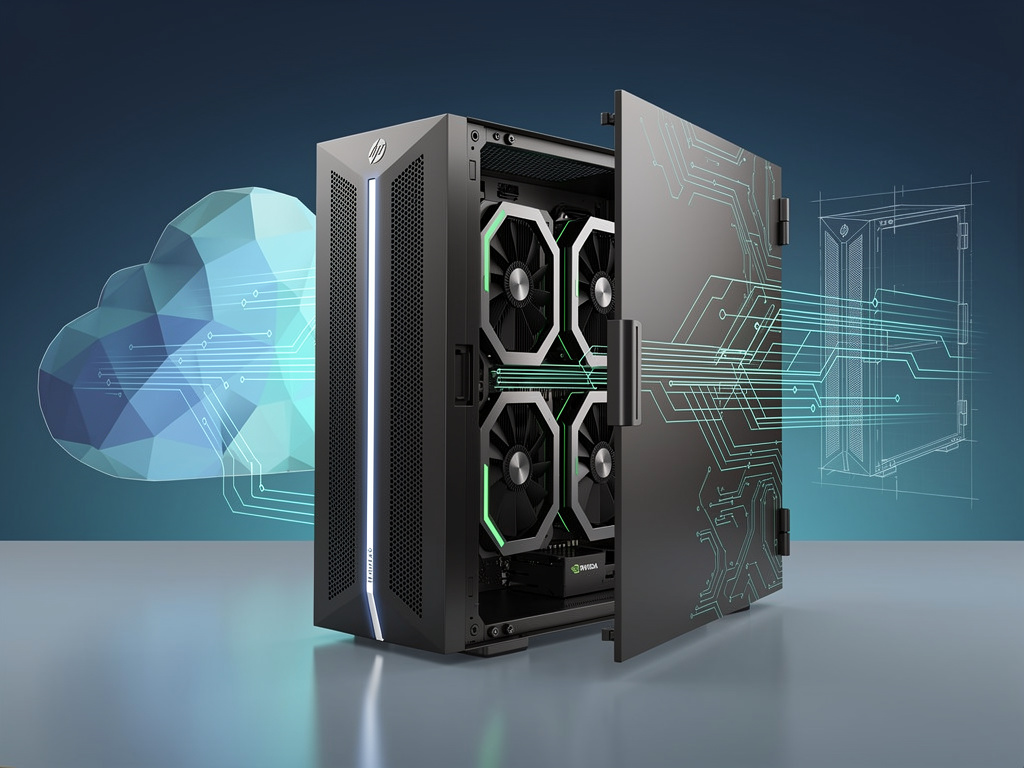
HP just built what it calls the most powerful PC it has ever made. Four NVIDIA Blackwell GPUs. A single chassis. And a side panel design so unconventional it was literally sketched by a customer.
The HP Z8 G6, unveiled at HP Amplify 2025, represents a dramatic escalation in what a desktop workstation can deliver. It’s not a server rack. It’s not a data center node. It’s a workstation — the kind of machine that sits near a desk, under a desk, or in a lab — and it now packs the kind of GPU density that would have been confined to enterprise server rooms just two years ago. According to TechRadar, the system supports up to four NVIDIA Blackwell-architecture GPUs, making it a direct answer to the surging demand for local AI training, simulation, and rendering horsepower that can’t — or shouldn’t — be offloaded to the cloud.
The timing is deliberate. Every major workstation OEM is scrambling to position its hardware as “AI-ready,” a term that’s become nearly meaningless through overuse. But HP is backing up the branding with genuine architectural changes. The Z8 G6 doesn’t just slot in more GPUs. It rethinks the thermal envelope, the power delivery, and the serviceability of the entire machine. That last point is where things get interesting — and a little weird.
The side panel. It deserves its own discussion.
HP says the Z8 G6 features a tool-free side panel that was directly inspired by a user who sketched the idea on a napkin during a customer feedback session. The mechanism allows the panel to be removed without screws, latches, or any traditional fastening hardware, making internal access nearly instantaneous. For IT departments managing fleets of workstations, this isn’t a novelty. It’s a maintenance multiplier. When you’re swapping GPUs, adding memory, or troubleshooting thermal issues across dozens of machines, shaving even 30 seconds off each case opening adds up fast. TechRadar’s report highlights the design as one of the most distinctive elements of the new system, noting its origins in direct customer collaboration — a rare instance where a hand-drawn concept actually made it into a shipping product.
But the real story here is compute density and what it means for AI workloads that are migrating back from the cloud to local infrastructure.
NVIDIA’s Blackwell architecture, which succeeded Hopper, delivers substantial generational improvements in AI training throughput and inference efficiency. Packing four of these GPUs into a single workstation chassis gives data scientists, engineers, and content creators the ability to run large model fine-tuning, complex simulations, and multi-stream rendering workflows without depending on remote compute instances. The economics shift when you factor in cloud egress costs, latency sensitivity, and data sovereignty requirements. For industries like defense, healthcare, and financial services — where sending training data to a third-party cloud provider introduces compliance headaches — a local four-GPU workstation isn’t a luxury. It’s a necessity.
HP hasn’t disclosed exact GPU model numbers for the Z8 G6’s Blackwell configuration, and pricing remains unannounced. That’s typical for workstation-class hardware aimed at enterprise procurement cycles, where configurations are often custom-quoted. But the signal is clear: HP is targeting the segment of buyers who need maximum local compute and are willing to pay for it.
The competitive context matters. Dell Technologies has been aggressively pushing its Precision workstation line with similar multi-GPU configurations, and Lenovo’s ThinkStation PX has offered up to four professional GPUs for over a year. What differentiates the Z8 G6, at least on paper, is the combination of Blackwell-generation silicon with the serviceability and thermal engineering that HP claims to have refined specifically for sustained GPU loads. Workstations running four high-end GPUs generate enormous amounts of heat, and managing that heat without resorting to liquid cooling or deafening fan speeds is a genuine engineering challenge.
HP’s broader strategy at Amplify 2025 extended well beyond the Z8 G6. The company announced a range of AI-focused PCs, commercial notebooks, and management software updates. But the Z8 G6 is the flagship — the proof point for HP’s argument that workstations remain essential even as cloud computing absorbs more general-purpose compute tasks. The argument has merit. Cloud is unbeatable for elastic, bursty workloads. For sustained, high-throughput, data-sensitive work? Local hardware still wins on total cost of ownership and predictability.
So where does this leave the workstation market?
It leaves it in an unexpectedly strong position. IDC data from earlier this year showed workstation shipments stabilizing after a post-pandemic dip, with AI-related demand cited as a primary growth driver. Organizations building internal AI capabilities — whether for generative AI applications, scientific computing, or autonomous systems development — need hardware that developers can touch, configure, and iterate on without submitting cloud provisioning tickets. The Z8 G6, with its four Blackwell GPUs and its napkin-designed side panel, is HP’s bet that the developers want exactly that.
And the napkin thing? It’s a small detail, but it reveals something real about how HP is approaching product design. The best hardware companies don’t just engineer in isolation. They listen — sometimes literally to a sketch on a napkin — and build what their users actually need. Whether the Z8 G6 delivers on its performance promises will depend on benchmarks, thermal performance under sustained load, and real-world pricing. But the intent is unmistakable. HP wants to own the top of the workstation market, and it’s throwing four Blackwell GPUs and a genuinely clever chassis design at the problem to prove it.


 WebProNews is an iEntry Publication