
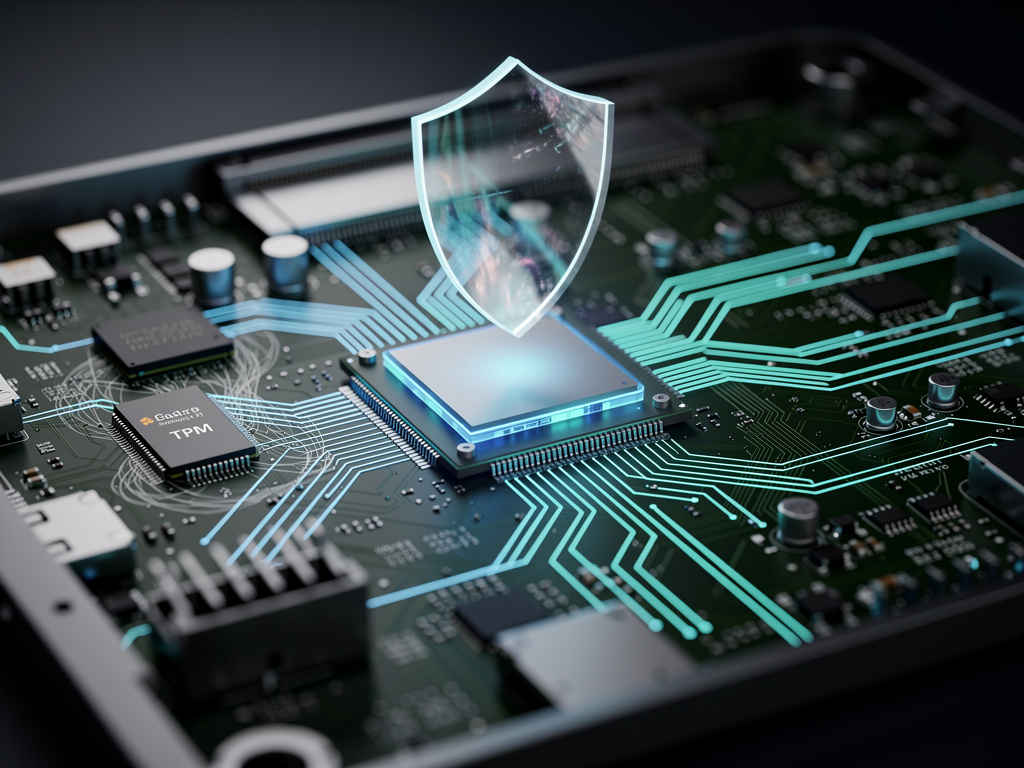
For years, a vulnerability sat inside HP’s firmware like an unlocked back door on a bank vault. BitLocker, Microsoft’s full-disk encryption tool trusted by millions of enterprise users, was supposed to keep data unreadable without proper authentication. But a flaw in how certain HP laptops communicated between their Trusted Platform Module and the CPU meant that an attacker with physical access could intercept encryption keys in transit — completely bypassing BitLocker’s protections. The encrypted drive? Readable. In plain text.
HP has now closed that gap. And the fix, while quiet, matters enormously for corporate IT departments and security teams that have long relied on BitLocker as a foundational layer of endpoint protection.
The vulnerability centers on a hardware design choice that has plagued not just HP but the broader PC industry: the use of discrete Trusted Platform Modules connected to the processor over an exposed SPI (Serial Peripheral Interface) bus. As MakeUseOf reported, this architecture creates a physical attack surface where the encryption keys BitLocker stores in the TPM can be sniffed during boot using relatively inexpensive hardware — a logic analyzer, some clips, and a bit of know-how. Security researchers have demonstrated this class of attack repeatedly over the past several years, including notable public demonstrations at conferences and in YouTube videos that attracted widespread attention.
The core problem is straightforward. When a Windows machine boots with BitLocker enabled in its default configuration, the TPM automatically releases the Volume Master Key to the CPU so the operating system can decrypt the drive. If the TPM is a separate chip communicating over an unencrypted bus, that key travels in the clear across a physical trace on the motherboard. Anyone who can attach a probe to that trace can capture the key. Game over.
This isn’t theoretical. Researchers have pulled it off in under a minute on vulnerable machines.
HP’s fix, delivered through a firmware update, implements a software-based TPM — sometimes called fTPM or firmware TPM — that runs inside the processor itself rather than relying on a separate discrete chip. Because the TPM functionality now executes within the CPU’s secure enclave, there’s no external bus to sniff. The key never leaves the processor. This approach mirrors what AMD and Intel have offered for years through their respective Platform Security Processor and Intel PTT (Platform Trust Technology) implementations, but many OEMs, HP included, continued shipping machines configured to use discrete TPMs by default.
The shift matters more than it might seem at first glance. Enterprise deployments of BitLocker are vast. Microsoft has pushed the technology as a standard feature in Windows Pro and Enterprise editions, and many organizations mandate its use through group policy. The assumption among IT administrators has generally been that BitLocker with TPM provides strong at-rest encryption — that a stolen laptop is a lost asset, not a data breach. The discrete TPM sniffing attack undermined that assumption in a way that was difficult to mitigate without hardware changes or complex pre-boot authentication configurations that most organizations avoided because they introduced friction for end users.
HP’s firmware patch effectively eliminates the hardware interception vector on affected models. According to MakeUseOf, the update transitions the TPM trust anchor from the discrete chip to the firmware-based implementation inside the CPU, which means the SPI bus is no longer the weak link in the chain. IT departments running HP fleets should prioritize this update, particularly for machines used by executives, finance teams, legal departments, and anyone handling sensitive intellectual property or regulated data.
But there’s a catch. Switching from a discrete TPM to a firmware TPM isn’t a trivial operation. BitLocker keys are sealed to a specific TPM, so changing the TPM means the existing keys become invalid. Organizations will need to suspend BitLocker protection, apply the firmware update, and then re-enable BitLocker so that keys are sealed to the new fTPM. For a single machine, that’s a minor inconvenience. For a fleet of thousands, it requires careful planning and orchestration — exactly the kind of IT project that tends to get deprioritized until something bad happens.
The broader industry context here is instructive. Microsoft’s hardware requirements for Windows 11 mandate TPM 2.0, and the company has increasingly encouraged the use of firmware-based TPM implementations. Intel’s PTT and AMD’s fTPM have been available in processors for the better part of a decade. Yet discrete TPMs persisted in many business-class laptops because of certification requirements, supply chain inertia, and a general institutional reluctance to change what appeared to be working. The sniffing attack exposed the cost of that inertia.
Security researchers have been vocal about this risk for some time. In 2024 and into 2025, multiple demonstrations showed BitLocker keys being extracted from discrete TPMs on various vendors’ hardware, not just HP’s. The attacks don’t require nation-state capabilities. A motivated attacker with a few hundred dollars in equipment and physical access to the target machine can execute them. That profile fits corporate espionage, insider threats, and even opportunistic theft scenarios where a laptop is snatched from a hotel room or conference.
So why did it take this long for OEMs to act? Part of the answer lies in the perceived threat model. Physical access attacks have traditionally been considered lower priority than remote exploits because they require the attacker to have hands on the device. But that calculus has shifted as organizations increasingly recognize that lost and stolen devices represent a significant percentage of data breach incidents. The FBI’s Internet Crime Complaint Center and various data breach studies have consistently highlighted physical device theft as a vector, particularly in industries like healthcare, financial services, and government contracting where regulatory consequences for data exposure are severe.
HP deserves credit for shipping the fix, even if the timing feels overdue. The company hasn’t made a major public announcement about the update — it arrived as a firmware revision rather than a headline-grabbing security bulletin. That low-key approach is typical for hardware-level fixes, which tend to get less attention than flashy zero-day patches. But the practical impact for organizations running affected HP hardware is significant. This is the kind of update that should be on every CISO’s radar.
For organizations not running HP hardware, the lesson is clear: check whether your machines use discrete or firmware-based TPMs. If they’re discrete, your BitLocker deployment may be vulnerable to the same class of attack. Dell, Lenovo, and other major OEMs have their own TPM configurations, and the risk profile varies by model and generation. Microsoft’s own documentation provides guidance on verifying TPM type through the tpm.msc management console or PowerShell commands.
There’s also a broader architectural question worth considering. BitLocker’s default configuration — TPM-only authentication without a pre-boot PIN or USB key — was designed for convenience. Microsoft explicitly designed it so that users could boot their machines without entering an additional password or inserting a token. That design choice traded security for usability, and the discrete TPM sniffing attack exploited exactly that tradeoff. Organizations that configured BitLocker with a pre-boot PIN were already protected against this attack because the TPM won’t release the key without the correct PIN, regardless of what an attacker can sniff on the bus.
The firmware TPM approach HP has adopted is a better default because it closes the physical interception vector without requiring users to change their behavior. No extra PINs. No USB keys. The protection is architectural rather than procedural, which is almost always more reliable in practice because it doesn’t depend on humans remembering to do something.
Still, defense in depth remains the right posture. Even with a firmware TPM, organizations should evaluate whether pre-boot authentication makes sense for their highest-risk devices. And they should ensure that firmware updates are being deployed consistently — a persistent challenge in enterprise environments where BIOS and UEFI updates often lag behind operating system patches by months or even years.
HP’s patch is a concrete step forward. It addresses a known, demonstrated, and practically exploitable weakness in one of the most widely deployed encryption technologies in the Windows world. The fix is available now. The question is how quickly organizations will actually deploy it — and whether the rest of the industry will follow HP’s lead in making firmware TPM the default across their product lines.
That question, as always, will be answered by how seriously enterprises take physical security threats relative to the operational cost of rolling out firmware updates at scale. History suggests the answer will be: not fast enough.


 WebProNews is an iEntry Publication