
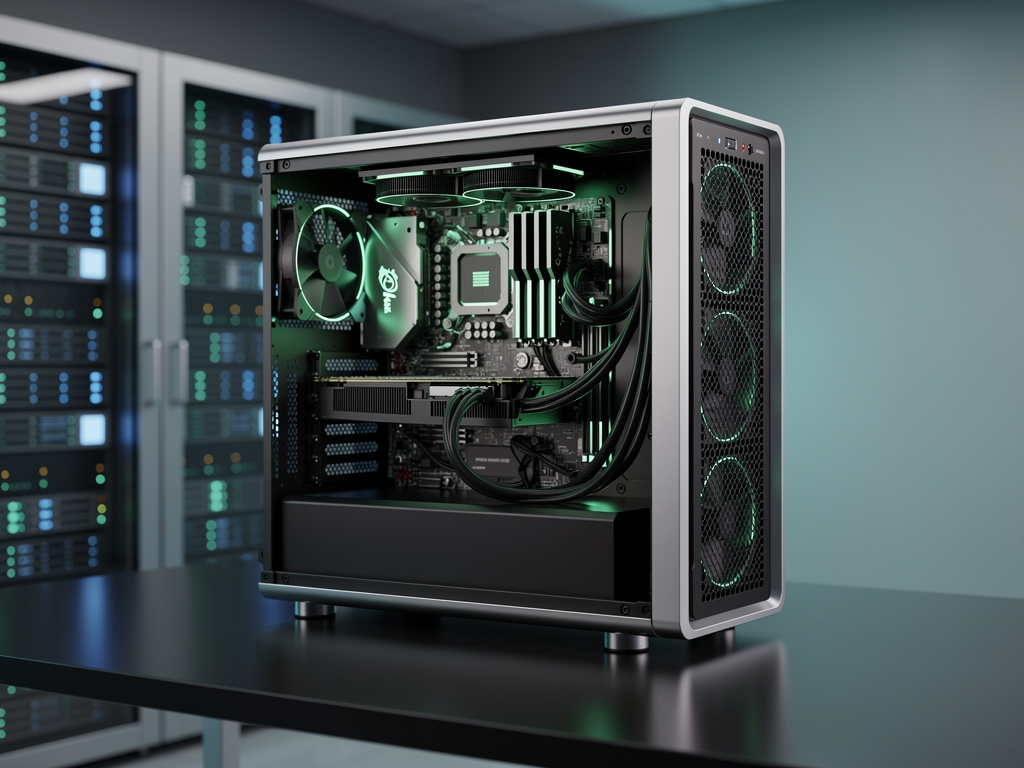
HP has introduced what stands as the most capable Windows-based AI workstation to date, built around Nvidia’s Grace Blackwell architecture and equipped with an astonishing 784GB of unified memory. The system promises to run models holding up to one trillion parameters locally, removing many of the latency, privacy, and recurring cost barriers associated with cloud-only inference. While the price will place the machine firmly in the domain of specialized enterprise and research buyers, its specifications mark a significant step forward for on-premises generative AI workloads.
The new workstation pairs Nvidia’s Grace CPU with up to four Blackwell GPUs in a single chassis. Each GPU can be configured with the highest memory variants currently available, allowing the combined platform to pool 784GB of coherent memory across CPU and GPU fabrics. This unified memory space matters because large language models no longer need to be partitioned across separate address spaces or constantly swapped from system RAM to GPU VRAM. Instead, the entire model can remain resident, enabling faster context switching and dramatically lower latency during interactive sessions.
Nvidia’s NVLink-C2C interconnect binds the Grace CPU directly to the Blackwell GPUs at 900GB/s bidirectional bandwidth per link. The result is memory coherency that behaves more like a single system image than a cluster of discrete accelerators. For developers training or fine-tuning models in the 70-billion to 405-billion parameter range, the ability to keep weights, optimizer states, and activation tensors in one addressable pool reduces engineering overhead and improves debugging. The same advantage extends to inference, where retrieval-augmented generation pipelines can access massive vector databases without repeated data movement.
Memory capacity on this scale also opens practical doors for multimodal models that combine language, vision, and audio within a single forward pass. A single trillion-parameter mixture-of-experts model, for instance, might activate only a fraction of its total parameters per token, yet still require the full set of expert weights to be quickly accessible. With 784GB at its disposal, the HP workstation can host several such models simultaneously, allowing users to switch contexts without reloading from storage. This capability is especially relevant for research labs, creative studios, and engineering teams that iterate rapidly across different specialized models throughout a workday.
The workstation’s design extends beyond raw memory. HP engineers focused on thermal and power delivery to sustain high utilization rates over long periods. Liquid cooling options are available for the GPU sleds, while the chassis incorporates reinforced power delivery stages capable of supporting sustained draws above 3,000 watts. Such headroom matters because real-world AI workloads rarely run at the clean 50% utilization figures seen in marketing slides. Sustained matrix operations at scale generate consistent heat, and any thermal throttling would undermine the value of the large memory pool.
Storage follows the same high-performance philosophy. The base configuration includes multiple NVMe SSDs in RAID 0 delivering more than 50GB/s sequential reads, enough to checkpoint a multi-hundred-gigabyte model state in seconds. Expansion slots allow additional drives or high-speed networking cards so that the workstation can act as a small departmental cluster node when connected to similar systems via InfiniBand or Ethernet. This flexibility lets organizations begin with a single powerful node and scale outward as demand grows, rather than committing to a full rack of servers from day one.
Software support centers on Nvidia’s CUDA, TensorRT, and the newly optimized CUDA-X libraries tuned for the Grace-Blackwell platform. Microsoft has also worked closely with both vendors to ensure Windows 11 Enterprise runs efficiently on the Arm-based Grace CPU. The operating system now includes native Arm64 builds of key AI frameworks and improved hypervisor support for virtual machines that can each be assigned large contiguous memory blocks. For users accustomed to Windows-based creative applications, this marks the first time a workstation of this caliber can run both traditional content-creation tools and trillion-parameter models without dual-boot complexity.
Pricing has not been disclosed in exact figures, yet industry analysts expect the fully configured version to start above $60,000 and climb toward six figures once maximum memory, storage, and support contracts are added. The cost reflects more than component prices. It includes custom validation, extended thermal engineering, and enterprise-grade support commitments that HP and Nvidia offer for mission-critical deployments. Organizations that currently spend tens of thousands per month on cloud API calls for proprietary data may find the upfront investment pays for itself within a year, especially when factoring in data-sovereignty requirements or latency-sensitive applications such as real-time digital assistants inside secure facilities.
Early access programs have already placed similar Grace-Blackwell systems with select customers in semiconductor design, pharmaceutical research, and film visual-effects studios. Feedback consistently highlights two advantages: the elimination of data egress fees and the ability to experiment with model architectures too large or too sensitive for cloud providers. One automotive manufacturer reportedly cut its weekly simulation loop from 48 hours on a cloud cluster to under nine hours on a single local workstation, largely because the model no longer needed to be quantized or distilled to fit within cloud instance memory limits.
The arrival of such hardware also influences the broader software landscape. Framework developers are accelerating support for unified memory architectures, producing new abstractions that automatically decide when to prefetch parameters or when to keep data on the CPU side for preprocessing. Tools that once assumed a strict host-device divide now treat the entire 784GB as a single flat pool, simplifying code and reducing bugs related to manual memory staging. This shift benefits smaller teams who lack the resources to maintain complex distributed training pipelines yet still need access to frontier-scale models.
Security features receive equal attention. The workstation includes hardware root-of-trust modules tied to both the Grace CPU and each Blackwell GPU, allowing measured boot sequences that extend into the AI runtime itself. Model weights can be encrypted at rest and decrypted directly into GPU memory without ever appearing in plaintext inside system DRAM. For industries handling sensitive intellectual property or personal health information, these capabilities remove one of the last objections to running large models on premises.
Power efficiency has improved compared with previous generations, though the absolute consumption remains high. Nvidia reports that the Grace-Blackwell combination delivers roughly 2.5 times better performance per watt on large language model inference than the prior Hopper generation when memory capacity is held constant. The gain comes from both the new Blackwell tensor cores and the tighter integration between CPU and GPU, which reduces data movement overhead. Facilities with constrained electricity budgets will still need to plan carefully, but the performance delivered per kilowatt-hour now justifies the infrastructure investment for many use cases.
Looking forward, HP intends to offer the platform in both tower and rack-mount configurations so that customers can choose between a standalone developer workstation and a dense datacenter node. Future iterations are expected to incorporate even higher memory densities as HBM4 and next-generation CXL devices reach the market. The current 784GB figure, impressive today, may appear modest within two years, yet it establishes a baseline for what Windows-compatible AI hardware can achieve.
The introduction of this workstation signals that local AI infrastructure has reached a threshold where many organizations can realistically consider moving their most demanding workloads in-house. By combining massive unified memory, high-bandwidth CPU-GPU coherence, and full Windows compatibility, HP and Nvidia have produced a machine that satisfies both the performance requirements of researchers and the operational expectations of IT departments. While the price will limit initial adoption to well-funded teams, the long-term effect may be a gradual decentralization of AI compute, returning control of sensitive models and data to the organizations that generate them. As more software tools adapt to this new class of hardware, the practical difference between cloud and local inference will continue to narrow, giving users greater choice about where and how they run their most important AI applications.


 WebProNews is an iEntry Publication