
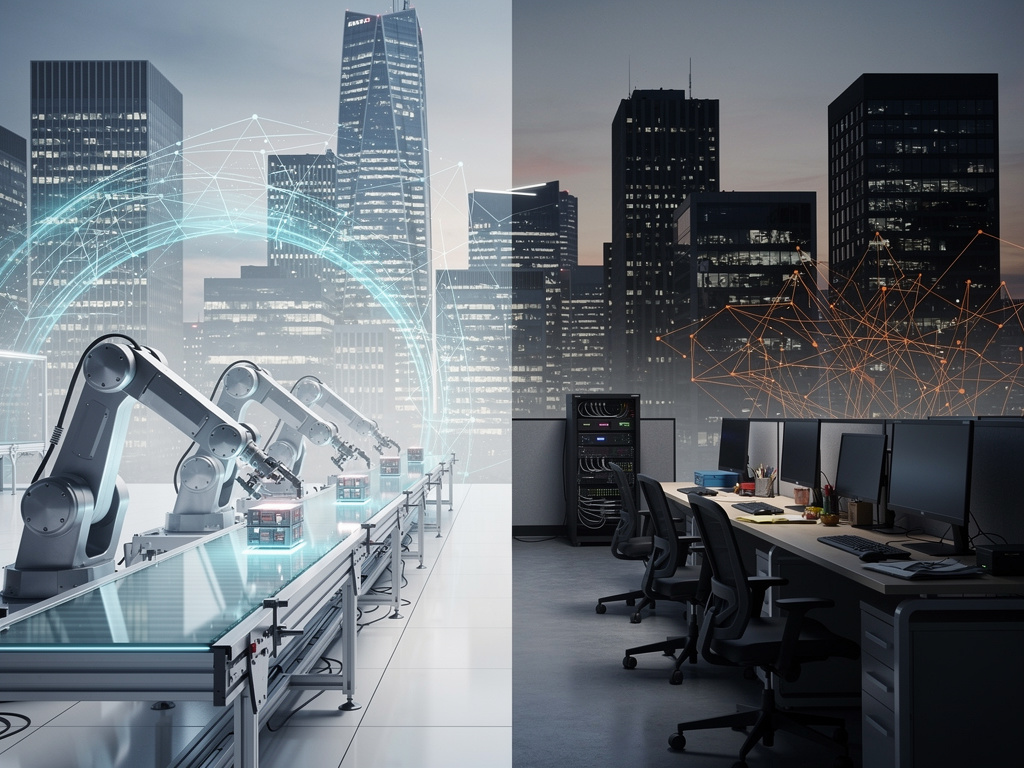
As the artificial intelligence revolution accelerates, investors and economists are grappling with its profound implications for the workforce. Howard Marks, the billionaire co-founder of Oaktree Capital Management, recently issued a stark warning about AI’s potential to upend not just jobs, but the very fabric of human purpose and economic stability. In a memo to clients, Marks described the outlook as “terrifying,” arguing that while AI promises a surge in productivity, it risks leaving vast swaths of the population without paychecks or meaningful roles in society. This perspective echoes growing concerns among industry leaders, as AI tools increasingly automate tasks once reserved for human ingenuity.
Marks’ cautionary note comes at a time when data from various studies paints a grim picture of job displacement. For instance, a recent MIT report indicates that AI could already replace nearly 12% of the U.S. workforce, spanning sectors like finance, healthcare, and professional services. This isn’t mere speculation; the study, detailed in Fortune, highlights how advancements in machine learning are making roles obsolete faster than anticipated. Marks builds on this by questioning the assumption that higher productivity will automatically translate to widespread prosperity, pointing out that if fewer people have income, demand for goods and services could plummet.
Beyond immediate job losses, Marks delves into the philosophical void AI might create. He posits that work isn’t just about earning a living—it’s a source of identity and purpose for many. If AI displaces millions, what fills that gap? This concern is amplified by reports from organizations like the World Economic Forum, which in a 2025 analysis noted that entry-level positions are particularly vulnerable, potentially shutting doors for young workers entering the job market. The forum’s insights, available via World Economic Forum, suggest AI is reshaping career paths, widening global talent disparities while automating routine tasks.
The Productivity Paradox Unveiled
Drawing from historical parallels, Marks compares AI’s rise to past technological shifts, like the Industrial Revolution, which displaced workers but eventually created new opportunities. However, he argues this time could be different due to AI’s speed and scope. A Goldman Sachs report reinforces this, estimating that AI-related innovations may cause short-term job displacement while fostering growth elsewhere, as outlined in Goldman Sachs. Yet Marks warns that the benefits might concentrate among a tech-savvy elite, exacerbating inequality.
Recent surveys underscore the immediacy of these changes. According to a CNBC poll of HR leaders, 89% expect AI to impact jobs in 2026, transforming how workforces operate. This sentiment aligns with findings from PwC’s AI Jobs Barometer, which tracks how AI is accelerating changes for both employees and businesses, detailed in PwC. Marks ties this to a broader economic risk: if AI boosts output but slashes employment, who will buy the extra products? He cites the potential for a demand shortfall, where productivity gains fail to circulate through the economy.
Posts on X (formerly Twitter) reflect public anxiety around these issues, with users highlighting warnings from figures like Senator Mark Warner about unemployment spiking to 25% among recent college graduates due to AI. Such discussions, often shared in real-time, amplify Marks’ memo by illustrating grassroots fears of social disruption. Meanwhile, a J.P. Morgan analysis questions whether the paradigm shift in job growth is already underway, with some industries facing higher risks, as explored in J.P. Morgan Global Research.
Investor Perspectives on Economic Ripples
Howard Marks isn’t alone in his apprehensions; other investors are echoing similar themes. For example, posts on X reference David Sacks, appointed as the White House AI and Crypto Czar, admitting that AI investments propped up much of U.S. GDP growth in early 2025, while other sectors stagnated. This reliance on AI for economic buoyancy raises questions about sustainability if job losses mount. Marks extends this by critiquing the “assumed productivity boom,” noting that without broad-based income, consumption could falter, leading to a vicious cycle.
A deeper look at labor market data reveals nuanced effects. The Budget Lab at Yale has been tracking AI’s impact, using metrics from Anthropic to show trends in task automation and augmentation through August 2025. Their analysis, found in The Budget Lab at Yale, indicates that white-collar and early-career roles are seeing reduced demand, a point Marks uses to argue for proactive policy interventions. He suggests that governments and companies must rethink education and retraining to adapt.
Furthermore, MIT Sloan’s research offers a counterbalance, showing that AI can lead to substantial gains for companies, potentially translating into new jobs. As reported in MIT Sloan, firms integrating AI see productivity boosts that could create opportunities, though Marks cautions this might not offset widespread displacements. He emphasizes the human element: without purpose derived from work, societal unrest could follow, drawing from historical examples where technological unemployment sparked movements.
Human Purpose in an Automated World
Shifting focus to the existential side, Marks probes how AI might erode the sense of fulfillment many derive from their professions. If machines handle creative and analytical tasks, what’s left for humans? This resonates with predictions from Nexford University, which forecasts AI affecting jobs from 2026 to 2030, creating new roles while eliminating others, as detailed in Nexford University. Marks argues that resisting AI isn’t the answer; instead, society must ride the wave by fostering skills that complement technology.
Recent news amplifies these concerns. A Microsoft feature on AI trends for 2026 highlights how AI could become a true partner in teamwork and research, potentially boosting efficiency but at the cost of traditional roles, per Microsoft News. Posts on X, including those citing Mario Nawfal, warn of an “AI job massacre,” with 77,999 tech jobs lost in 2025 alone, underscoring the urgency Marks highlights. He questions whether college degrees are becoming obsolete, as AI replaces entry-level positions.
EY’s latest survey provides optimism amid the gloom, noting that AI-driven productivity is leading to reinvestments in R&D and employee retraining rather than mass layoffs, as covered in EY US. Marks references such data to advocate for strategic adaptations, but he remains skeptical, warning that without addressing affordability gaps, economic growth could stall.
Policy Responses and Future Pathways
Policymakers are beginning to heed these warnings. The World Economic Forum’s report predicts AI displacing 85 million jobs globally by 2025’s end but creating 97 million new ones, a net positive tempered by uneven distribution. Marks uses this to call for equitable transitions, emphasizing retraining programs that preserve human dignity. In the U.S., SHRM research indicates 23.2 million roles already impacted, spanning various sectors, fueling debates on universal basic income or similar safety nets.
Forbes’ predictions for AI in 2026 foresee AGI development and AI agents replacing jobs, urging businesses to adopt automation strategies, as outlined in Forbes. Marks aligns with this by stressing investor responsibility: capital allocators like him must consider societal costs when backing AI ventures. He draws from his experience in distressed debt to predict that unchecked AI could lead to “economic distress” on a macro scale.
MIT Technology Review’s vision of the world in 2030 envisions AI deeply integrated into daily life, with discussions on its societal reshaping, available through MIT Technology Review. Marks’ memo serves as a clarion call within this context, urging a balanced approach where technology enhances rather than diminishes human potential.
Balancing Innovation with Equity
Industry insiders are increasingly vocal about these dynamics. Posts on X quote investors like Himanshu Sharma warning of an “AI Apocalypse” in the job market, with waves of replacements starting from front-line staff. Marks echoes this by highlighting the need for foresight, critiquing overly optimistic narratives that ignore displaced workers’ plights.
A CNBC study from November 2025 reinforces that AI can already replace 11.7% of the U.S. workforce, per CNBC, aligning with Marks’ “terrifying” assessment. He argues for a reevaluation of economic models, where productivity isn’t pursued at the expense of purpose.
Ultimately, Marks’ perspective invites a broader dialogue on redefining work in an AI-dominated era. By integrating insights from reports like those from Goldman Sachs and MIT, he paints a picture of cautionary optimism: AI could usher in abundance, but only if society addresses the human costs head-on. As 2026 approaches, the challenge lies in ensuring that technological progress bolsters, rather than undermines, our collective sense of meaning.


 WebProNews is an iEntry Publication