
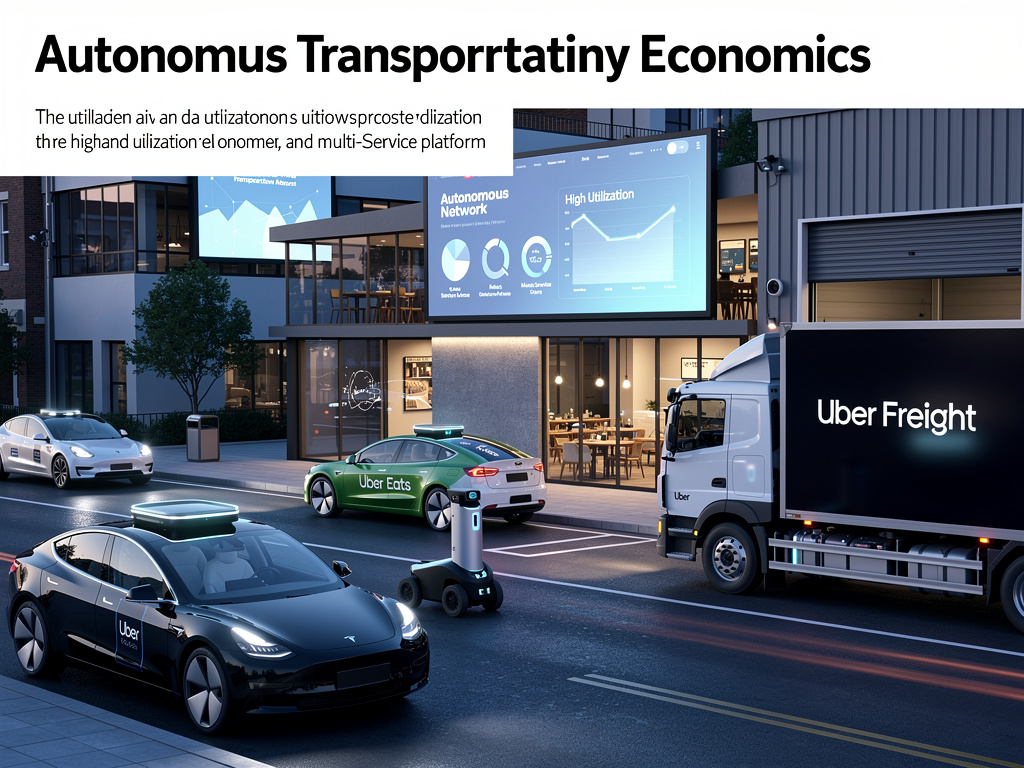
While technology giants and automotive manufacturers race to deploy fleets of self-driving taxis, Uber Technologies has quietly positioned itself with a strategic advantage that competitors may have overlooked: a sprawling logistics network that extends far beyond passenger transportation. CEO Dara Khosrowshahi believes that Uber’s existing businesses in food delivery and freight could provide the company with a critical edge as autonomous vehicles reshape urban mobility over the next decade.
According to Business Insider, Khosrowshahi has articulated a vision where Uber’s diversified platform—spanning ride-hailing, Uber Eats, and freight operations—creates a multi-faceted ecosystem that pure-play robotaxi companies cannot easily replicate. This strategic positioning comes at a crucial moment when Waymo, owned by Alphabet, and Tesla are aggressively expanding their autonomous vehicle ambitions, yet remain primarily focused on passenger transportation.
The thesis underlying Khosrowshahi’s confidence is straightforward but profound: autonomous vehicles will eventually need to maximize utilization rates to achieve profitability, and companies with diverse use cases will be better positioned to keep vehicles productive throughout the day. A robotaxi that sits idle during off-peak hours represents a significant capital inefficiency, but a vehicle that can seamlessly transition between delivering passengers during rush hour, transporting restaurant meals during lunch and dinner, and moving freight overnight could fundamentally alter the economics of autonomous fleets.
The Utilization Advantage: Beyond Peak-Hour Passenger Demand
Traditional ride-hailing faces inherent demand fluctuations, with pronounced peaks during morning and evening commutes and notable troughs during mid-day and late-night hours. This cyclical pattern creates inefficiencies that autonomous vehicles alone cannot solve. Uber’s integrated platform, however, offers the potential to smooth these demand curves by allocating autonomous vehicles across different services based on real-time needs.
Industry analysts have long recognized that vehicle utilization rates will determine the winner in autonomous transportation. A study by McKinsey & Company found that shared autonomous vehicles would need to achieve utilization rates of 40-50% to be economically viable, compared to the 4-5% utilization rate of privately owned vehicles. Uber’s diversified service portfolio could enable utilization rates that exceed even these ambitious targets by ensuring vehicles remain productive across multiple revenue streams.
Uber Eats: The Hidden Autonomous Asset
Uber Eats has evolved into a formidable business unit, generating billions in gross bookings quarterly and establishing relationships with hundreds of thousands of restaurants worldwide. This network represents more than just a food delivery service—it constitutes a dense web of pickup and dropoff points that could be optimally served by autonomous vehicles operating on predictable routes.
The economics of food delivery could be transformed by autonomous vehicles. Currently, delivery fees and driver compensation represent significant costs that are either absorbed by Uber, passed to consumers, or split between restaurants and customers. Autonomous delivery vehicles could dramatically reduce these costs while improving delivery times and reliability. Moreover, the shorter, more predictable routes typical of food delivery may actually be easier to automate than longer passenger trips that traverse diverse urban environments.
Several companies are already piloting autonomous food delivery. Nuro, a robotics company focused on goods delivery, has partnered with various retailers and restaurants to test specialized autonomous delivery vehicles. However, Nuro lacks Uber’s established merchant relationships, consumer base, and routing expertise—advantages that could prove decisive as the technology matures.
Freight: The Overnight Opportunity
While Uber Freight may receive less attention than the company’s consumer-facing services, it represents a substantial business that generated over $2 billion in revenue in recent quarters. More importantly, freight transportation operates on schedules that complement passenger and food delivery demand, creating opportunities for 24-hour vehicle utilization.
Long-haul trucking has been identified as one of the most promising early applications for autonomous vehicle technology. The relatively structured environment of highway driving, combined with the severe driver shortage facing the logistics industry, creates both technical feasibility and economic urgency. Companies like Aurora Innovation and TuSimple have focused exclusively on autonomous trucking, recognizing the sector’s potential.
Uber’s position in freight logistics provides access to shipper relationships, route data, and operational expertise that could accelerate autonomous freight deployment. A fleet of vehicles that transports passengers and food during the day could potentially handle regional freight movements at night, achieving utilization rates that dedicated robotaxis or autonomous trucks operating independently could not match.
The Technology Partnership Strategy
Unlike Tesla, which is developing autonomous technology in-house, or Waymo, which emerged from Google’s self-driving car project, Uber has adopted a partnership-oriented approach to autonomous vehicles. The company has established collaborations with multiple autonomous vehicle developers, including a significant partnership with Waymo announced in 2020 that integrated Waymo’s autonomous vehicles into the Uber platform in Phoenix.
This strategy reflects lessons learned from Uber’s earlier attempt to develop proprietary autonomous technology through its Advanced Technologies Group, which was ultimately sold to Aurora Innovation in 2020. Rather than bearing the enormous costs and risks of developing autonomous systems independently, Uber has positioned itself as the platform through which various autonomous vehicle providers can access customers and optimize fleet utilization.
The platform approach offers strategic flexibility. As different autonomous vehicle technologies mature at different rates for different applications—with highway trucking potentially arriving before urban robotaxis, and delivery vehicles possibly scaling faster than passenger vehicles—Uber can integrate whichever solutions prove most effective for each use case. This technology-agnostic stance could prove advantageous in a rapidly evolving field where the ultimate winners remain uncertain.
Competitive Pressures and Market Realities
Despite Uber’s strategic positioning, formidable competitors are advancing their own autonomous ambitions. Waymo has been operating commercial robotaxi services in Phoenix since 2020 and has expanded to San Francisco and other markets, accumulating millions of autonomous miles. The company’s focus on safety and methodical expansion has established it as the current leader in urban autonomous passenger transportation.
Tesla, meanwhile, has promised that its Full Self-Driving technology will eventually enable a Tesla Network where owners can add their vehicles to an autonomous ride-hailing fleet. CEO Elon Musk has repeatedly projected that this capability is imminent, though timelines have consistently slipped. If Tesla successfully deploys such a network, it could leverage its massive installed base of vehicles to create a distributed robotaxi fleet that dwarfs any centrally managed alternative.
Chinese technology companies, including Baidu with its Apollo Go service and Didi Chuxing, are also racing ahead with autonomous deployments in Chinese cities, often with more permissive regulatory environments than their American counterparts face. These companies are accumulating operational experience and refining their technologies in real-world conditions, potentially positioning them to export their expertise globally.
Regulatory Hurdles and Public Acceptance
The path to widespread autonomous vehicle deployment faces significant regulatory obstacles that could advantage companies with diverse service offerings. Different jurisdictions are developing varied frameworks for autonomous passenger vehicles, delivery robots, and autonomous trucks, with safety requirements, insurance mandates, and operational restrictions that differ substantially across applications and geographies.
Uber’s presence across multiple segments could provide regulatory advantages. Success in one domain—such as autonomous food delivery, which may face less stringent requirements than passenger transportation—could build public trust and regulatory confidence that facilitates approvals in other areas. Additionally, the company’s existing relationships with city governments and transportation regulators, developed through years of ride-hailing operations, provide channels for dialogue that pure technology companies may lack.
Public acceptance represents another critical factor. High-profile accidents involving autonomous vehicles, including fatal incidents with Uber’s own test vehicles in 2018 and Tesla’s Autopilot system, have generated skepticism about the technology’s readiness. A gradual rollout that begins with goods delivery before progressing to passenger transportation could provide a lower-stakes proving ground that builds public confidence incrementally.
The Economics of Multi-Service Autonomous Fleets
The financial case for Uber’s integrated approach ultimately depends on whether the operational complexities of managing multi-purpose autonomous fleets justify the theoretical utilization advantages. Vehicles optimized for passenger comfort may not be ideal for freight transportation, and vice versa. The logistics of cleaning, maintaining, and repositioning vehicles between different services could introduce costs that offset utilization gains.
However, emerging vehicle designs suggest these challenges may be surmountable. Modular autonomous vehicle platforms with interchangeable cargo and passenger compartments are being developed by companies including Zoox, which Amazon acquired in 2020. Such designs could enable rapid reconfiguration between passenger and delivery modes, making multi-service deployment more practical.
The ultimate competitive advantage may lie not in technology or fleet composition, but in data and algorithms. Uber has accumulated years of information about transportation demand patterns, optimal routing, pricing dynamics, and customer preferences across its various services. This data could enable more sophisticated fleet management algorithms that predict demand across services and allocate autonomous vehicles more efficiently than competitors operating in single segments.
The Timeline Question and Strategic Patience
When autonomous vehicles will achieve widespread deployment remains uncertain, with predictions ranging from optimistic forecasts of mass adoption within five years to more conservative estimates suggesting decades before the technology fully matures. This uncertainty creates strategic risks for companies making substantial investments in autonomous technology development.
Uber’s approach—maintaining a profitable core business while positioning for autonomous transition through partnerships rather than massive internal R&D spending—reflects a patient strategy appropriate for an uncertain timeline. The company can continue generating revenue from human drivers while gradually integrating autonomous vehicles as they become available and economically viable, rather than betting the company on a specific technological timeline.
Khosrowshahi’s emphasis on Uber Eats and freight as strategic advantages suggests the company is preparing for multiple scenarios. If passenger robotaxis arrive first, Uber’s platform is ready to integrate them. If delivery automation or autonomous trucking proves more tractable, those businesses provide alternative paths to capture autonomous vehicle benefits. This optionality could prove valuable as the technology evolves in unpredictable ways.
The autonomous vehicle revolution will reshape transportation, logistics, and urban mobility in profound ways. While much attention focuses on robotaxis and the companies developing the underlying technology, Uber’s diversified platform approach represents a distinct strategic vision. Whether the company’s breadth of services provides the decisive advantage Khosrowshahi envisions, or whether focused competitors with superior technology prevail, will determine not just Uber’s future but the structure of autonomous transportation ecosystems for decades to come. The answer will depend on execution, technology development, regulatory evolution, and whether the theoretical benefits of multi-service fleet utilization translate into practical competitive advantages in the real world.


 WebProNews is an iEntry Publication