
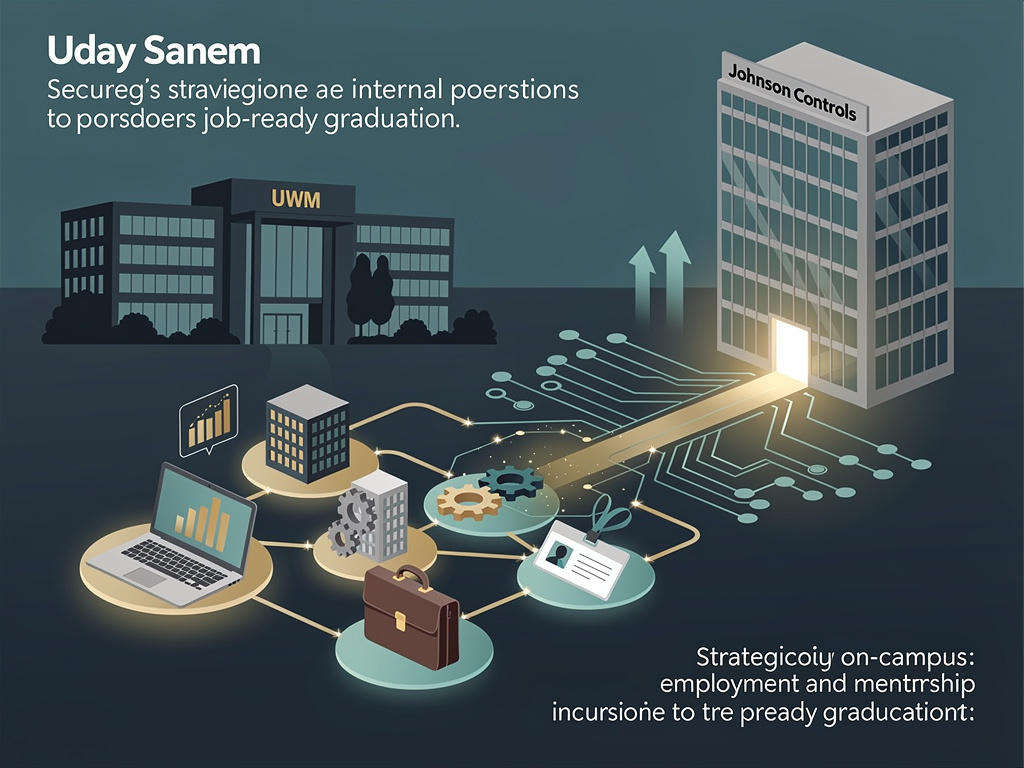
The traditional narrative of graduate education emphasizes academic rigor and theoretical knowledge, yet a growing body of evidence suggests that practical, on-campus work experience may be equally critical to launching successful careers. At the University of Wisconsin-Milwaukee, master’s student Uday Sanem secured a coveted position at Johnson Controls before completing his IT management degree—a achievement he attributes not to coursework alone, but to strategic on-campus employment and mentorship relationships cultivated during his graduate studies.
According to UWM News, Sanem’s journey illustrates a paradigm shift in how universities prepare students for competitive technology sectors. His position within University Housing provided more than supplemental income; it became an incubator for developing technical competencies, professional networks, and leadership capabilities that directly translated to corporate readiness. The experience demonstrates how institutions can leverage internal operations as training grounds that rival traditional internship programs.
The significance of Sanem’s story extends beyond individual success. As technology companies face persistent talent shortages and universities grapple with employment outcome metrics, the integration of meaningful work experiences into graduate education represents a scalable solution. Johnson Controls’ decision to hire Sanem before graduation signals employer recognition that hands-on campus roles can produce job-ready candidates who require minimal onboarding—a consideration increasingly important in fast-moving technology sectors where time-to-productivity directly impacts competitive positioning.
The Evolution of Campus Employment Beyond Work-Study
Campus employment has historically been viewed primarily through a financial aid lens, providing students with income to offset educational costs. However, contemporary approaches recognize these positions as strategic career development opportunities. Sanem’s experience at UWM Housing transcended traditional student worker roles, involving responsibilities that mirrored corporate IT environments including system management, user support, and project coordination.
The structured nature of his campus position allowed Sanem to develop technical skills in a lower-stakes environment where mistakes become learning opportunities rather than career-limiting events. This graduated responsibility model—beginning with foundational tasks and progressing to complex problem-solving—mirrors corporate training programs but occurs organically within the campus ecosystem. The University Housing department effectively functioned as a live laboratory where Sanem could test theoretical knowledge from coursework against real-world operational challenges.
Mentorship as the Multiplier of Campus Work Experience
While the technical experience proved valuable, UWM News emphasizes that mentorship relationships formed during campus employment served as the critical differentiator in Sanem’s career preparation. Unlike traditional academic advising, workplace mentorship provided industry-contextualized guidance, helping him understand how technical skills translate to business value—a connection often missing in purely academic settings.
These mentorship relationships extended beyond technical instruction to encompass professional development dimensions including communication strategies, stakeholder management, and organizational navigation. Campus supervisors familiar with both academic requirements and professional expectations could tailor guidance to bridge these domains effectively. This dual perspective enabled Sanem to develop a professional identity that resonated with corporate recruiters while still completing academic obligations.
The Johnson Controls Connection: What Employers Value in Campus-Trained Talent
Johnson Controls’ decision to extend an offer before Sanem’s graduation reflects broader shifts in corporate recruiting strategies. Technology companies increasingly recognize that traditional indicators—GPA, coursework, and even internships—provide incomplete pictures of candidate readiness. Sanem’s campus employment history offered tangible evidence of sustained performance, reliability, and progressive skill development over an extended period.
The campus work experience addressed a persistent employer concern: the gap between academic knowledge and operational capability. By demonstrating his ability to manage real systems with actual users depending on uptime and performance, Sanem provided proof of concept that academic credentials alone cannot deliver. This track record reduced perceived hiring risk from Johnson Controls’ perspective, making the pre-graduation offer a rational business decision rather than a speculative investment in potential.
Replicating Success: Institutional Strategies for Maximizing Campus Employment Value
UWM’s approach to campus employment suggests a deliberate strategy rather than fortuitous circumstance. The university appears to have structured student positions within operational departments to provide genuine responsibility rather than peripheral tasks. This requires institutional commitment to treating student employees as developmental investments rather than merely temporary labor solutions.
The model demands that campus departments balance operational needs with educational objectives—a tension requiring careful management. Supervisors must possess both technical expertise and mentorship capabilities, willing to invest time in student development even when training costs exceed short-term productivity gains. This long-term orientation aligns with university missions but requires departmental leaders to resist pressures for immediate operational efficiency in favor of student outcome optimization.
The IT Management Curriculum Connection
Sanem’s success also highlights the synergy between UWM’s IT management curriculum and practical application opportunities. Graduate programs in technology management face the challenge of remaining current in rapidly evolving fields while maintaining academic rigor. Campus employment provides a feedback mechanism, allowing students to immediately test classroom concepts against operational realities and bring real-world challenges back into academic discussions.
This bidirectional flow enriches both domains. Sanem could leverage campus work challenges as case studies for academic projects, while applying newly learned frameworks to workplace problems. Faculty benefit from this integration as well, gaining insights into current industry practices through students’ workplace experiences, helping maintain curriculum relevance without requiring constant formal industry partnerships.
Competitive Advantages in Graduate Recruitment
For universities competing to attract top graduate students, the ability to offer meaningful employment opportunities represents a significant differentiator. Prospective students evaluating programs increasingly consider total value propositions including financial support, career preparation, and employment outcomes. Programs that can credibly promise career-relevant work experience alongside academic credentials hold distinct advantages in recruitment.
UWM’s model suggests that institutions need not rely solely on external partnerships to provide career preparation. By strategically deploying student talent within campus operations, universities can create controlled environments where students develop professional capabilities while contributing to institutional missions. This approach proves particularly valuable for students like Sanem who may lack extensive professional networks or prior industry experience, providing equitable access to career-launching opportunities.
Measuring Return on Investment for Campus Work Programs
The outcomes Sanem achieved raise questions about how universities should evaluate campus employment programs. Traditional metrics focus on operational efficiency and cost containment, but Sanem’s story suggests that student development outcomes may represent the more significant return on investment. When campus positions lead to competitive job placements, they enhance institutional reputation, improve employment statistics, and strengthen alumni networks—benefits that compound over time.
Quantifying these benefits requires longitudinal tracking of student employees’ career trajectories compared to peers without similar experiences. UWM’s willingness to publicize Sanem’s success suggests institutional recognition of campus employment’s strategic value, but systematic assessment would strengthen the case for expanding such programs. Universities might consider developing frameworks that balance operational contributions against developmental outcomes, creating hybrid evaluation models appropriate for positions serving dual purposes.
Implications for the Broader Higher Education Sector
Sanem’s pathway from campus employment to corporate success offers a template potentially applicable across institutions and disciplines. The fundamental elements—meaningful work responsibilities, mentorship relationships, and curriculum integration—translate beyond IT management to other fields where practical experience enhances academic preparation. Professional programs in business, engineering, and healthcare could adapt similar models to their operational contexts.
However, successful replication requires more than structural changes. It demands cultural shifts in how universities conceptualize student employment, moving from transactional labor relationships to developmental partnerships. This transformation affects hiring practices, supervision approaches, and performance evaluation systems. Institutions must train campus supervisors in mentorship techniques and create incentive structures that reward student development alongside operational achievements.
The Future of Integrated Career Preparation
As higher education faces increasing pressure to demonstrate value and justify costs, integrated models combining academic study with practical experience offer compelling responses to skeptics. Sanem’s story provides concrete evidence that universities can prepare career-ready graduates without sacrificing academic standards or requiring extensive external partnerships. The campus itself becomes the laboratory, the classroom, and the launching pad.
For students, this model offers clarity and purpose often missing in traditional graduate education. Rather than viewing coursework and employment as competing demands, integrated approaches position them as complementary dimensions of professional development. The result, as Sanem’s experience demonstrates, can be graduates who enter the workforce not as novices requiring extensive training, but as contributors ready to add value from day one—an outcome that serves students, employers, and institutions equally well in an increasingly competitive global economy.


 WebProNews is an iEntry Publication