
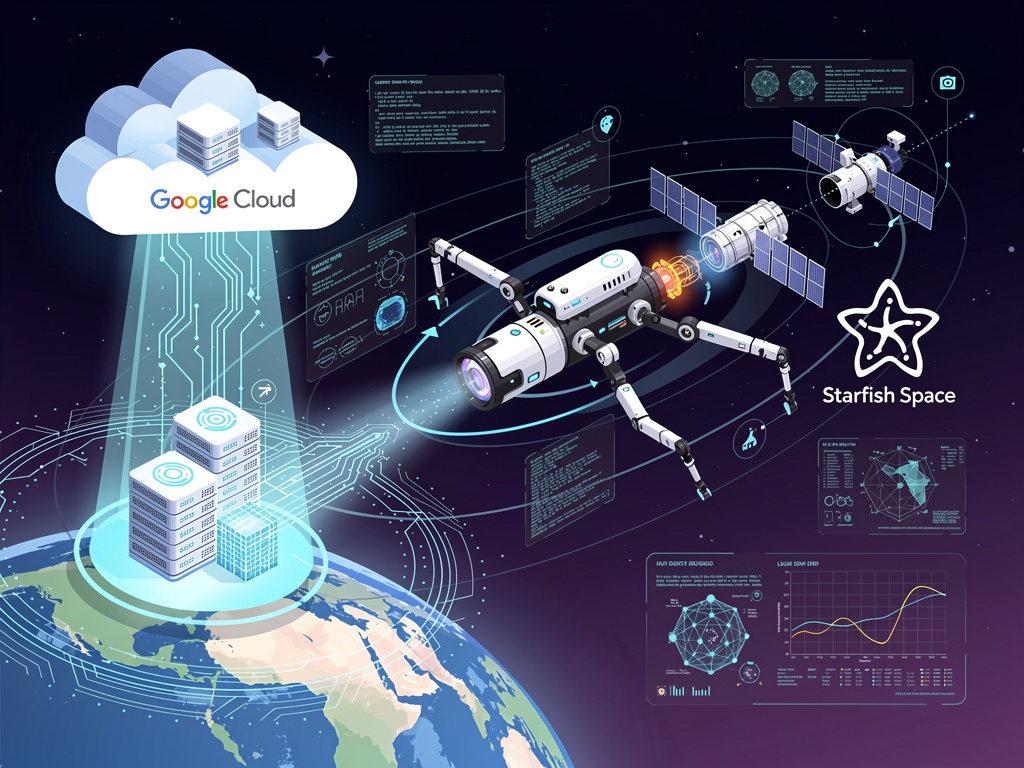
In the rapidly expanding domain of in-orbit satellite servicing, a small but ambitious company based in Kent, Washington, is making outsized bets on cloud computing to solve one of the space industry’s most vexing problems: what happens when a satellite in orbit breaks down, runs out of fuel, or drifts out of position. Starfish Space, a startup founded in 2019, is leveraging Google Cloud’s infrastructure to develop autonomous spacecraft capable of rendezvousing with, docking to, and servicing other satellites already in orbit — a capability that could reshape the economics of the entire space sector.
The concept of on-orbit servicing is not new. NASA demonstrated rudimentary satellite repair during the Space Shuttle era, most famously with the Hubble Space Telescope servicing missions. But those were crewed operations costing billions of dollars. What Starfish Space envisions is something fundamentally different: small, autonomous robotic spacecraft that can extend the life of commercial and government satellites at a fraction of the cost. The challenge, however, lies in the extraordinary computational demands of guidance, navigation, and control algorithms required to safely approach and dock with an uncooperative or semi-cooperative object hurtling through space at thousands of miles per hour.
From Garage Startup to Google Cloud Partner: Starfish Space’s Rapid Ascent
Starfish Space’s journey from a small startup to a company tackling one of the most technically demanding problems in spaceflight has been marked by strategic technology partnerships. According to a detailed account published by Google Cloud’s public sector blog, the company chose Google Cloud as its primary computing platform to accelerate the development and testing of its satellite servicing technology. The partnership is not merely about hosting data; it is about fundamentally enabling the kind of high-fidelity simulation and machine learning workloads that would be impossible for a startup to run on its own hardware.
At the heart of Starfish Space’s technology is its Otter spacecraft, a satellite servicing vehicle designed to perform proximity operations — the delicate art of maneuvering close to another satellite, matching its orbit and attitude, and then physically docking with it. The Otter is equipped with a proprietary capture mechanism and relies on sophisticated autonomous guidance algorithms to perform these maneuvers without human intervention. The computational burden of developing and validating these algorithms is immense, requiring thousands of simulated rendezvous scenarios under varying orbital conditions, lighting environments, and target satellite configurations.
Why Cloud Computing Is Mission-Critical for Autonomous Spacecraft
The Google Cloud blog details how Starfish Space uses the platform’s computing resources to run large-scale Monte Carlo simulations — a statistical technique that involves running thousands or even millions of randomized scenarios to test the robustness of a system. In the context of satellite servicing, this means simulating countless approach trajectories, sensor noise profiles, thruster failure modes, and target tumble rates to ensure that the Otter spacecraft can safely complete its mission under virtually any conceivable circumstance. Running these simulations on-premises would require a startup to invest millions of dollars in high-performance computing hardware — capital that is far better spent on spacecraft development and launch costs.
Google Cloud’s infrastructure also supports Starfish Space’s machine learning pipelines. The company uses computer vision and AI-driven pose estimation to allow the Otter spacecraft to identify and track a target satellite using onboard cameras. Training these models requires vast datasets of synthetic and real imagery, processed through GPU-accelerated computing instances that Google Cloud provides on demand. This elasticity — the ability to spin up hundreds of virtual machines for a simulation campaign and then shut them down when the work is done — is particularly valuable for a company operating with the lean budgets typical of venture-backed space startups.
The Economics of Satellite Life Extension and Orbital Debris Mitigation
The business case for satellite servicing is compelling. A single geostationary communications satellite can cost $300 million or more to build and launch. When such a satellite runs low on fuel — the most common end-of-life scenario — its operator faces a stark choice: let a perfectly functional spacecraft become orbital debris, or invest in a servicing mission that could extend its operational life by five, ten, or even fifteen years. The economics overwhelmingly favor servicing, provided the technology is reliable and the cost is a fraction of building and launching a replacement. Starfish Space is positioning itself to offer exactly this kind of service, initially targeting satellites in low Earth orbit and eventually expanding to geostationary and other orbital regimes.
The implications extend beyond commercial economics. The growing problem of orbital debris — defunct satellites, spent rocket stages, and fragments from collisions — poses an existential threat to the long-term sustainability of space operations. Every satellite that can be refueled, repositioned, or safely deorbited at end of life is one fewer piece of debris threatening the orbital environment. Government agencies including the U.S. Space Force and NASA have identified on-orbit servicing, assembly, and manufacturing (OSAM) as a strategic priority, and companies like Starfish Space are at the forefront of translating that priority into operational capability.
Starfish Space’s Otter: A Closer Look at the Technology
The Otter spacecraft represents a new class of satellite servicing vehicle. Unlike larger, more expensive servicing platforms being developed by companies such as Northrop Grumman (whose Mission Extension Vehicle has already demonstrated life extension for geostationary satellites), the Otter is designed to be smaller, more affordable, and more versatile. Its modular architecture allows it to be adapted for different mission profiles — from simple docking and inspection to more complex tasks like refueling and component replacement. The spacecraft’s autonomous navigation system is its most critical subsystem, and it is here that the Google Cloud partnership pays its greatest dividends.
As described in the Google Cloud blog, Starfish Space’s engineers use cloud-based simulation environments to test the Otter’s guidance, navigation, and control (GNC) software against a wide range of scenarios before any code is uploaded to flight hardware. This approach — sometimes called “digital twin” testing — allows the company to identify and fix software bugs, optimize fuel consumption, and validate safety margins without the cost and risk of physical testing in orbit. The result is a development cycle that is both faster and more rigorous than traditional aerospace engineering workflows.
The Role of Public-Private Partnerships in Advancing Space Technology
Starfish Space’s use of Google Cloud is emblematic of a broader trend in the space industry: the increasing reliance on commercial cloud platforms to accelerate spacecraft development. Amazon Web Services has its own Aerospace and Satellite division, and Microsoft Azure has partnered with multiple space companies through its Azure Orbital program. The competition among cloud providers to serve the space sector reflects the enormous growth potential of the industry, which Morgan Stanley has projected could generate over $1 trillion in annual revenue by 2040.
For Google Cloud, the partnership with Starfish Space serves as a showcase for its public sector and defense capabilities. The company has been aggressively pursuing government contracts and partnerships with defense-adjacent startups, positioning its cloud platform as a secure, scalable foundation for mission-critical applications. Starfish Space’s work aligns neatly with this strategy: satellite servicing is a dual-use technology with clear applications for both commercial operators and military space programs that need to maintain and protect their orbital assets.
What Lies Ahead for Starfish Space and the On-Orbit Servicing Market
Starfish Space has already demonstrated key elements of its technology in orbit. The company launched its first mission, a proximity operations demonstration, to validate its autonomous navigation algorithms in the actual space environment. These early missions are critical stepping stones toward full commercial service, providing the flight heritage data that potential customers — satellite operators, government agencies, and insurers — demand before committing to a servicing contract.
The competitive field in on-orbit servicing is growing. In addition to Northrop Grumman’s Mission Extension Vehicle program, companies like Astroscale (focused on debris removal), Orbit Fab (developing in-space refueling depots), and several others are pursuing different segments of the servicing market. Starfish Space’s differentiation lies in its combination of small, affordable spacecraft and advanced autonomous navigation — capabilities that are directly enabled by its cloud computing infrastructure. As the company scales its operations and takes on more complex missions, its reliance on Google Cloud’s elastic computing resources will only deepen.
The story of Starfish Space is, in many ways, the story of the modern space industry itself: a small team with ambitious goals, leveraging the best available commercial technology to solve problems that were once the exclusive domain of national space agencies. By partnering with Google Cloud, Starfish Space has effectively turned one of the world’s largest computing platforms into an extension of its engineering team — a force multiplier that allows a startup to punch far above its weight in one of the most demanding technical fields on or off the planet.


 WebProNews is an iEntry Publication