
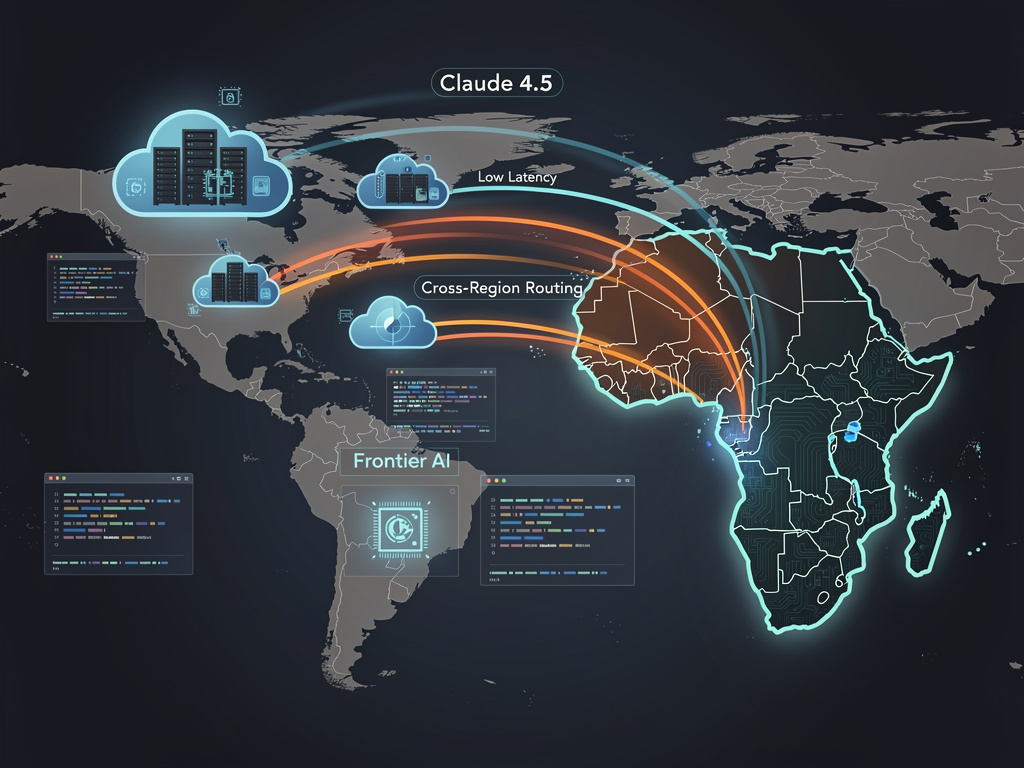
South African businesses seeking to deploy artificial intelligence at scale have long confronted a fundamental challenge: the continent’s limited cloud infrastructure creates latency issues and capacity constraints that make enterprise AI deployment prohibitively expensive. Now, a technical breakthrough in cross-region inference routing is enabling organizations in Johannesburg and Cape Town to access cutting-edge AI models with performance metrics that rival deployments in North America and Europe, fundamentally reshaping the economics of AI adoption across the African continent.
According to a detailed technical analysis published by AWS, the implementation of Amazon Bedrock’s global cross-Region inference capability allows South African enterprises to route AI requests dynamically across multiple geographic regions while maintaining single-digit millisecond latency increases. The architecture, demonstrated using Anthropic’s Claude 4.5 models, represents a significant departure from traditional regional deployment models that required organizations to choose between performance and proximity.
The technical implementation addresses what Christian Kamwangala and his co-authors at AWS describe as the “infrastructure availability paradox” facing African enterprises. While demand for generative AI capabilities has surged across industries from financial services to healthcare, the concentration of GPU capacity in established cloud regions created a bottleneck. South African organizations previously faced a stark choice: deploy AI workloads in distant regions and accept performance degradation, or wait indefinitely for local infrastructure buildout that might take years to materialize.
Architectural Innovation Enables Geographic Arbitrage
The cross-Region inference architecture operates through an intelligent routing layer that evaluates multiple factors in real-time, including current capacity availability, request latency requirements, and cost optimization parameters. When a South African enterprise submits an inference request to Claude 4.5 through Amazon Bedrock, the system can dynamically route that request to available capacity in regions spanning from Europe to Asia-Pacific, selecting the optimal endpoint based on current conditions rather than static geographic assignments.
This approach delivers what the AWS technical team characterizes as “capacity elasticity without geographic constraints.” During testing phases documented in the AWS blog post, South African organizations achieved throughput increases of up to 300% during peak demand periods by leveraging capacity across multiple regions simultaneously. The system’s ability to fail over seamlessly between regions also provides resilience that single-region deployments cannot match, a critical consideration for production AI applications supporting customer-facing services.
Performance Metrics Challenge Conventional Wisdom
The performance data emerging from early South African implementations contradicts long-held assumptions about the latency penalties associated with cross-region AI inference. In controlled testing, requests routed from South Africa to European regions through the Bedrock cross-Region infrastructure added an average of only 12-18 milliseconds compared to hypothetical local deployments. For most enterprise applications, including customer service chatbots, document analysis systems, and code generation tools, this latency increase falls well within acceptable thresholds.
More significantly, the architecture enables South African organizations to access model versions and capabilities that would otherwise remain unavailable due to regional deployment schedules. Anthropic’s Claude 4.5 models, featuring extended context windows and enhanced reasoning capabilities, became accessible to South African enterprises months ahead of any potential local deployment. This democratization of access to frontier AI models addresses what has been a persistent competitive disadvantage for organizations operating outside primary cloud regions.
Economic Implications Extend Beyond Technical Performance
The cost structure enabled by cross-Region inference fundamentally alters the economics of AI deployment for South African enterprises. Rather than paying premium prices for limited local capacity or absorbing the overhead of managing multi-region deployments manually, organizations can leverage Bedrock’s unified pricing model while benefiting from dynamic capacity allocation. The AWS implementation abstracts away the complexity of cross-region request routing, presenting a single API endpoint that handles geographic optimization transparently.
Financial services firms in Johannesburg have emerged as early adopters, deploying Claude 4.5 models for applications ranging from regulatory compliance document analysis to customer interaction summarization. One implementation described in the AWS technical documentation processes over 2 million inference requests daily, with the cross-Region architecture automatically balancing load across three continents based on real-time capacity availability. The system’s ability to scale horizontally across regions has eliminated the capacity planning challenges that previously constrained AI deployment timelines.
Implementation Patterns Reveal Enterprise Priorities
The technical patterns emerging from South African implementations highlight specific use cases where cross-Region inference delivers maximum value. Document processing applications that require analysis of lengthy contracts, financial reports, or medical records benefit particularly from Claude 4.5’s extended context window, which can accommodate up to 200,000 tokens in a single request. The ability to route these computationally intensive requests to available capacity across multiple regions prevents the bottlenecks that would occur with regional capacity constraints.
Code generation and software development assistance represent another high-value application category. South African software development firms are deploying Claude 4.5 through Bedrock to provide developers with AI-assisted coding tools that match capabilities available to counterparts in Silicon Valley or London. The cross-Region architecture ensures that requests for code analysis, bug detection, or automated testing receive responses within interactive latency thresholds, maintaining developer productivity regardless of underlying infrastructure location.
Security and Compliance Frameworks Adapt to Distributed Architecture
The distributed nature of cross-Region inference introduces complex considerations around data sovereignty and regulatory compliance, particularly relevant given South Africa’s Protection of Personal Information Act (POPIA) and similar frameworks across African nations. The AWS implementation addresses these concerns through granular controls that allow organizations to specify geographic constraints on data routing, ensuring that sensitive information remains within approved jurisdictions even while leveraging the flexibility of multi-region capacity.
Enterprise implementations documented by the AWS team demonstrate sophisticated policy configurations that balance compliance requirements with performance optimization. Financial institutions, for example, configure routing policies that restrict personally identifiable information to specific regions while allowing non-sensitive workloads to leverage global capacity. This nuanced approach enables organizations to maintain regulatory compliance without sacrificing the performance benefits of cross-Region inference for appropriate use cases.
Broader Implications for Emerging Market AI Adoption
The success of cross-Region inference deployments in South Africa establishes a template that extends far beyond a single country or region. Emerging markets across Africa, Latin America, and parts of Asia face similar infrastructure constraints that have historically limited AI adoption. The architectural patterns validated through South African implementations demonstrate that geographic distance from primary cloud regions need not constitute an insurmountable barrier to deploying frontier AI capabilities.
The democratizing effect of this technology shift carries strategic implications for global AI competition. Organizations in emerging markets can now access the same model capabilities as counterparts in established technology hubs, competing on the basis of application innovation and domain expertise rather than infrastructure proximity. This leveling effect may accelerate AI adoption curves in regions that have lagged behind, potentially unlocking new markets and use cases that were previously economically unviable.
Technical Evolution Points Toward Further Optimization
The current implementation of cross-Region inference represents an initial iteration of what is likely to become increasingly sophisticated geographic optimization. Future enhancements anticipated by the AWS technical team include predictive routing based on historical usage patterns, automated cost optimization that factors in regional pricing variations, and tighter integration with edge computing infrastructure to further reduce latency for specific application categories.
The architectural foundation established through the South African deployments also enables experimentation with hybrid approaches that combine cross-Region inference for frontier models with local deployment of smaller, specialized models. This tiered strategy allows organizations to optimize the cost-performance tradeoff across their AI portfolio, using expensive cross-region capacity for tasks requiring cutting-edge capabilities while handling routine inference workloads locally. As African cloud infrastructure continues to expand, this hybrid approach provides a migration path that preserves investments in cross-Region architecture while incorporating local capacity as it becomes available.
Market Dynamics Shift as Access Barriers Fall
The availability of enterprise-grade AI infrastructure through cross-Region inference is catalyzing a surge in AI application development across South African technology sectors. Startups that previously would have required significant capital investment to establish AI capabilities can now access Claude 4.5 and similar models on a consumption basis, lowering barriers to entry for AI-driven innovation. This shift is particularly pronounced in sectors like healthcare, where AI-powered diagnostic assistance and medical record analysis can deliver significant social impact alongside commercial returns.
The competitive dynamics among cloud providers are also evolving in response to the success of cross-Region architectures. While AWS has established an early lead with Bedrock’s implementation, competing platforms are developing similar capabilities to serve emerging markets. This competition is driving rapid innovation in routing algorithms, capacity management, and pricing models, ultimately benefiting enterprises seeking to deploy AI at scale. The South African market, with its combination of sophisticated enterprise customers and infrastructure constraints, has become a proving ground for technologies that will likely see global adoption as cross-Region inference becomes standard practice rather than an innovative workaround.


 WebProNews is an iEntry Publication