
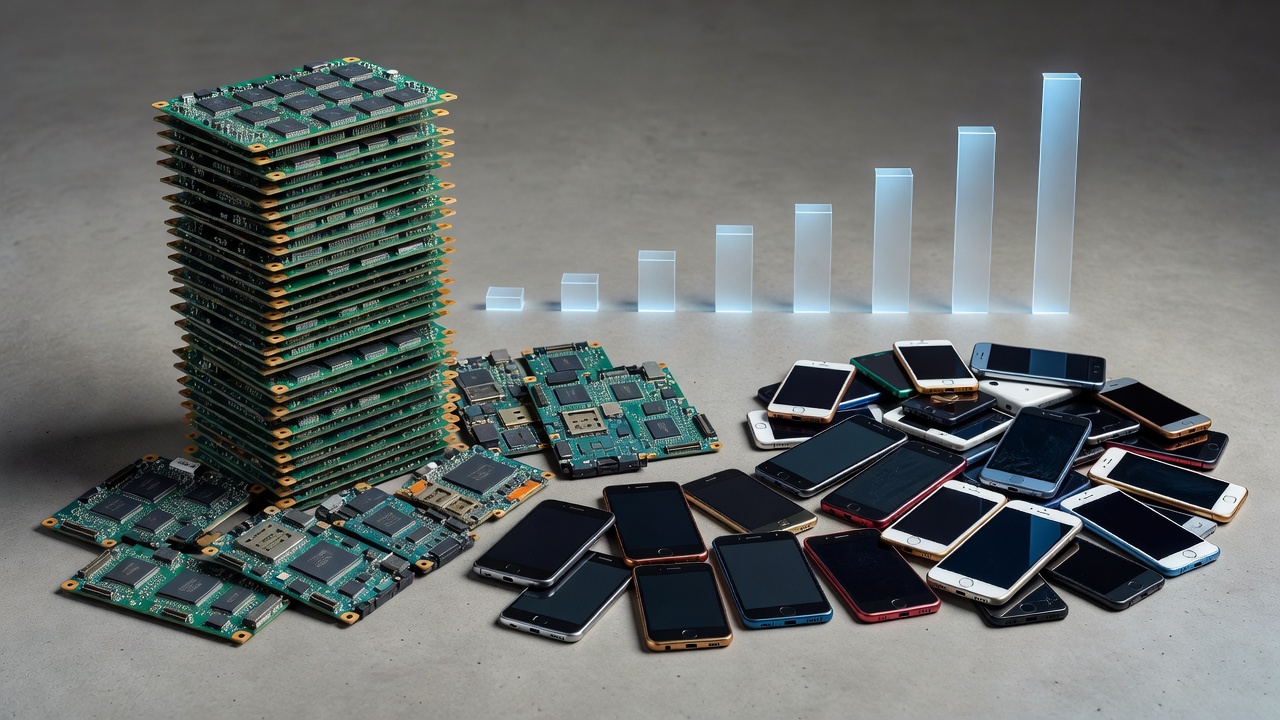
Memory prices have climbed so fast that budget handsets once taken for granted now look commercially risky. In the first quarter of 2026 memory alone ate nearly 60 percent of the bill of materials for smartphones priced below $400. That share keeps growing. Manufacturers find themselves squeezed between suppliers charging premiums for every chip and buyers unwilling to absorb higher sticker prices.
The Register first highlighted the squeeze in a report published today that draws on data from analyst house Omdia. Omdia estimates that sub-$400 smartphone shipments will fall 22 percent this year. The broader global market contracts 12 percent. Yet devices above $400 hold steady or even expand. The split reveals how memory scarcity now dictates product strategy more than consumer demand.
But why the sudden spike? AI data centers. Hyperscalers and training clusters consume vast quantities of high-bandwidth memory and conventional DRAM alike. Suppliers such as Samsung, SK Hynix and Micron have redirected production capacity toward those higher-margin contracts. Consumer-grade low-power DRAM for phones receives less wafer starts. The result is a classic supply-demand imbalance that shows no sign of easing soon.
Counterpoint Research revised its 2026 smartphone shipment forecast downward by 2.6 percentage points to a 2.1 percent contraction. Low-end models below $200 suffered the worst. Their bill of materials jumped 20 to 30 percent since the start of the year. Midrange devices saw 15 percent increases. Flagships absorbed about 10 percent. Further memory price rises of up to 40 percent through the second quarter could push those figures another 8 to 15 percent higher. “What we are seeing now is the low end of the market (below $200) being impacted most severely, with BoM costs increasing by 20%-30% since the beginning of the year,” said Research Director MS Hwang of Counterpoint.
TrendForce offered an even starker early warning. In November 2025 the firm cut its smartphone production outlook from modest growth to a 2 percent decline for 2026. It warned that DRAM contract prices had already surged more than 75 percent year-over-year in late 2025. Memory’s typical 10 to 15 percent share of total component costs suddenly drove overall unit expenses up 8 to 10 percent. Additional 5 to 7 percent BOM inflation loomed for 2026. Smaller brands struggled to secure allocation. Larger players with scale and vertical integration gained ground.
Recent data shows the pace of increases moderating but not reversing. Tom’s Hardware covered TrendForce’s July 2026 survey that projects conventional DRAM contract prices to rise another 13 to 18 percent in the third quarter. NAND Flash follows with 10 to 15 percent gains. Those figures mark a slowdown from the 60 percent jumps seen in the prior quarter. Consumer resistance finally bites. “Memory prices will keep climbing through the third quarter of 2026, but the blistering increases of the past few quarters are set to cool as consumer buyers reach the ceiling of what they can afford,” the publication reported. AI demand for servers remains solid. Long-term supply agreements cap some server DRAM escalation. Phones and notebooks receive no such protection.
Manufacturers respond with cost engineering that borders on desperation. They downgrade displays from LTPO to older LTPS panels, saving three to five dollars per unit but sacrificing smoothness. Camera counts drop. Image sensors shrink. Older system-on-chips return to the lineup. Some models lose premium audio components or periscope zoom modules. “In some models, we are seeing downgrades of components like camera modules and periscope solutions, displays, audio components and, of course, memory configurations,” noted Senior Analyst Shenghao Bai at Counterpoint. “Other tactics include reusing old components, streamlining the portfolio, and pushing consumers to higher-specification ‘Pro’ variants.”
These moves carry risks. A phone that feels cheaper inside risks damaging brand perception. Yet the alternative, absorbing the memory cost, erases already thin margins on entry-level devices. Many Chinese vendors including HONOR, OPPO and vivo face the largest downward shipment revisions. Transsion, strong in Africa, could see volumes drop 32 percent. Xiaomi may fall 28 percent. Samsung trims only 4 percent. Apple stays flat thanks to its premium focus and tight supply chain control. “Apple and Samsung are best positioned to weather the next few quarters,” said Senior Analyst Yang Wang at Counterpoint. “But it will be tough for others that don’t have as much wiggle room to manage market share versus profit margins.”
Consumers already vote with their wallets. Average smartphone lifetime stretched to 4.2 years and analysts expect it to reach 4.7 years by decade’s end. The used-phone market grows 12 percent this year as buyers hunt premium features without paying new-device premiums. Second-hand inventory suddenly looks attractive when a new budget model costs nearly as much as last year’s midranger.
Memory makers post record profits. Samsung’s earnings jumped nineteenfold in the latest reported quarter, fueled largely by memory sales. The same dynamic plays out across the industry. Yet that windfall comes at the expense of volume markets that once drove unit growth. Industry watchers warn of possible consolidation. Smaller brands unable to secure chips or pass on costs may exit or merge.
Relief remains distant. TrendForce sees AI server demand supporting memory prices into 2027. New wafer fabs take years to ramp. Even when they do, much of the output targets high-bandwidth memory for accelerators rather than mobile DRAM. Software efficiency gains could help. Lighter apps and smarter memory management might reduce the need for eight or twelve gigabytes in basic phones. Few developers optimize under that pressure today.
The market therefore polarizes. Premium phones add AI features, larger batteries and brighter screens while holding price. Budget buyers either stretch to midrange tiers, buy used, or keep older devices longer. What once felt like a democratizing force in technology now splits along economic lines. The cheap smartphone that brought billions online faces an existential threat from the very memory technology that powers the AI boom.
And the numbers keep moving. Counterpoint now forecasts average selling prices to climb 6.9 percent this year, nearly double its earlier projection. That figure masks even steeper jumps at the low end where many simply walk away. “In the lower price bands, steep price increases on smartphones are not sustainable,” Yang Wang added. “And if cost pass-through isn’t possible, OEMs will start pruning parts of their portfolios.”
So manufacturers prune. They shift production mix toward profitable segments. They negotiate harder with memory suppliers while quietly raising prices where they can. The outcome is a smartphone industry that sells fewer units overall but extracts more revenue per sale. Whether that trade-off sustains innovation at the bottom of the pyramid remains an open question. For now the data points to a clear contraction in access to affordable new devices. The memory crunch shows no quick exit.


 WebProNews is an iEntry Publication