
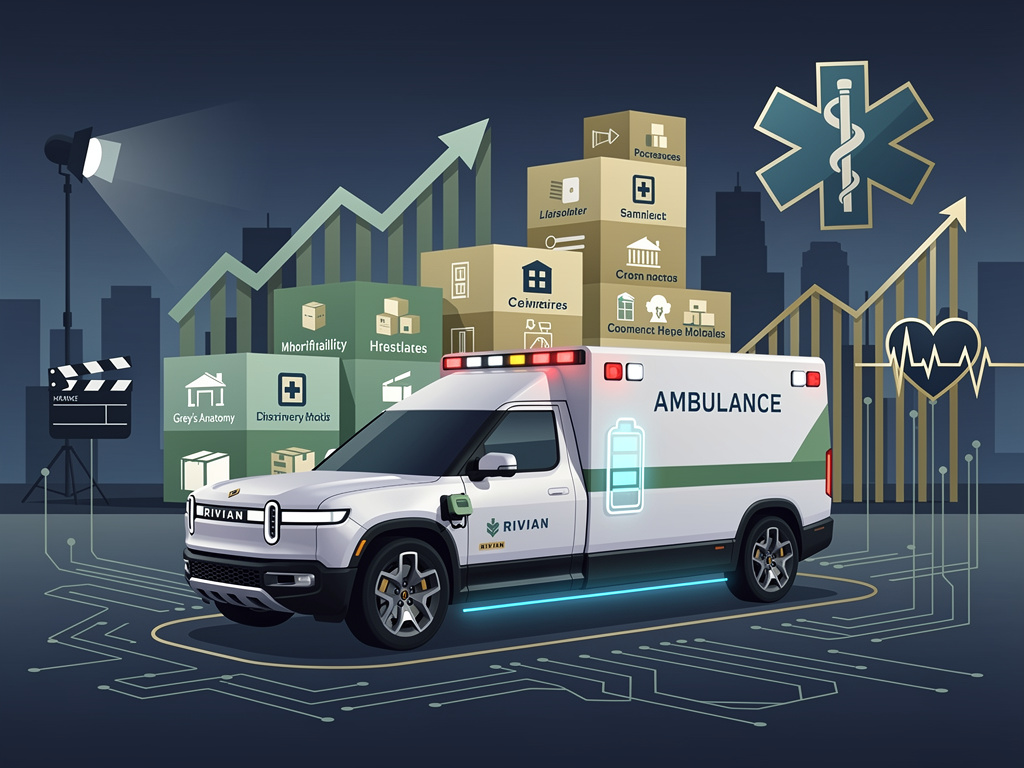
When Rivian Automotive unveiled its custom-built electric ambulance for ABC’s medical drama Grey’s Anatomy, the California-based electric vehicle manufacturer signaled something far more significant than a Hollywood prop collaboration. The vehicle, which debuted in the show’s 21st season, represents a strategic pivot toward commercial and specialty vehicle markets that could redefine both Rivian’s business trajectory and the future of emergency medical services across America.
According to Engadget, the ambulance is based on Rivian’s Commercial Van platform, the same foundation used for the company’s fleet of delivery vehicles currently operating for Amazon. The custom build features medical equipment integration, emergency lighting systems, and the kind of rapid response capabilities that emergency medical services demand. While the immediate application serves as product placement for one of television’s longest-running medical dramas, industry analysts suggest the implications extend far beyond entertainment.
The timing of this reveal is particularly noteworthy. Rivian has faced mounting pressure from investors to diversify its revenue streams beyond consumer vehicles, which have proven challenging to produce profitably. The company reported losses of $1.45 billion in its most recent quarter, despite delivering 10,018 vehicles during that period. Commercial applications, particularly in specialized sectors like emergency services, municipal fleets, and utility companies, offer higher margins and more predictable order volumes than the volatile consumer market.
The Economics of Electric Emergency Vehicles
The financial calculus for electric ambulances differs dramatically from traditional diesel-powered emergency vehicles. Fleet operators in the emergency medical services sector typically spend between $150,000 and $250,000 per ambulance, with fuel and maintenance costs adding another $15,000 to $25,000 annually over a vehicle’s typical ten-year service life. Electric powertrains promise to slash those operating costs by approximately 60 percent, according to industry research from the National Renewable Energy Laboratory.
Maintenance savings prove particularly compelling for ambulance operators. Traditional diesel ambulances require frequent oil changes, transmission servicing, and exhaust system maintenance. Electric vehicles eliminate most of these requirements, with brake systems lasting significantly longer due to regenerative braking technology. For large metropolitan emergency medical services operating fleets of 50 or more ambulances, these savings could total millions of dollars annually.
Technical Challenges and Infrastructure Requirements
Despite the economic advantages, transitioning emergency medical services to electric vehicles presents substantial technical challenges. Ambulances must maintain readiness for immediate deployment, typically idling their engines to power medical equipment and climate control systems. This constant power draw requires battery systems substantially larger than those in standard delivery vehicles. Rivian’s Commercial Van platform offers a battery capacity of up to 135 kWh, but ambulance applications may require even greater capacity to ensure vehicles can complete multiple emergency calls without recharging.
Charging infrastructure represents another critical hurdle. Emergency medical services stations would need to install high-capacity charging systems capable of rapidly replenishing vehicle batteries between calls. Level 3 DC fast charging systems, which can cost between $50,000 and $150,000 per unit, would be essential for maintaining operational readiness. Many emergency medical services facilities, particularly in rural areas, lack the electrical infrastructure to support such systems without significant utility upgrades.
Market Positioning and Competitive Dynamics
Rivian’s entry into the emergency vehicle market places it in direct competition with established manufacturers like REV Group and Demers Ambulances, which have dominated the sector for decades. However, these traditional manufacturers have been slow to electrify their offerings, creating an opportunity for electric vehicle specialists to capture market share. Ford has made preliminary moves in this direction with its E-Transit platform, but has not yet developed purpose-built emergency medical vehicles.
The Grey’s Anatomy partnership provides Rivian with invaluable marketing exposure to a demographic that extends beyond typical automotive audiences. The show averages approximately 3.5 million viewers per episode, many of whom work in healthcare or related fields. This visibility could accelerate conversations between Rivian and emergency medical services directors who might not otherwise consider electric vehicles for their fleets.
Regulatory Tailwinds and Government Incentives
Federal and state policies increasingly favor electric vehicle adoption in government and quasi-government fleets. The Infrastructure Investment and Jobs Act allocated $7.5 billion for electric vehicle charging infrastructure, with specific provisions supporting emergency services and first responder vehicle electrification. The Inflation Reduction Act extended commercial electric vehicle tax credits, potentially reducing the upfront cost premium of electric ambulances by $40,000 or more per vehicle.
California, Rivian’s home state, has been particularly aggressive in promoting electric vehicle adoption for commercial and government fleets. The California Air Resources Board’s Advanced Clean Fleets regulation requires that 50 percent of new vehicle purchases by government fleets be zero-emission by 2024, increasing to 100 percent by 2027. Similar regulations are under consideration in New York, Washington, and Massachusetts, creating a substantial addressable market for electric emergency vehicles.
Real-World Performance Considerations
Emergency medical services directors remain cautiously optimistic about electric ambulances, citing concerns about real-world performance in extreme conditions. Ambulances operate 24 hours daily across all weather conditions, from desert heat to arctic cold. Battery performance degrades in temperature extremes, potentially compromising vehicle range and reliability when they’re needed most. Rivian’s battery thermal management systems, developed for its consumer trucks, will need to prove themselves in the demanding emergency services environment.
Range anxiety takes on heightened significance in emergency applications. While most ambulance calls occur within a 20-mile radius of the station, vehicles must be capable of extended operations during mass casualty incidents or natural disasters. The ability to rapidly refuel diesel ambulances at any gas station provides operational flexibility that electric vehicles cannot yet match without extensive charging infrastructure development.
Industry Response and Future Development
The broader emergency medical services industry has begun exploring electric vehicle adoption, with several pilot programs underway across North America. The Falck ambulance service in Denmark has operated electric ambulances since 2020, reporting positive results despite initial skepticism. Their experience suggests that with proper charging infrastructure and fleet management protocols, electric ambulances can meet the operational demands of emergency medical services.
Rivian’s demonstration vehicle for Grey’s Anatomy may serve as a proof of concept that accelerates broader industry adoption. If the company can successfully transition the vehicle from television prop to production model, it would mark a significant milestone in commercial electric vehicle development. The specialized medical equipment integration, emergency lighting systems, and ruggedized construction required for ambulance service represent engineering challenges that would demonstrate Rivian’s technical capabilities beyond consumer vehicle production.
Strategic Implications for Rivian’s Business Model
The commercial vehicle sector represents Rivian’s most promising path to profitability. The Amazon delivery van contract, which calls for 100,000 vehicles by 2030, provides stable production volumes that help the company achieve economies of scale. Expanding into adjacent commercial markets like emergency services, utility trucks, and municipal vehicles could further stabilize revenue while leveraging existing manufacturing capabilities and component supply chains.
Wall Street analysts have noted that Rivian’s stock performance correlates more closely with commercial vehicle announcements than consumer product launches. The company’s market capitalization, while down substantially from its post-IPO peak, still reflects investor optimism about its commercial vehicle potential. Successfully penetrating the emergency vehicle market would validate Rivian’s commercial strategy and potentially open doors to other specialized vehicle segments.
The Road Ahead for Electric Emergency Vehicles
Rivian’s Grey’s Anatomy ambulance, while initially conceived as entertainment industry collaboration, may ultimately be remembered as the catalyst that transformed emergency medical transportation. The convergence of improving battery technology, supportive government policies, and compelling operating economics creates conditions favorable for electric ambulance adoption. However, significant obstacles remain, particularly regarding charging infrastructure and real-world operational validation.
The next 18 to 24 months will prove critical for determining whether Rivian can translate its television prop into a viable commercial product. Emergency medical services directors will be watching closely, evaluating whether electric vehicles can meet their operational requirements while delivering promised cost savings. For Rivian, success in this market could provide a blueprint for expansion into other specialized commercial vehicle segments, potentially reshaping the company’s future and accelerating the broader transition to electric transportation across industries that have been slow to embrace electrification.


 WebProNews is an iEntry Publication