
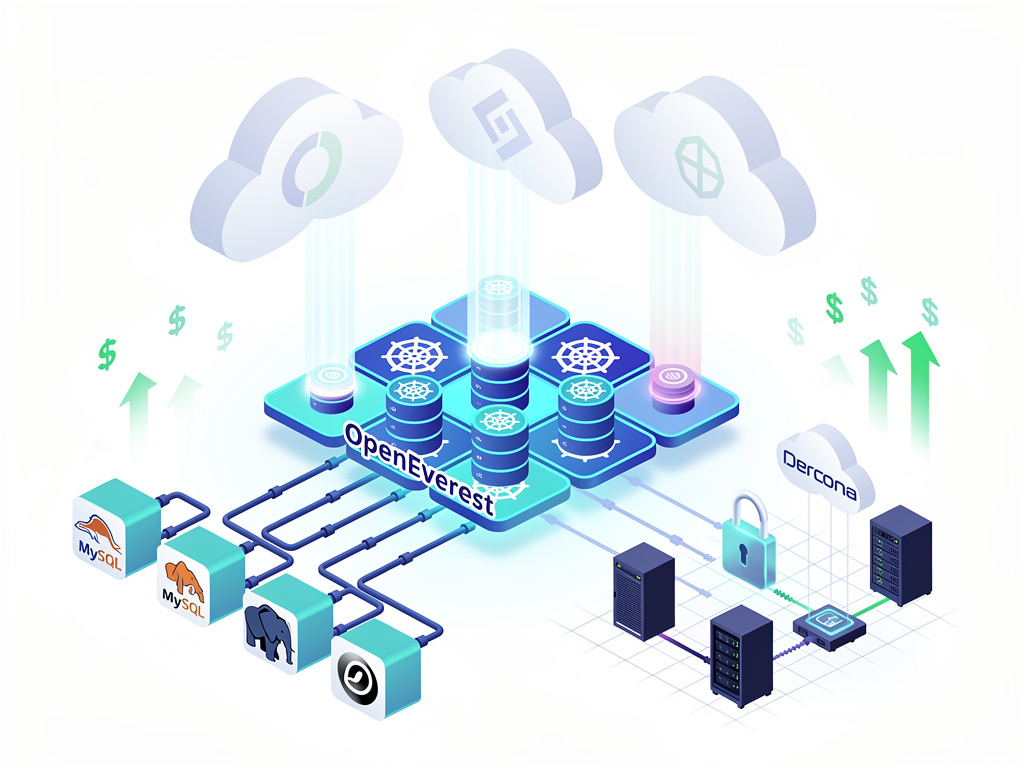
The enterprise database management industry stands at an inflection point. As organizations increasingly migrate workloads to Kubernetes environments, the traditional approaches to database operations—dominated by proprietary cloud provider solutions—are facing their most serious challenge yet. Percona, a company with deep roots in open-source database technology, has launched OpenEverest, a platform designed to fundamentally alter how businesses deploy and manage databases in cloud-native infrastructures.
According to WebProNews, OpenEverest represents a direct challenge to the database-as-a-service offerings from Amazon Web Services, Google Cloud, and Microsoft Azure. The platform provides Kubernetes-native database automation that allows enterprises to maintain control over their data infrastructure while benefiting from cloud-native operational patterns. This approach addresses a growing concern among enterprise technology leaders: vendor lock-in and the escalating costs associated with proprietary database services.
The timing of Percona’s move is particularly strategic. Kubernetes adoption has accelerated dramatically across enterprise environments, with organizations seeking standardized approaches to application deployment and management. Yet database operations have remained a stubborn exception, often requiring specialized tools and processes that sit outside the Kubernetes paradigm. OpenEverest aims to bridge this gap by bringing database management fully into the Kubernetes operational model, using custom resource definitions and operators to automate previously manual tasks.
The Architecture of Database Independence
OpenEverest’s architecture reflects a fundamental philosophical departure from cloud provider database services. Rather than offering a single database engine wrapped in proprietary management tools, the platform supports multiple database technologies including MySQL, PostgreSQL, and MongoDB. This multi-engine approach allows organizations to standardize their operational tooling while maintaining flexibility in their database technology choices—a combination that has proven elusive in the current market.
The platform leverages Kubernetes operators, specialized software components that encode operational knowledge about specific applications. These operators handle routine database administration tasks such as provisioning, backup, recovery, and scaling. By codifying these operations as Kubernetes-native resources, OpenEverest enables database management to follow the same declarative patterns that development teams already use for application deployment. This convergence of operational models represents a significant reduction in complexity for organizations managing diverse technology stacks.
What distinguishes OpenEverest from previous attempts at Kubernetes-native database management is its emphasis on production-grade capabilities. The platform includes sophisticated backup and recovery mechanisms, point-in-time recovery options, and automated failover procedures. These features address longstanding concerns about running stateful workloads like databases in Kubernetes environments, where the platform’s original design emphasized stateless applications that could be easily replaced.
Economic Pressures Driving Open-Source Adoption
The economic case for OpenEverest becomes compelling when examining the total cost of ownership for database services. Cloud provider database offerings typically charge based on instance size, storage consumption, and data transfer—costs that can escalate rapidly as data volumes grow. Additionally, these services often include premium charges for features like automated backups, read replicas, and cross-region replication. For large enterprises with substantial database footprints, these costs can reach millions of dollars annually.
OpenEverest’s open-source model presents an alternative economic structure. Organizations can deploy the platform on their existing Kubernetes infrastructure, whether that infrastructure runs in public clouds, private data centers, or hybrid configurations. This flexibility allows companies to optimize their infrastructure costs independently of their database management tooling. The platform’s support for multiple cloud providers and on-premises deployments also provides leverage in negotiations with infrastructure vendors.
However, the economic equation extends beyond simple cost comparison. The total cost of ownership must account for operational expertise, support requirements, and the risks associated with managing critical infrastructure. Percona addresses these factors through commercial support offerings that provide enterprise customers with guaranteed response times, security patches, and expert consultation. This hybrid model—open-source software with optional commercial support—has proven successful in other infrastructure categories and appears well-suited to the database management sector.
Technical Differentiation in a Crowded Market
The database management market has no shortage of solutions, making technical differentiation essential for new entrants. OpenEverest distinguishes itself through several architectural decisions that reflect lessons learned from earlier Kubernetes database projects. The platform’s use of custom resource definitions allows database configurations to be version-controlled alongside application code, enabling infrastructure-as-code practices that many organizations consider essential for reliable operations.
The platform’s approach to high availability demonstrates sophisticated understanding of distributed systems challenges. OpenEverest implements automated failover mechanisms that detect database instance failures and promote standby replicas without manual intervention. These mechanisms use Kubernetes-native health checking and service discovery, ensuring that applications automatically reconnect to available database instances. This level of automation reduces the mean time to recovery for database failures, a critical metric for organizations with strict uptime requirements.
Security considerations receive substantial attention in OpenEverest’s design. The platform supports encryption at rest and in transit, role-based access control, and integration with enterprise authentication systems. These security features address compliance requirements in regulated industries where data protection mandates often dictate technology choices. By embedding security capabilities directly into the platform rather than treating them as optional add-ons, Percona signals an understanding of enterprise priorities that extends beyond pure technical functionality.
The Competitive Response from Cloud Giants
The major cloud providers have invested heavily in their database service portfolios, viewing databases as strategic offerings that drive customer retention and incremental revenue. Amazon Web Services alone offers more than a dozen different database services, each optimized for specific use cases and workload patterns. Google Cloud and Microsoft Azure have similarly expanded their database offerings, creating comprehensive ecosystems designed to keep workloads within their respective platforms.
These cloud giants possess significant advantages in this competition. Their database services integrate seamlessly with other platform services, providing simplified networking, security, and monitoring. They can leverage their massive scale to optimize performance and reduce costs in ways that smaller competitors struggle to match. Additionally, their services abstract away much of the operational complexity that traditionally required specialized database administration expertise.
Yet these advantages come with corresponding limitations that OpenEverest exploits. Cloud provider database services create dependencies that make it difficult and expensive to migrate workloads between providers or back to on-premises infrastructure. They typically require organizations to accept the provider’s operational model, limiting customization options that some enterprises require. And their pricing models can create unexpected cost escalations as workloads scale, particularly for data-intensive applications that generate substantial network traffic.
Enterprise Adoption Patterns and Challenges
Early enterprise adoption of platforms like OpenEverest typically follows a predictable pattern. Organizations begin with non-critical workloads, testing the platform’s capabilities and operational characteristics before expanding to production systems. This cautious approach reflects the high stakes associated with database infrastructure, where failures can result in data loss, service disruptions, and significant business impact.
The success of OpenEverest will likely depend on its ability to build a robust ecosystem around the core platform. This ecosystem must include comprehensive documentation, training resources, and a community of practitioners who can share operational knowledge. Percona’s existing reputation in the open-source database community provides a foundation for ecosystem development, but sustaining community engagement requires ongoing investment and careful stewardship.
Integration with existing enterprise tooling represents another critical adoption factor. Organizations have invested substantially in monitoring systems, backup solutions, and operational workflows that must accommodate any new database platform. OpenEverest’s Kubernetes-native design facilitates integration with the growing ecosystem of Kubernetes management tools, but enterprises often require connectors for legacy systems that predate cloud-native architectures. The platform’s ability to bridge these different operational worlds will significantly influence its adoption trajectory.
The Broader Implications for Database Technology
OpenEverest’s emergence reflects broader trends reshaping enterprise technology. The shift toward open-source infrastructure components continues to accelerate, driven by organizations seeking to avoid vendor lock-in and maintain control over critical systems. Kubernetes has established itself as the de facto standard for container orchestration, creating opportunities for tools that extend its capabilities to new domains. And the economic pressures facing many organizations have intensified scrutiny of cloud spending, creating demand for alternatives to premium cloud services.
The platform also represents an evolution in how database technology is delivered and consumed. Traditional database vendors sold licenses for software that customers installed and managed themselves. Cloud providers transformed this model by offering databases as managed services, abstracting away operational complexity but creating new dependencies. OpenEverest proposes a third model that combines operational automation with organizational control, potentially defining a new category in the database market.
For the database industry’s established players, OpenEverest serves as a reminder that innovation rarely respects incumbent positions. The cloud giants’ database services have achieved remarkable success, but they have also created opportunities for competitors who can address unmet needs or underserved segments. Whether OpenEverest ultimately succeeds in its challenge to these giants will depend on execution, ecosystem development, and the evolving priorities of enterprise technology buyers. What seems certain is that the competition will benefit customers by expanding their options and potentially moderating the cost escalation that has characterized database services in recent years.


 WebProNews is an iEntry Publication