
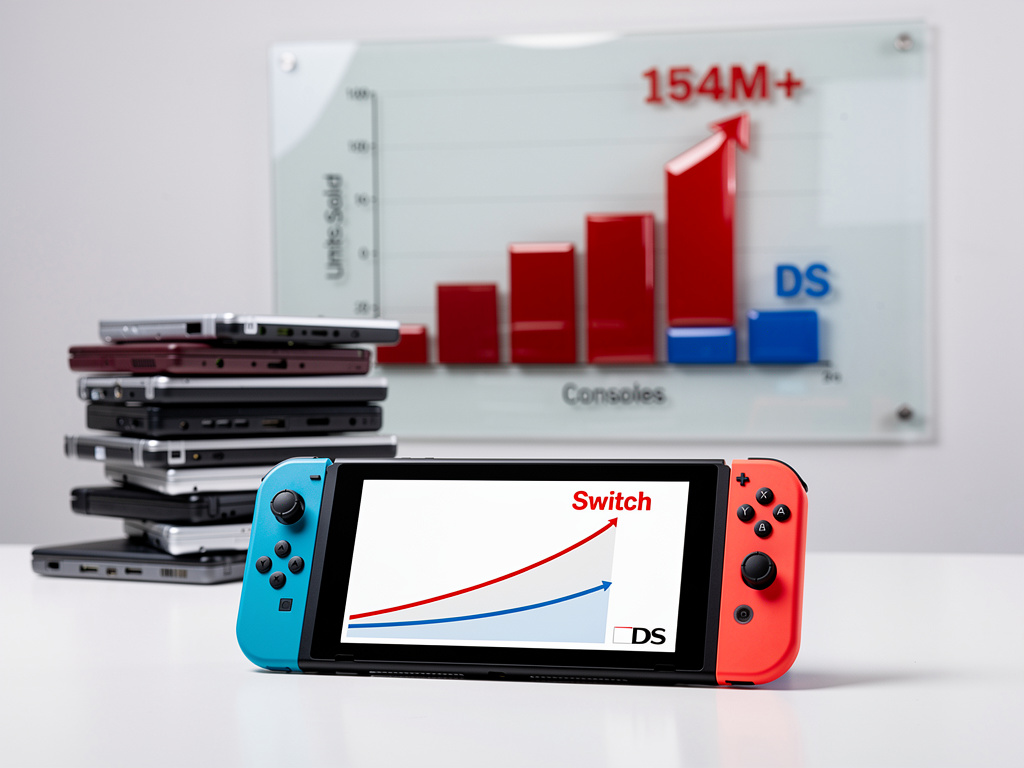
In a remarkable achievement that caps nearly eight years of market dominance, Nintendo’s Switch has officially surpassed the company’s previous record-holder to become its best-selling gaming console of all time. According to CNBC, the hybrid console has now sold more units than any other Nintendo platform in the company’s storied 135-year history, eclipsing the Nintendo DS handheld system that previously held the crown with 154.02 million units sold worldwide.
The milestone represents more than just impressive sales figures—it validates Nintendo’s strategic pivot toward hybrid gaming at a time when competitors Microsoft and Sony were locked in a conventional arms race over processing power and graphical fidelity. By focusing on versatility and innovative gameplay rather than raw technical specifications, Nintendo carved out a unique position in the gaming market that has proven remarkably resilient even as the console enters its eighth year on the market.
The Hybrid Strategy That Defied Conventional Wisdom
When Nintendo unveiled the Switch in October 2016 and launched it in March 2017, industry analysts were skeptical. The company was coming off the Wii U, which sold only 13.56 million units over its lifetime and was widely considered a commercial failure. The gaming industry had seemingly settled into a pattern: home consoles like the PlayStation and Xbox competed on power, while mobile gaming on smartphones captured the casual market. Nintendo’s bet on a device that could seamlessly transition between handheld and docked play seemed risky at best.
Yet the Switch’s hybrid nature addressed a fundamental shift in how people wanted to consume entertainment. As The Verge reported in their analysis of Nintendo’s strategy, the console arrived at a moment when consumers increasingly valued flexibility and portability without sacrificing the premium gaming experience. The ability to play full-featured games like “The Legend of Zelda: Breath of the Wild” both on a television and during a commute represented a genuine innovation in user experience rather than mere technical iteration.
First-Party Titles Drive Unprecedented Attach Rates
Nintendo’s success with the Switch has been inextricably linked to its software library, particularly its first-party titles. The company has released multiple games that have sold over 20 million copies each, including “Mario Kart 8 Deluxe” with over 60 million units sold, “Animal Crossing: New Horizons” with over 45 million units, and “Super Smash Bros. Ultimate” with over 32 million units, according to Nintendo’s financial reports. These aren’t just strong numbers—they represent attach rates that far exceed industry norms, with many Switch owners purchasing multiple first-party titles.
The COVID-19 pandemic provided an unexpected tailwind for Switch sales, particularly for “Animal Crossing: New Horizons,” which launched in March 2020 just as lockdowns began worldwide. Bloomberg documented how the game became a cultural phenomenon, offering players a peaceful virtual escape during an anxious time. The Switch became nearly impossible to find in retail stores throughout much of 2020, with units selling for significant premiums on secondary markets.
The Economics of Longevity in a Fast-Cycle Industry
Perhaps most remarkable about the Switch’s achievement is the timeline over which it has occurred. Traditional console lifecycles typically span five to seven years before replacement, yet the Switch has maintained strong sales momentum well into its eighth year without a true successor. Nintendo released the Switch OLED model in 2021, offering an improved screen and other refinements while maintaining full compatibility with the existing library, a strategy that extended the platform’s appeal without fragmenting its user base.
This longevity has significant economic implications. As The Wall Street Journal noted in their analysis of Nintendo’s financial performance, the company has been able to amortize its development costs over a much longer period than competitors, while continuing to generate high-margin software sales on an established hardware base. The result has been consistently strong profitability even as the console ages and hardware prices decline.
Regional Variations in Market Penetration
The Switch’s global success masks interesting regional variations in adoption patterns. In Japan, the Switch has dominated the market to an extraordinary degree, regularly accounting for the majority of weekly hardware and software sales. GamesIndustry.biz reported that the Switch became Japan’s best-selling console ever in 2021, surpassing even the Nintendo DS in its home market. The console’s portability particularly resonates in Japan, where long commutes on public transportation make handheld gaming especially appealing.
In North America and Europe, the Switch has competed more directly with PlayStation and Xbox but has carved out a distinct demographic niche. The console has proven particularly popular with families and as a secondary device for gamers who own one of the more powerful competing consoles. Nintendo’s focus on local and couch co-op gameplay, increasingly rare in an industry focused on online multiplayer, has given the Switch unique value in households with multiple players.
Third-Party Support Evolution
One persistent challenge throughout the Switch’s lifecycle has been third-party support, particularly for major multiplatform releases. The console’s mobile-focused hardware, based on NVIDIA’s Tegra processor, lacks the raw power of the PlayStation 5 or Xbox Series X, making it difficult to port the most graphically demanding games. Yet Nintendo has cultivated a robust ecosystem of third-party titles optimized for the platform’s capabilities.
Independent developers, in particular, have embraced the Switch. Games like “Hades,” “Hollow Knight,” and “Stardew Valley” have found enormous success on the platform, with developers reporting that Switch versions often outsell releases on other platforms. Polygon documented this phenomenon, noting that the Switch’s portability makes it ideal for the types of games that players want to experience in short sessions. The platform has become a preferred destination for indie titles, creating a virtuous cycle that strengthens the overall software library.
Manufacturing Challenges and Supply Chain Resilience
Nintendo’s ability to maintain Switch production through global supply chain disruptions deserves particular attention. The semiconductor shortage that plagued the gaming industry from 2020 through 2023 severely constrained PlayStation 5 and Xbox Series X availability, yet Switch production remained relatively stable. Reuters attributed this to Nintendo’s use of older, more readily available chip technology and strong relationships with suppliers, particularly in Asia.
This supply chain advantage proved crucial in maintaining momentum during a critical period. While competitors struggled to meet demand for their new consoles, Nintendo could reliably stock retail shelves with Switch units, capturing sales that might otherwise have gone to next-generation platforms. The company’s conservative approach to hardware specifications, often criticized by tech enthusiasts, became a strategic asset when component scarcity struck the industry.
Looking Toward the Future
As the Switch claims the title of Nintendo’s best-selling console, questions naturally turn to what comes next. Nintendo has confirmed that a successor platform is in development, though the company has released few details. IGN has compiled reports suggesting the next system will maintain backward compatibility with Switch games, a crucial consideration given the platform’s massive installed base and software library.
The challenge Nintendo faces is formidable: how to innovate beyond the Switch without abandoning the hybrid concept that has proven so successful. The company has a history of radical reinvention between console generations—the Wii’s motion controls bore little resemblance to the GameCube, just as the Switch departed dramatically from the Wii U. Yet the Switch’s success suggests that the core hybrid concept has room for evolution rather than revolution. Enhanced performance, improved online infrastructure, and refined ergonomics could extend the platform’s appeal without requiring a complete conceptual reset.
The Switch’s ascension to the top of Nintendo’s sales charts also reflects broader industry trends. The traditional console generation cycle, with its rigid five-to-seven-year replacement pattern, appears to be giving way to more flexible approaches. Microsoft has embraced a model where Xbox exists across multiple devices and price points, while Sony has introduced mid-generation upgrades like the PlayStation 5 Pro. Nintendo’s success in extending the Switch’s lifecycle suggests that consumers value consistency and compatibility alongside cutting-edge technology.
Market Implications and Competitive Dynamics
The Switch’s record-breaking sales have implications beyond Nintendo’s balance sheet. The console has demonstrated that a focused, differentiated strategy can succeed even against competitors with vastly larger resources. Microsoft and Sony both dwarf Nintendo in corporate size and R&D budgets, yet neither has matched the Switch’s sales velocity. This success validates the “blue ocean strategy” of creating uncontested market space rather than competing head-to-head on established terms.
For the broader gaming industry, the Switch’s achievement reinforces the importance of exclusive content and distinctive value propositions. In an era when many third-party games are available across multiple platforms, the decision of which console to purchase often comes down to exclusive titles and unique features. Nintendo’s deep bench of beloved franchises—Mario, Zelda, Pokémon, Animal Crossing, and others—provides a competitive moat that pure hardware specifications cannot overcome. The company’s willingness to let technical capabilities lag behind competitors while focusing on gameplay innovation and franchise strength has proven to be a winning formula.
As the gaming industry continues to evolve, with cloud gaming, subscription services, and cross-platform play reshaping traditional business models, the Switch stands as evidence that hardware still matters when it enables genuinely new experiences. The console’s success suggests that the future of gaming may be less about raw power and more about flexibility, accessibility, and the timeless appeal of well-crafted interactive entertainment. Nintendo’s achievement with the Switch—surpassing even the cultural phenomenon of the DS—cements the company’s position as a unique force in the gaming industry, one that succeeds by following its own path rather than chasing competitors.


 WebProNews is an iEntry Publication