
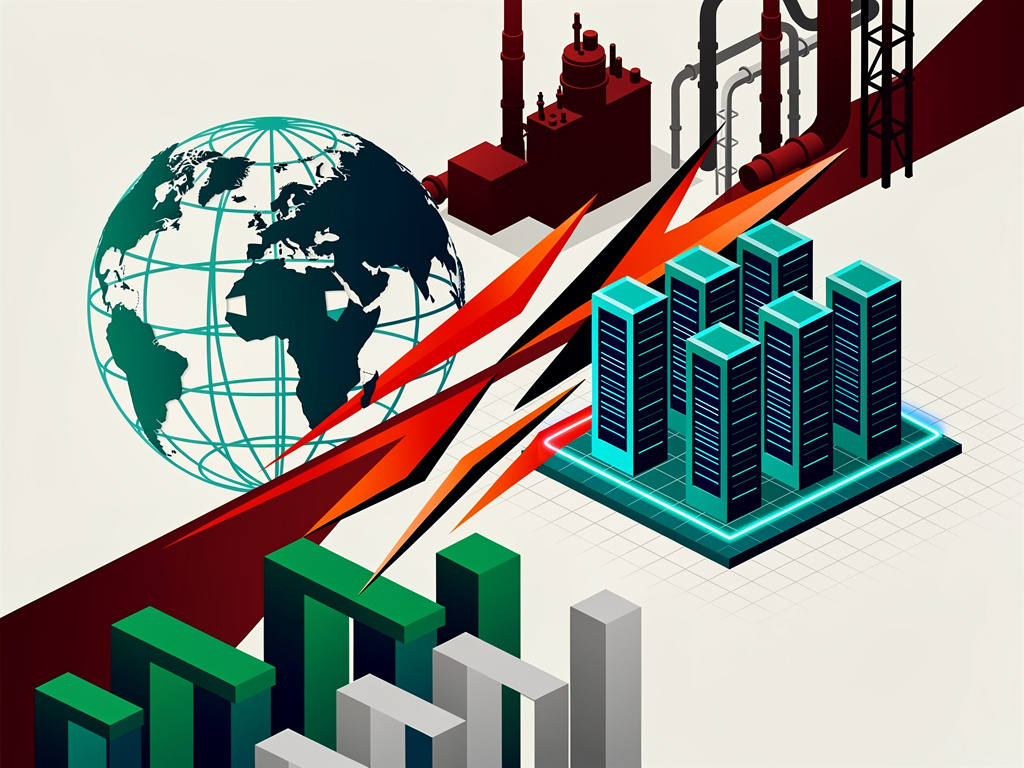
Global energy markets remain on edge as geopolitical friction in the Middle East, particularly involving Iran, threatens to disrupt international oil and gas supply chains. The Strait of Hormuz, a critical maritime chokepoint bordered by Iran, facilitates the daily transit of approximately 20 percent of the world’s global oil consumption and a significant portion of liquefied natural gas (LNG). Any military escalation or blockade in this region immediately sends shockwaves through energy commodities, driving up the cost of fossil fuels worldwide. Analysts at the World Bank recently warned that a severe conflict could push oil prices above $150 a barrel, a scenario that would cascade through every sector of the global economy.
While the immediate concern of an energy crisis usually centers on transportation and manufacturing, a new, massive consumer of electricity is highly vulnerable to these price shocks: the technology sector’s rapidly expanding infrastructure for artificial intelligence. Over the past two years, the race to build generative AI models has triggered an unprecedented construction boom of massive computing facilities. These facilities require continuous, heavy amounts of power to keep servers running and cooling systems operational. Unlike traditional office buildings or standard warehouses, these specialized structures draw immense wattage per square foot, operating twenty-four hours a day without interruption. This relentless power draw links the ambitions of Silicon Valley directly to the physical realities of global resource extraction.
The Staggering Energy Demands of Artificial Intelligence
The International Energy Agency (IEA) reports that global electricity demand from computing facilities, artificial intelligence, and the cryptocurrency sector could double by 2026. In 2022, these facilities consumed roughly 460 terawatt-hours (TWh) of electricity. By 2026, that figure is projected to reach up to 1,050 TWh, which is roughly equivalent to the entire electricity consumption of Japan. A single query to OpenAI’s ChatGPT requires nearly ten times the electricity of a standard Google search, according to researchers at the Electric Power Research Institute.
To support this growth, companies like Microsoft, Google, Amazon, and Meta are investing tens of billions of dollars into physical infrastructure. However, the physical reality of electricity generation means these companies are directly tethered to the broader energy market. Even as tech giants invest heavily in wind and solar projects, the intermittent nature of renewable energy requires a stable baseload power supply to ensure servers never go offline. In the United States, that baseload is overwhelmingly provided by natural gas.
Natural Gas and the Tech Industry’s Hidden Vulnerability
Natural gas generates roughly 43 percent of all utility-scale electricity in the United States, according to the US Energy Information Administration (EIA). When global energy markets panic over potential Middle Eastern conflicts, US domestic natural gas prices often experience corresponding volatility due to the interconnected nature of global LNG exports. If European or Asian markets lose access to Middle Eastern energy supplies, they will increase their purchases of American LNG, driving up domestic prices and, consequently, the cost of electricity.
This creates a direct financial link between foreign policy crises and the operational costs of American tech companies. Cloud computing providers operate on tight margins regarding infrastructure costs. A sustained spike in natural gas prices would significantly increase the operational expenditure of running massive server farms. While large tech firms often secure long-term power purchase agreements to hedge against short-term price fluctuations, a prolonged conflict that fundamentally alters the global energy supply would eventually force utility providers to pass higher generation costs onto their largest commercial consumers.
Financial Pressures on Cloud Computing and AI Training
The financial implications of an energy price spike are staggering when considering the scale of modern AI training. Training a large language model like GPT-4 takes months of continuous processing across tens of thousands of specialized graphics processing units (GPUs). Research firm SemiAnalysis estimates that operating a cluster of 100,000 advanced GPUs consumes approximately 150 megawatts of power. If electricity rates jump by just a few cents per kilowatt-hour due to natural gas shortages, the cost of training a single model could increase by millions of dollars.
These increased costs would inevitably trickle down to consumers and enterprise clients. Cloud computing platforms like Amazon Web Services (AWS), Google Cloud, and Microsoft Azure would face pressure to adjust their pricing structures, potentially ending the era of cheap, accessible cloud storage and processing. Startups and academic researchers who rely on renting computing power could find themselves quickly priced out of the market, potentially slowing the overall pace of computational development. The vulnerability of these facilities to fossil fuel prices exposes a critical weakness in the current trajectory of the technology sector, proving that software advancements are entirely bound by hardware and energy limitations.
The Pivot to Nuclear Energy
Recognizing the long-term risks associated with fossil fuel dependence and grid instability, major technology firms are aggressively pursuing nuclear energy. Nuclear power provides the steady, carbon-free baseload electricity required for round-the-clock server operations, isolating the facilities from the unpredictable swings of global oil and gas markets. In late 2024, Microsoft signed a 20-year power purchase agreement with Constellation Energy to restart Unit 1 at the Three Mile Island nuclear plant in Pennsylvania, specifically to power its AI ambitions.
Amazon has made similar moves, acquiring a massive server facility adjacent to the Susquehanna Steam Electric Station in Pennsylvania from Talen Energy for $650 million. Google recently announced agreements to purchase power from multiple small modular reactors (SMRs) developed by Kairos Power, aiming to bring them online by the end of the decade. These investments highlight a strategic shift; tech leaders understand that relying on a grid vulnerable to international oil and gas disputes is an unsustainable business model for their energy-intensive future.
Local Grid Strain and Community Backlash
While the transition to nuclear power offers a potential solution, these projects will take years, if not decades, to come online. In the interim, the tech industry remains reliant on the existing, natural gas-heavy grid. This reliance is causing significant strain in concentrated infrastructure hubs. Northern Virginia, often referred to as Data Center Alley, processes an estimated 70 percent of the world’s internet traffic. The local utility, Dominion Energy, has had to rapidly revise its long-term load forecasts, warning that the region’s power demand will double over the next 15 years.
If a conflict involving Iran drives up natural gas prices, the residents living near these tech hubs could face a double financial burden. Not only would they experience the general inflation associated with higher energy costs, but they might also see their local utility bills surge as power companies burn more expensive fuel to keep the neighboring server farms operational. Consumer advocacy groups are increasingly voicing concerns that residential ratepayers are indirectly subsidizing the massive energy requirements of trillion-dollar technology corporations.
Facing an Uncertain Energy Future
The intersection of Middle Eastern geopolitics and Silicon Valley’s artificial intelligence boom represents a novel structural risk in the global economy. Previously, the primary concern regarding a conflict with Iran was the impact on gasoline prices and traditional manufacturing. Today, the threat extends directly into the digital infrastructure that underpins modern communication, finance, and technological innovation. Analysts at Goldman Sachs project that computing facilities will account for 8 percent of total US power demand by 2030, up from 3 percent in 2022.
As energy demands continue to climb, the tech industry faces a precarious few years. Until next-generation nuclear reactors and massive grid storage solutions become commercially viable and operational, the servers powering the AI expansion remain tethered to the traditional fossil fuel economy. Any disruption in the Strait of Hormuz or escalation in regional Middle Eastern conflicts will serve as a stark reminder that the digital world is entirely dependent on the physical realities of global energy production. The internet may exist in the cloud, but the cloud is anchored to the ground, running on generators that are highly sensitive to the drums of war.


 WebProNews is an iEntry Publication