
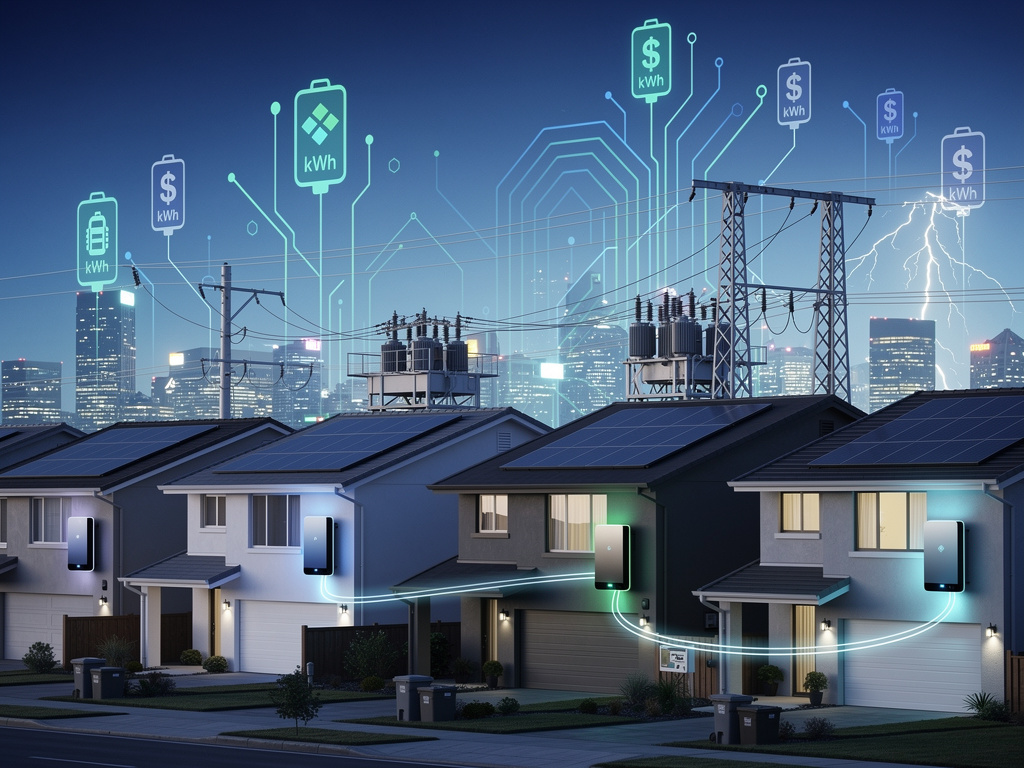
Silicon Valley’s latest clean energy gambit isn’t about solar panels or wind turbines—it’s about transforming millions of American garages into miniature power plants. Lunar Energy, a Mountain View-based startup founded by former Tesla and Google executives, has secured $232 million in Series B funding to deploy residential battery systems that double as grid stabilization assets, marking one of the largest investments in distributed energy resources this year.
The funding round, led by Energize Ventures with participation from Valor Equity Partners, Andreessen Horowitz, and existing investors, values the three-year-old company at approximately $1 billion, according to TechCrunch. The capital infusion comes as utilities nationwide grapple with aging infrastructure, extreme weather events, and the intermittent nature of renewable energy sources—challenges that distributed battery networks promise to address without the decade-long timelines and billion-dollar price tags of traditional power plant construction.
Unlike conventional home battery systems that simply store excess solar energy for nighttime use, Lunar’s technology integrates sophisticated software that allows utilities to tap into aggregated residential batteries during peak demand periods. This virtual power plant model transforms homeowners into active participants in grid management, earning them credits on their electricity bills while helping prevent blackouts and reducing reliance on fossil fuel peaker plants that utilities fire up during times of maximum stress.
The Economics of Distributed Energy Storage
The business model represents a fundamental shift in how America generates and distributes electricity. Traditional utilities operate on a centralized model: large power plants transmit electricity across vast networks to millions of customers. This architecture, largely unchanged since Thomas Edison’s era, struggles with the variability of wind and solar power and requires massive reserve capacity to meet peak demand that occurs only a few dozen hours per year.
Lunar’s approach flips this equation. By installing 25-kilowatt-hour battery systems in homes—roughly double the capacity of Tesla’s Powerwall—and networking them through cloud-based software, the company creates flexible capacity that can be deployed precisely when and where it’s needed. The company’s proprietary algorithms predict household energy usage patterns, optimize charging times to take advantage of off-peak electricity rates, and coordinate with utility partners to discharge stored energy during grid stress events.
Regulatory Tailwinds and Market Timing
The fundraising success reflects growing recognition among investors and policymakers that distributed energy resources will play a crucial role in decarbonizing the power sector. The Inflation Reduction Act provides a 30% federal tax credit for residential battery storage systems, significantly reducing upfront costs for homeowners. California, Texas, and several northeastern states have implemented programs that compensate battery owners for providing grid services, creating revenue streams that improve the economic proposition beyond backup power alone.
According to data from Wood Mackenzie’s Power & Renewables division, residential battery installations in the United States grew 42% year-over-year in 2025, with California, Texas, and Hawaii leading adoption. The research firm projects the market will exceed 2 gigawatt-hours of installed capacity by 2027, representing more than $3 billion in annual revenue opportunities for manufacturers, installers, and software providers.
Technical Innovation and Competitive Differentiation
Lunar Energy’s technology stack distinguishes itself through several key innovations. The company manufactures its own lithium-iron-phosphate battery cells, which offer longer lifespans and improved safety characteristics compared to the nickel-manganese-cobalt chemistry used in many electric vehicles and competing home batteries. The systems feature integrated inverters that can both charge from the grid or solar panels and feed electricity back during discharge events, eliminating the need for separate equipment.
Perhaps most significantly, Lunar’s software platform employs machine learning algorithms that continuously optimize battery performance based on household consumption patterns, local electricity rates, weather forecasts, and grid conditions. The system automatically participates in utility demand response programs, requiring no manual intervention from homeowners while maximizing both grid benefits and household savings. Early pilot programs with utilities in California and Texas have demonstrated the ability to reduce peak demand by 15-20% in neighborhoods with high battery penetration.
The Competitive Arena Intensifies
Lunar enters a market that has attracted significant attention from both established players and well-funded startups. Tesla’s Energy division continues to dominate residential storage with its Powerwall product, having installed more than 500,000 units globally since 2015. Enphase Energy, known for its solar microinverters, has rapidly scaled its battery business, while traditional electrical equipment manufacturers like Schneider Electric and Eaton have introduced competing offerings.
What sets Lunar apart, according to company executives, is the integrated approach that combines hardware manufacturing, installation services, and software optimization under one roof. This vertical integration allows tighter quality control and faster iteration on both product design and grid integration capabilities. The company has also cultivated partnerships with major utilities including Pacific Gas & Electric, Southern California Edison, and Austin Energy, providing access to millions of potential customers and valuable operational data.
Installation Challenges and Scaling Hurdles
Despite the compelling economics and technology, Lunar faces significant operational challenges in scaling from thousands to millions of installations. The home battery installation process requires electrical work that must be performed by licensed contractors, creating bottlenecks in markets where skilled labor is scarce. Supply chain constraints for battery cells, inverters, and other components have plagued the industry, with lead times stretching to six months or more during periods of high demand.
The company plans to use a substantial portion of the new funding to build out its installation network, recruiting and training contractors across target markets. Lunar is also investing in manufacturing capacity, with plans to open a domestic battery assembly facility in the southeastern United States by late 2026. This move addresses both supply chain vulnerabilities and positions the company to benefit from domestic content requirements in various federal and state incentive programs.
Utility Partnerships and Grid Integration
The success of Lunar’s model depends critically on utility cooperation, which has proven uneven across different markets and regulatory jurisdictions. Some utilities view distributed batteries as valuable grid assets that defer or eliminate costly infrastructure upgrades. Others see them as threats to traditional business models built around selling kilowatt-hours and earning regulated returns on capital-intensive generation and transmission assets.
Progressive utilities have embraced virtual power plant programs that compensate battery owners for providing grid services. Austin Energy’s program pays participants up to $400 annually for allowing the utility to dispatch their batteries during peak demand periods. Green Mountain Power in Vermont offers customers subsidized battery installations in exchange for rights to use the stored energy during grid emergencies. These programs have demonstrated measurable benefits: during a heat wave in August 2025, Austin Energy’s network of residential batteries provided 150 megawatts of capacity, equivalent to a small natural gas power plant.
The Path Forward for Distributed Energy
Lunar’s massive funding round signals investor confidence that distributed energy resources represent not just an environmental imperative but a genuine business opportunity. The convergence of falling battery costs, supportive policies, increasing grid stress from extreme weather, and growing consumer interest in energy independence has created conditions ripe for rapid scaling.
The company projects it will install systems in 50,000 homes by the end of 2026, growing to 200,000 installations by 2028. At that scale, Lunar’s networked batteries would represent approximately 5 gigawatt-hours of storage capacity—equivalent to several large-scale battery facilities but distributed across communities in a way that provides localized resilience benefits alongside system-wide grid support.
Industry analysts suggest the distributed battery market could eventually rival or exceed centralized storage in total capacity. Unlike utility-scale battery projects that face lengthy permitting processes and community opposition, residential installations leverage existing infrastructure and property rights. As battery costs continue declining and software becomes more sophisticated, the economic case strengthens for a hybrid model that combines both centralized and distributed storage assets.
Implications for Energy Markets and Policy
The rise of distributed battery networks carries profound implications for electricity market design and regulatory frameworks developed for a centralized grid. Current rate structures in most states were designed when electricity flowed in one direction—from power plants to customers. Bidirectional flows and time-varying value of electricity challenge traditional cost allocation methods and raise questions about who pays for grid infrastructure when customers both consume and provide services.
Regulators in leading states are grappling with these issues, developing new tariff structures and compensation mechanisms that recognize the value batteries provide while ensuring fair cost allocation. California’s recent decision to reduce net metering credits for solar energy while increasing compensation for battery discharge during peak periods reflects this evolution. These policy developments will significantly influence the economics of residential batteries and the pace of adoption across different markets.
As Lunar Energy deploys its $232 million war chest, the company’s success or failure will provide crucial data points for investors, policymakers, and utilities evaluating the role of distributed resources in the energy transition. The stakes extend beyond one startup’s fortunes to fundamental questions about how America will power itself in an era of climate change, aging infrastructure, and evolving technology. The answers emerging from garages and basements across the country may prove as consequential as any decision made in corporate boardrooms or legislative chambers.


 WebProNews is an iEntry Publication