
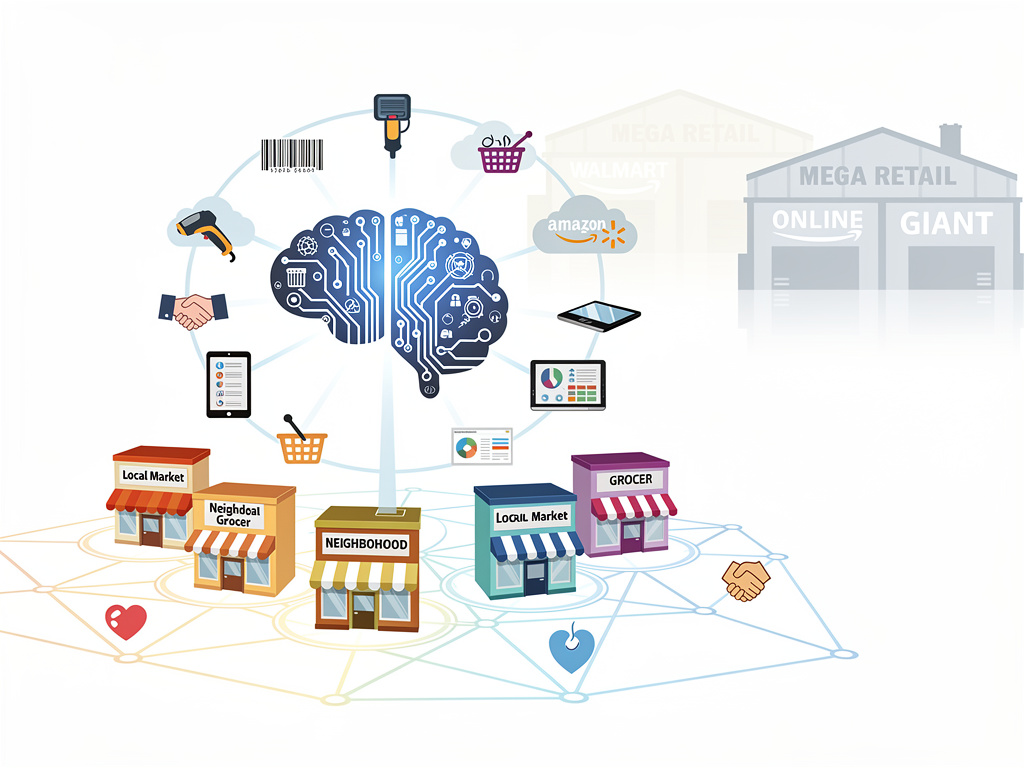
The independent grocery sector, long considered the underdog in an industry dominated by massive chains like Walmart and Kroger, is finding an unexpected equalizer in artificial intelligence. At the 2026 National Grocers Association conference, Wakefern Food Corp. Chairman and CEO Michael Stigers delivered a clarion call to independent retailers: embrace AI technology or risk obsolescence in an increasingly competitive marketplace.
Stigers, who leads the nation’s largest retailer-owned cooperative with approximately $19 billion in annual sales, emphasized that independent grocers should “not be afraid” of artificial intelligence, according to Grocery Dive. His message comes at a critical juncture when independent grocers control roughly 1.2% of the total U.S. grocery market, facing mounting pressure from both traditional supermarket chains and e-commerce behemoths like Amazon.
The urgency behind Stigers’ advocacy stems from a fundamental shift in how grocery retail operates. Where independent stores once competed primarily on personal service and community ties, today’s consumers increasingly expect the technological conveniences pioneered by larger competitors—from personalized promotions to seamless online ordering and predictive inventory management. AI promises to deliver these capabilities at a scale previously unattainable for smaller operators.
Democratizing Technology Through Cooperative Power
Wakefern’s approach to AI adoption illustrates how independent retailers can leverage collective strength to access enterprise-level technology. The cooperative, which operates ShopRite, Price Rite, The Fresh Grocer, Dearborn Market, Gourmet Garage, and Fairway Market stores, has been investing heavily in AI-powered systems that benefit its 46 member companies operating 360 supermarkets across the Northeast.
The cooperative model provides a crucial advantage: shared technology costs. While a single independent grocer might struggle to justify the six- or seven-figure investment required for sophisticated AI systems, Wakefern can distribute these expenses across its entire membership. This economies-of-scale approach effectively levels the playing field against national chains that have dedicated technology budgets running into the hundreds of millions of dollars annually.
Wakefern has already deployed AI in several operational areas, including demand forecasting, which helps stores optimize inventory levels and reduce waste—a critical concern in an industry where profit margins typically hover between 1% and 3%. The cooperative has also implemented machine learning algorithms for promotional planning, enabling member stores to offer personalized deals that rival those of major competitors without requiring individual stores to build their own data science teams.
Overcoming the Fear Factor in AI Adoption
Despite AI’s potential benefits, Stigers acknowledged that many independent grocers harbor legitimate concerns about adopting these technologies. Chief among these worries are the initial investment costs, the complexity of implementation, and fears about replacing human workers with automated systems. These concerns are particularly acute for family-owned businesses operating on thin margins where a failed technology investment could prove catastrophic.
The Wakefern CEO’s “not be afraid” message directly addresses these anxieties by reframing AI not as a replacement for the human touch that defines independent grocery stores, but as a tool that enhances it. By automating routine tasks like inventory tracking, pricing updates, and basic customer service inquiries, AI frees store employees to focus on higher-value interactions—the personal relationships and specialized knowledge that have always been independent grocers’ competitive advantage.
Industry data supports this balanced approach. Research indicates that grocery stores implementing AI-powered systems alongside strong customer service see higher customer retention rates than those relying solely on technology or exclusively on traditional methods. The key lies in using AI to handle data-intensive background operations while preserving human expertise in areas like specialty department management, community engagement, and personalized shopping assistance.
Practical Applications Transforming Daily Operations
The AI applications most relevant to independent grocers extend far beyond futuristic concepts into immediately practical tools. Computer vision systems, for instance, can monitor shelf inventory in real-time, automatically generating restocking alerts when products run low. This technology, once exclusive to Amazon Go stores, is now available through third-party vendors at price points accessible to cooperatives like Wakefern.
Pricing optimization represents another high-impact application. AI algorithms can analyze competitor pricing, local demand patterns, seasonal trends, and inventory levels to recommend optimal price points for thousands of SKUs—a task that would require dozens of hours weekly if performed manually. For independent grocers competing against chains with sophisticated pricing teams, this capability provides essential parity.
Customer relationship management has also been revolutionized by AI. Machine learning models can analyze purchase histories to predict what individual customers are likely to buy, when they’ll shop, and which promotions will resonate most effectively. These insights enable independent grocers to deliver the personalized marketing that consumers increasingly expect, matching capabilities that previously required the massive customer databases of national chains.
The Cooperative Advantage in Technology Investment
Wakefern’s structure offers a blueprint for how independent retailers can collectively access AI capabilities that would be prohibitively expensive individually. The cooperative’s technology investments benefit from network effects—as more member stores use AI-powered systems, the algorithms become more accurate, and the per-store cost decreases.
This cooperative approach extends to data sharing, another critical component of effective AI implementation. While a single independent store might have insufficient transaction data to train robust machine learning models, Wakefern’s collective data from 360 stores provides the volume necessary for accurate predictions and meaningful insights. Member stores gain AI capabilities comparable to regional chains while maintaining their independent ownership and local decision-making authority.
The model also addresses the talent shortage in AI and data science. Rather than each independent grocer attempting to hire scarce technical specialists, Wakefern maintains a centralized technology team that develops and deploys solutions across the entire network. Member stores access expertise they could never afford individually while focusing their own hiring on customer-facing roles that directly impact the shopping experience.
Navigating Implementation Challenges
Despite the compelling benefits, AI adoption in independent grocery stores faces real obstacles. Legacy technology systems present a significant barrier, as many independent grocers operate on outdated point-of-sale and inventory management platforms that don’t easily integrate with modern AI tools. Upgrading these foundational systems represents a substantial investment that must precede or accompany AI implementation.
Data quality issues compound the challenge. AI algorithms require clean, consistent data to function effectively, but many independent grocers have accumulated years of inconsistent data entry, incomplete records, and siloed information systems. Preparing data for AI use often requires significant cleanup efforts and process standardization—unglamorous but essential work that can delay time-to-value for new technology investments.
Change management represents perhaps the most underestimated challenge. Store employees accustomed to traditional methods may resist new AI-powered systems, particularly if implementation is handled poorly or if workers fear job displacement. Successful AI adoption requires comprehensive training programs, clear communication about how technology will augment rather than replace human workers, and patience as staff adapt to new workflows.
The Competitive Imperative Driving Adoption
Stigers’ urgency about AI adoption reflects the competitive dynamics reshaping grocery retail. Major chains are investing billions in technology, with Walmart alone spending over $15 billion annually on technology and e-commerce capabilities. Amazon continues expanding its grocery footprint while leveraging its technological sophistication. For independent grocers, standing still means falling behind.
The COVID-19 pandemic accelerated this technology gap, as consumers rapidly adopted online ordering and contactless shopping options. Large chains quickly scaled these capabilities, while many independent grocers struggled to implement even basic e-commerce functions. The crisis demonstrated that technological capabilities are no longer optional differentiators but essential requirements for remaining competitive.
Consumer expectations continue evolving in ways that favor technologically sophisticated retailers. Younger shoppers particularly expect seamless omnichannel experiences, personalized recommendations, and digital convenience features. Independent grocers that fail to meet these expectations risk losing entire demographic segments to competitors, regardless of their advantages in product quality, community ties, or personal service.
Looking Ahead: AI as Strategic Necessity
The message from Wakefern’s leadership represents more than encouragement—it’s a strategic imperative for independent grocers’ survival. As AI capabilities become increasingly accessible through cooperative structures, third-party vendors, and cloud-based platforms, the barriers to adoption continue falling. The question is no longer whether independent grocers can afford to implement AI, but whether they can afford not to.
The most successful independent grocers will likely be those that embrace Stigers’ philosophy: using AI to enhance their traditional strengths rather than abandoning what makes them distinctive. Technology can handle data analysis, inventory optimization, and routine tasks, freeing independent grocers to focus on the personal relationships, community engagement, and specialized expertise that national chains struggle to replicate.
For the independent grocery sector, AI represents both challenge and opportunity. Those who heed Stigers’ call to overcome their fears and strategically implement these technologies position themselves to compete effectively in an increasingly digital marketplace. Those who delay risk becoming casualties of a transformation that shows no signs of slowing, as the grocery industry continues its inexorable march toward technology-enabled retail.


 WebProNews is an iEntry Publication