
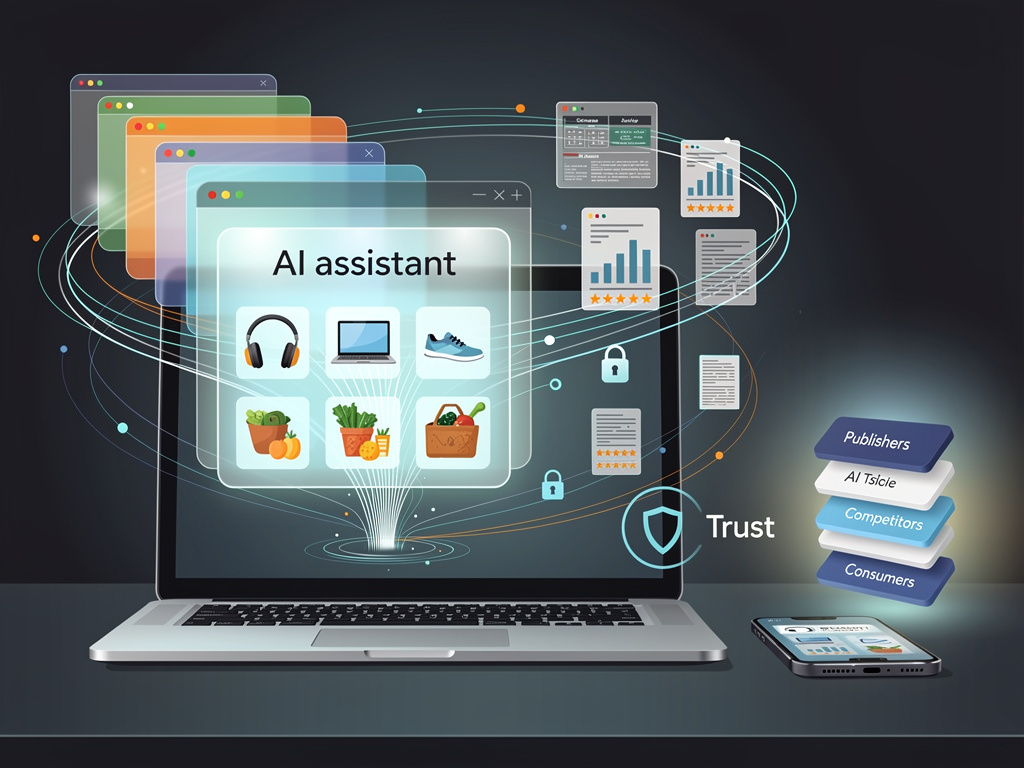
There was a time when making a purchase decision meant visiting a store, talking to a knowledgeable salesperson, and walking out with a product. Today, even buying a simple household appliance can devolve into hours of browser-tab proliferation, contradictory Reddit threads, and a creeping paralysis that behavioral scientists call decision fatigue. A growing number of consumers are discovering that Google’s Gemini AI assistant may be the antidote — not by replacing human judgment, but by compressing the research cycle that precedes it.
The phenomenon was recently explored in a deeply personal account published by Android Police, in which technology writer Rita El Khoury described how Gemini transformed her approach to everyday purchasing decisions. El Khoury’s experience resonated because it was not about a flashy AI demo or a futuristic use case — it was about the mundane but maddening process of choosing a robot vacuum cleaner without losing an entire weekend to research.
The Modern Affliction of Too Many Choices
Decision fatigue is not a new concept. The term was popularized by social psychologist Roy Baumeister, who demonstrated that the quality of human decisions deteriorates after a long session of decision-making. What has changed is the sheer volume of information available for even trivial purchases. A search for “best robot vacuum 2025” returns dozens of listicles, each with different top picks, different criteria, and different affiliate incentives shaping their recommendations. The consumer is left to synthesize conflicting advice across a sprawl of open browser tabs.
El Khoury’s account in Android Police captures this perfectly. She described the familiar spiral: opening one review site leads to another, which leads to a Reddit thread, which leads to a YouTube teardown, which leads to a specs comparison spreadsheet that never quite gets finished. The cognitive load is enormous, and the irony is that more information often leads to worse decisions — or no decision at all. This is the paradox of choice that psychologist Barry Schwartz identified two decades ago, now supercharged by the modern internet.
Gemini as a Personal Research Analyst
What El Khoury found was that Gemini could serve as a kind of personal research analyst. Rather than opening dozens of tabs and trying to manually cross-reference specifications, user reviews, and expert opinions, she posed her question directly to Google’s AI assistant. Gemini synthesized information from multiple sources, presented a curated shortlist of options, and explained the trade-offs between them in plain language. The entire process that might have consumed hours was compressed into a conversational exchange lasting minutes.
This is not the same as simply trusting the first Google search result. Gemini’s large language model architecture allows it to process and weigh information from across the web, identifying consensus recommendations and flagging areas of disagreement. When El Khoury asked follow-up questions — about specific features, price points, or compatibility concerns — Gemini responded contextually, building on the prior conversation rather than starting from scratch. The experience, as she described it, felt less like querying a search engine and more like consulting a well-informed friend who had already done the homework.
Why This Matters More Than It Seems
It would be easy to dismiss this as a trivial convenience — a slightly faster way to buy a vacuum. But the implications run deeper than that. Decision fatigue affects not just consumer purchases but professional workflows, healthcare choices, financial planning, and virtually every domain where humans must evaluate complex, multi-variable options. If AI assistants can reliably compress the research phase of decision-making, the productivity gains across the economy could be substantial.
Google has been steadily expanding Gemini’s capabilities throughout 2025. The assistant is now deeply integrated into the Android ecosystem, accessible through the phone’s home button, available within Google Workspace applications, and increasingly capable of performing multi-step tasks. Google’s strategy appears to be positioning Gemini not as a novelty but as an essential utility layer — the default interface through which users interact with the internet’s vast information stores. The robot vacuum query is a small example of a much larger ambition.
The Trust Question That Looms Over AI Recommendations
Of course, delegating research to an AI assistant raises legitimate concerns about accuracy, bias, and transparency. Large language models are known to hallucinate — generating plausible-sounding but factually incorrect information. If Gemini recommends a product based on synthesized reviews, how does the user verify that those reviews were real, that the synthesis was fair, and that no commercial relationship influenced the recommendation? These are not hypothetical concerns. The Federal Trade Commission has been increasingly scrutinizing AI-generated content for potential deceptive practices, and consumer advocacy groups have raised alarms about the opacity of AI recommendation systems.
El Khoury acknowledged this tension in her Android Police piece, noting that she did not blindly accept Gemini’s first recommendation. Instead, she used the AI’s output as a starting point — a curated foundation that dramatically reduced the scope of her manual verification. This hybrid approach, where AI handles the initial synthesis and the human performs targeted validation, may represent the most practical model for consumer decision-making in the near term. It captures most of the efficiency gains while preserving a meaningful check on AI accuracy.
Google’s Competitive Position in the AI Assistant Race
Google is not the only company pursuing this vision. OpenAI’s ChatGPT, Microsoft’s Copilot, Apple’s Siri with its forthcoming AI enhancements, and a host of specialized AI shopping assistants are all competing for the role of the consumer’s default research tool. What distinguishes Gemini is its integration with Google’s search infrastructure — the same index that already powers the world’s dominant search engine. This gives Gemini access to a breadth of real-time web information that standalone AI models may struggle to match.
The competitive dynamics are further complicated by the ongoing antitrust scrutiny facing Google. The U.S. Department of Justice’s landmark case against Google’s search monopoly could reshape how AI assistants access and present web information. If regulators impose structural remedies that limit Google’s ability to bundle Gemini with Android and Chrome, the company’s advantage in AI-assisted decision-making could be significantly curtailed. For now, however, Gemini’s seamless integration into the Android ecosystem gives it a distribution advantage that rivals find difficult to replicate.
What the Tab-Closing Revolution Means for Publishers
There is another constituency that should be paying close attention to this trend: the publishers and content creators who produce the reviews, comparisons, and buying guides that currently populate those 47 open tabs. If consumers increasingly rely on AI assistants to synthesize product information, the traffic that flows to individual review sites could decline precipitously. This is already a source of anxiety in the digital publishing industry, where Google’s AI Overviews feature has been accused of siphoning traffic by answering queries directly on the search results page.
The economics are stark. Review sites monetize through affiliate commissions and display advertising, both of which depend on users actually visiting the site. If Gemini provides a sufficiently comprehensive answer that the user never clicks through to the underlying source, the financial model that supports independent product journalism begins to erode. Some publishers have begun experimenting with AI-resistant content strategies — deeper analysis, original testing, and exclusive data that AI models cannot easily replicate. Whether these strategies will be sufficient remains an open question.
The Emerging Etiquette of Human-AI Decision-Making
El Khoury’s experience also hints at an emerging etiquette around human-AI collaboration in everyday life. She did not ask Gemini to make the decision for her. She asked it to narrow the field, explain the trade-offs, and surface information she might have missed. The final choice remained hers. This distinction matters because it preserves human agency while acknowledging that the information-gathering phase of decision-making has become unsustainably burdensome for individuals acting alone.
This model — AI as research assistant, human as final arbiter — could become the dominant paradigm for how people interact with AI in the coming years. It sidesteps the more dystopian scenarios in which AI systems make consequential decisions without human oversight, while still delivering meaningful quality-of-life improvements. The robot vacuum gets purchased. The weekend is not consumed by research. The 47 tabs are never opened in the first place.
A Quiet Shift With Loud Implications
What makes El Khoury’s account in Android Police compelling is its ordinariness. This is not a story about AI composing symphonies or diagnosing rare diseases. It is a story about a person who needed to buy a vacuum cleaner and found that an AI assistant made the process meaningfully less painful. The very banality of the use case is what makes it significant — it suggests that AI’s most transformative consumer impact may not come from spectacular demonstrations but from the quiet elimination of everyday friction.
For Google, each of these small victories compounds. Every time a user turns to Gemini instead of opening a new browser tab, the habit strengthens. Every satisfactory interaction increases the likelihood that the user will return for the next decision — whether it is choosing a vacuum, selecting a health insurance plan, or planning a vacation. The stakes, in aggregate, are enormous. The company that becomes the default AI intermediary between consumers and information will wield influence that makes today’s search monopoly look modest by comparison. The tab-closing revolution has only just begun.


 WebProNews is an iEntry Publication