
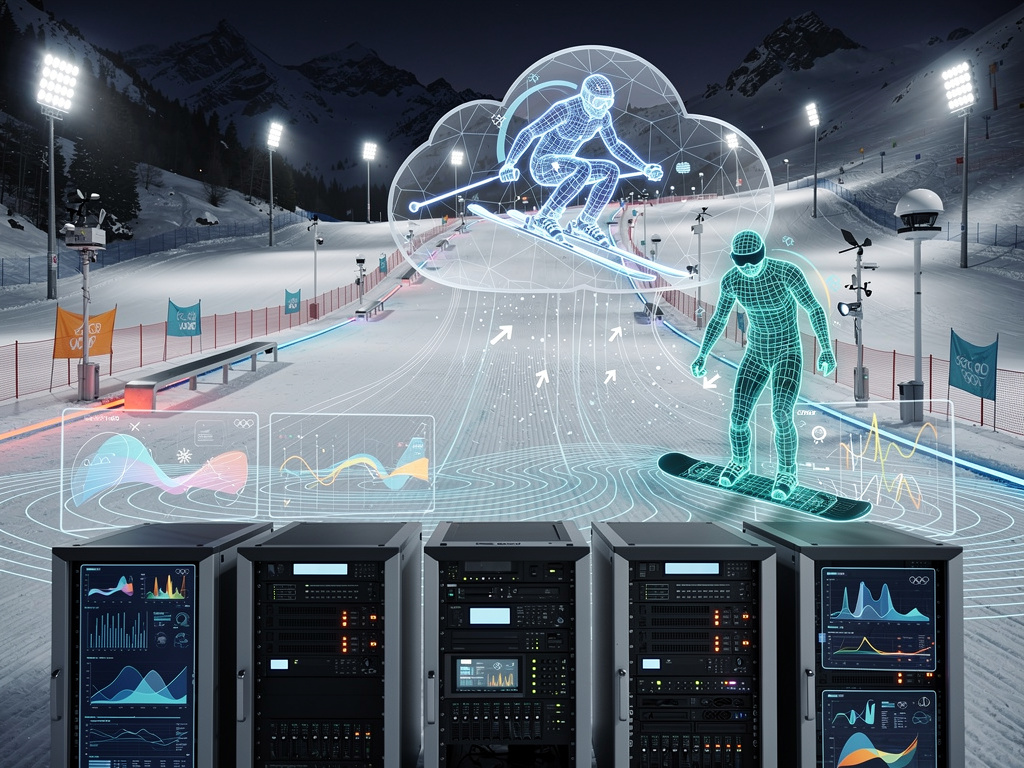
The fusion of artificial intelligence and elite athletic performance has reached a pivotal inflection point, as the U.S. Ski & Snowboard team deploys Google Cloud’s advanced machine learning capabilities to revolutionize training protocols ahead of the 2026 Winter Olympics in Milan-Cortina. This partnership represents more than a technological upgrade—it signals a fundamental transformation in how Olympic-caliber athletes prepare for competition, leveraging data analytics at a scale and sophistication previously unimaginable in winter sports.
According to Google’s official announcement, the collaboration centers on a custom-built platform that processes vast quantities of biomechanical data, environmental conditions, and performance metrics to deliver actionable insights to coaches and athletes. The system analyzes video footage from training runs, extracting granular details about body positioning, edge angles, and velocity changes that would be impossible for human observers to detect in real-time. This technological edge could prove decisive in competitions where victory margins are measured in hundredths of seconds.
The strategic timing of this partnership reflects the escalating arms race in sports technology among nations competing for Olympic supremacy. With the 2026 Games approaching, national teams worldwide are investing heavily in data-driven training methodologies, recognizing that traditional coaching intuition, while valuable, must now be augmented by computational power capable of identifying performance patterns across thousands of training runs and competitive events.
The Architecture of Athletic Excellence
The technical infrastructure underpinning this initiative leverages Google Cloud’s Vertex AI platform, which enables the U.S. Ski & Snowboard team to build custom machine learning models tailored specifically to winter sports disciplines. These models ingest data from multiple sources: high-speed cameras positioned along training courses, wearable sensors monitoring physiological responses, GPS tracking systems recording precise positioning, and historical performance databases spanning decades of competitive results. The platform’s ability to synthesize these disparate data streams into coherent, actionable recommendations represents a quantum leap beyond previous generations of sports analytics tools.
What distinguishes this approach from earlier attempts at sports analytics is the system’s capacity for real-time processing and feedback. Coaches can now review AI-generated insights within minutes of a training run’s completion, allowing for immediate tactical adjustments rather than waiting hours or days for manual video analysis. This acceleration of the feedback loop fundamentally alters the training paradigm, enabling athletes to iterate more rapidly on technique refinements and tactical decisions.
Biomechanical Precision Meets Computational Power
The platform’s computer vision capabilities represent perhaps its most transformative feature. By analyzing video footage frame-by-frame, the AI system can measure subtle variations in body position, weight distribution, and equipment angles that correlate with optimal performance. For alpine skiers navigating gates at speeds exceeding 80 miles per hour, microsecond decisions about weight transfer and edge engagement determine success or failure. The Google Cloud system quantifies these variables with unprecedented precision, creating a detailed performance fingerprint for each athlete that coaches can use to identify areas for improvement.
Beyond individual technique analysis, the platform incorporates environmental modeling that accounts for snow conditions, temperature, humidity, and course topology. These factors dramatically influence equipment selection and racing strategy, yet their complex interactions have historically relied on coaches’ experiential knowledge. By processing weather data, snow reports, and course characteristics through machine learning algorithms, the system can predict optimal equipment configurations and tactical approaches for specific conditions, removing much of the guesswork from race-day preparation.
The Competitive Intelligence Dimension
While the primary focus remains on optimizing U.S. athlete performance, the platform also incorporates competitive analysis capabilities. By analyzing publicly available footage of international competitors, the AI system can identify tactical patterns, technical strengths, and potential vulnerabilities in rival athletes’ approaches. This intelligence gathering, conducted at scale and with algorithmic consistency, provides American coaches with strategic insights that inform training priorities and competitive tactics. In sports where marginal gains accumulate into decisive advantages, this analytical capability could prove invaluable during the high-stakes environment of Olympic competition.
The ethical implications of AI-driven sports analytics deserve careful consideration. Questions arise about data privacy, the potential for technological disparities between well-funded and resource-constrained national programs, and whether algorithmic optimization might homogenize athletic technique in ways that diminish the sport’s creative elements. The U.S. Ski & Snowboard organization has emphasized its commitment to using these tools to enhance rather than replace human coaching expertise, positioning AI as a decision-support system rather than an autonomous authority.
Scaling Innovation Across Disciplines
The implications of this partnership extend beyond alpine skiing to encompass the full spectrum of winter sports disciplines under the U.S. Ski & Snowboard umbrella, including freestyle, snowboarding, and cross-country events. Each discipline presents unique analytical challenges: freestyle athletes require evaluation of aerial maneuvers and landing precision, snowboarders need assessment of rotational dynamics and trick execution, while cross-country skiers demand analysis of endurance pacing and energy expenditure patterns. The platform’s modular architecture allows for discipline-specific customization while maintaining a unified data infrastructure that enables cross-discipline insights and resource sharing.
The financial investment required for such sophisticated technological infrastructure raises questions about accessibility and equity in international sports competition. While exact figures remain undisclosed, industry observers estimate that comprehensive AI-driven training platforms require multi-million dollar investments in cloud computing resources, sensor technology, and specialized personnel. This reality threatens to widen the performance gap between wealthy sporting nations and developing programs, potentially concentrating Olympic success among a narrower band of technologically advanced countries.
The Human Element in an Algorithmic Age
Despite the technological sophistication, coaches and athletes emphasize that AI serves as a tool rather than a replacement for human judgment and athletic intuition. The platform generates recommendations and identifies patterns, but coaches retain ultimate authority over training decisions, and athletes must still execute techniques under the intense physical and psychological pressures of competition. This human-AI collaboration model acknowledges that athletic excellence emerges from the synthesis of data-driven insights and the intangible qualities—mental resilience, competitive instinct, creative problem-solving—that distinguish champions from merely proficient competitors.
The long-term trajectory of AI in sports points toward increasingly sophisticated applications. Future iterations might incorporate predictive modeling that forecasts injury risk based on biomechanical stress patterns, personalized nutrition and recovery protocols optimized through machine learning analysis of individual physiological responses, or virtual reality training environments that simulate race conditions with photorealistic accuracy. As computational capabilities continue advancing and sensor technologies become more sophisticated, the boundary between human athletic performance and technological augmentation will require ongoing ethical scrutiny and regulatory attention.
Measuring Success Beyond Medal Counts
The ultimate test of this Google Cloud partnership will arrive during the 2026 Winter Olympics, where medal counts provide the most visible success metric. However, the initiative’s value extends beyond podium finishes to encompass injury reduction through biomechanical optimization, career longevity enabled by data-driven training load management, and the democratization of elite coaching insights across the broader U.S. skiing and snowboarding community. By capturing and codifying expert knowledge in algorithmic form, the platform creates institutional memory that transcends individual coaching careers, ensuring that hard-won insights accumulate rather than dissipate with coaching transitions.
The broader sports technology industry watches this partnership closely as a potential template for other national Olympic programs and professional sports organizations. If the U.S. Ski & Snowboard team demonstrates measurable performance improvements attributable to AI-driven training methodologies, expect accelerated adoption across the global sports ecosystem. This diffusion will likely spur a new generation of specialized sports analytics companies, increased investment in cloud computing infrastructure for athletic applications, and intensified competition among technology providers seeking to establish dominance in this emerging market segment.
As the Milan-Cortina Games approach, the intersection of artificial intelligence and athletic excellence enters uncharted territory. The Google Cloud partnership with U.S. Ski & Snowboard represents more than a technological experiment—it embodies a fundamental reimagining of how elite athletes prepare for competition in an era where computational power and human performance converge. Whether this approach delivers Olympic gold remains to be seen, but the trajectory is clear: the future of competitive sports will be shaped as much by algorithms and cloud computing as by physical conditioning and technical skill. The question facing sports organizations worldwide is not whether to embrace these technologies, but how quickly they can adapt to a new paradigm where data-driven insights provide the margin between victory and defeat.


 WebProNews is an iEntry Publication