
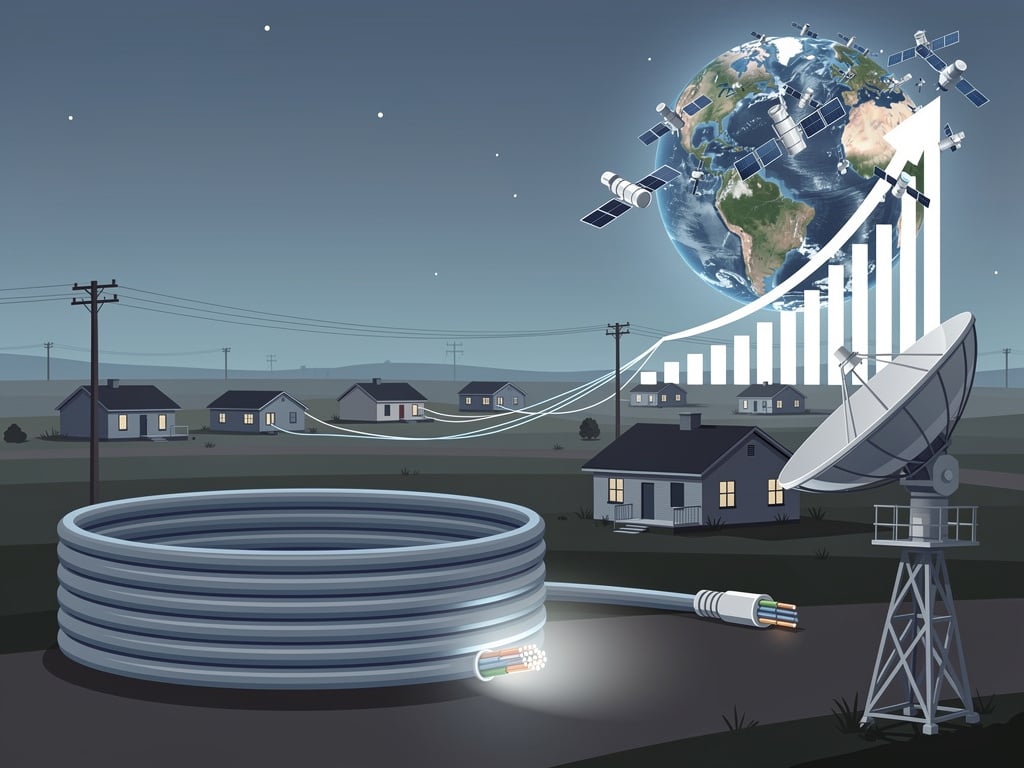
Months after Donald Trump returned to the White House, a signature federal effort to wire rural America with high-speed internet has delivered little in the way of actual connections. Billions sit largely untouched. Yet hundreds of millions have already flowed to companies controlled by Elon Musk and Jeff Bezos.
The Broadband Equity, Access and Deployment program, funded with $42.45 billion from the 2021 infrastructure law, was designed to close the digital divide once and for all. States would award grants mostly for fiber-optic networks. These offered fast, reliable service with decades of useful life. Instead the Trump administration rewrote the rules. It emphasized speed to market and cost. Satellite providers suddenly looked attractive.
Gizmodo reported on June 23 that the revamped program quickly directed $738.8 million to SpaceX for Starlink service and $311 million to Amazon’s Project Kuiper. The story drew on earlier Verge reporting that detailed how the shift happened almost immediately after the policy change. Few homes have been connected. Many states still wait for approval.
But the money moves anyway. And it moves to names familiar from campaign finance records and policy circles. Musk poured roughly $288 million into efforts to elect Trump, according to multiple accounts. Bezos’s companies contributed $1 million to the inauguration and spent $40 million on rights to a documentary about Melania Trump. Returns appear swift.
Sascha Meinrath, the Palmer Chair in Telecommunications at Penn State, put it bluntly. “It’s free money. We are subsidizing their already existing, but inadequate, infrastructure. It begs the question, ‘What exactly are we purchasing with these taxpayer dollars?’” He spoke to the Washington Monthly in a June 22 story that examined the financial upside for SpaceX ahead of its IPO.
That upside looks substantial. Starlink entered 2026 with about 2.7 million U.S. subscribers. The new grants cover service to roughly 476,000 locations. The Washington Monthly calculated this expands Starlink’s domestic base by 24 percent. Those rural customers often have no realistic alternative. They pay higher prices. One Nebraska resident told the publication she faced a 44 percent rate increase for a plan she considers suboptimal. “Fiber would be a more stable alternative. I would switch to fiber tomorrow if it was offered,” said Julie Slama, a lawyer in the state.
Starlink generated $11.39 billion in revenue in 2025. Average revenue per user had slipped as the company chased growth overseas among less affluent buyers. The BEAD customers represent a different profile. They live where wired options never arrived. Their payments could lift margins at a moment when SpaceX prepared to go public at a $1.75 trillion valuation. Starlink’s cash flow helps offset losses elsewhere in the rocket and artificial intelligence businesses.
Blair Levin, a longtime telecom analyst, saw the dynamic clearly. In the days after Trump’s victory he told associates that “the most important person for telecom policy … will be Elon Musk.” Levin added a pointed question. “Why would he want BEAD money to fund fiber deployments that would reduce his addressable market?”
The policy changes delivered exactly that protection. Commerce Secretary Howard Lutnick announced a “tech-neutral” approach that dropped previous preferences for fiber. Environmental reviews and labor requirements eased. Minimum speed and latency standards fell. Lowest-cost bids gained priority. Satellite systems, already orbiting, could check the basic boxes without new construction.
Evan Feinman, who ran the BEAD program in its early days, recalled the shift. “He asked if we had been talking to Elon.” Feinman later described the outcome in stark terms. The administration was “stranding all or part of rural America with worse internet so that we can make the world’s richest man even richer.”
Christopher Ali, a broadband scholar at Penn State, warned of long-term consequences. Lutnick’s changes cement “a new digital divide as parts of the country go to satellite while others move to fiber optics.” Fiber lasts. It delivers consistent performance. Satellite service degrades during peak hours. It requires ongoing subsidies because the satellites themselves need replacement every five to seven years.
States have noticed. Some, including Nevada, awarded $14 million to Project Kuiper to serve nearly 5,000 locations even before the full rewrite. Others, such as Louisiana, saw planned fiber projects reclassified. They received funding later than expected and only after agreeing to include Starlink options. By mid-2026, according to The Verge’s analysis of federal dashboards, just a few hundred homes had actually gained service through the entire program. Thirty-three of 56 states and territories that applied in 2025 still lacked final grant decisions.
The original vision was different. Congress intended the money to build future-proof infrastructure. Fiber creates local jobs during construction and leaves something permanent behind. Satellite contracts send most of the funds to corporate balance sheets in California and Washington state. Little stays in the rural counties that need economic activity.
Rural Digital Opportunity Fund awards, an earlier FCC effort, already showed problems. More than one-third of recipients have defaulted, according to an April 2026 Daily Yonder report. Past subsidy programs from the Connect America Fund boosted adoption temporarily but service often faded once support ended, University of California researchers found in 2024.
Yet the pattern repeats. Only $21 billion of the BEAD total has moved out under the revised rules. The remainder sits in reserve or tied up in re-bidding. Meanwhile Starlink gains both revenue and political leverage. Musk once called the original BEAD framework “an outrageous waste of taxpayer money” on X and said it “should be dissolved.” Now his company collects the largest single share.
Critics from both parties have begun to speak up. Some rural lawmakers who backed the infrastructure bill expected fiber in their districts. They see satellite as a temporary patch at best. Households face monthly bills around $120 for Starlink. Comparable fiber plans often run near $80. Over years the difference adds up. And unlike fiber, satellite performance varies with weather, network congestion and satellite replacement cycles.
The administration defends the approach as pragmatic. It argues that fiber takes too long and costs too much in remote terrain. Satellite can serve the hardest-to-reach places quickly. Officials point to Starlink’s real-world use in disasters and on farms. They insist the program still aims to connect people. Results, they say, will come.
So far the data tells another story. Only a fraction of the promised connections exist. Billions approved on paper have produced modest real-world impact beyond corporate earnings. SpaceX completed its IPO in June 2026. Starlink’s expanded U.S. footprint and guaranteed subsidy stream contributed to the narrative that made the valuation possible.
Telecom analyst Blair Levin had it right early on. Policy decisions now shape markets for decades. When those decisions favor companies whose executives helped shape the election outcome, questions arise about whose interests come first. Rural families waiting for dependable internet see their tax dollars subsidize orbital hardware instead of trenches in their own soil.
More states eye satellite subsidies as workarounds, The Wall Street Journal noted in May 2025. Maine and others have moved in that direction to address immediate gaps. The trend accelerates under the new BEAD guidance. Fiber projects once approved now face rescission or reallocation. The digital divide narrows for some. For many others it simply changes form. From no connection to an expensive, less reliable one funded by the same federal pot.
Over 40 million Americans still lack access to what most consider basic service. Children complete homework in library parking lots to catch a signal. Small businesses cannot compete in a digital economy. The promise was to fix that permanently. The delivery so far has sent cash upward instead.
Whether the remaining $22 billion reserved for non-deployment activities will change the picture remains unclear. NTIA has signaled flexibility. States may tap it for a variety of uses. Yet without stricter accountability on outcomes, the risk persists. Funds meant to build lasting infrastructure could continue to support quarterly reports and satellite constellations that require perpetual replenishment.
The story is not entirely new. Federal broadband subsidies have long struggled with waste, defaults and capture by incumbents. What feels different this time is the speed and transparency of the redirection toward two of the world’s wealthiest individuals. The contracts arrived before most states received basic approvals. The beneficiaries had clear financial and political ties to the decision makers.
Meinrath’s question lingers. What exactly are taxpayers buying? Faster marketing claims for Starlink? Political goodwill? Or actual broadband that rural communities can count on for generations? The early returns suggest the first two. The third still waits.


 WebProNews is an iEntry Publication