
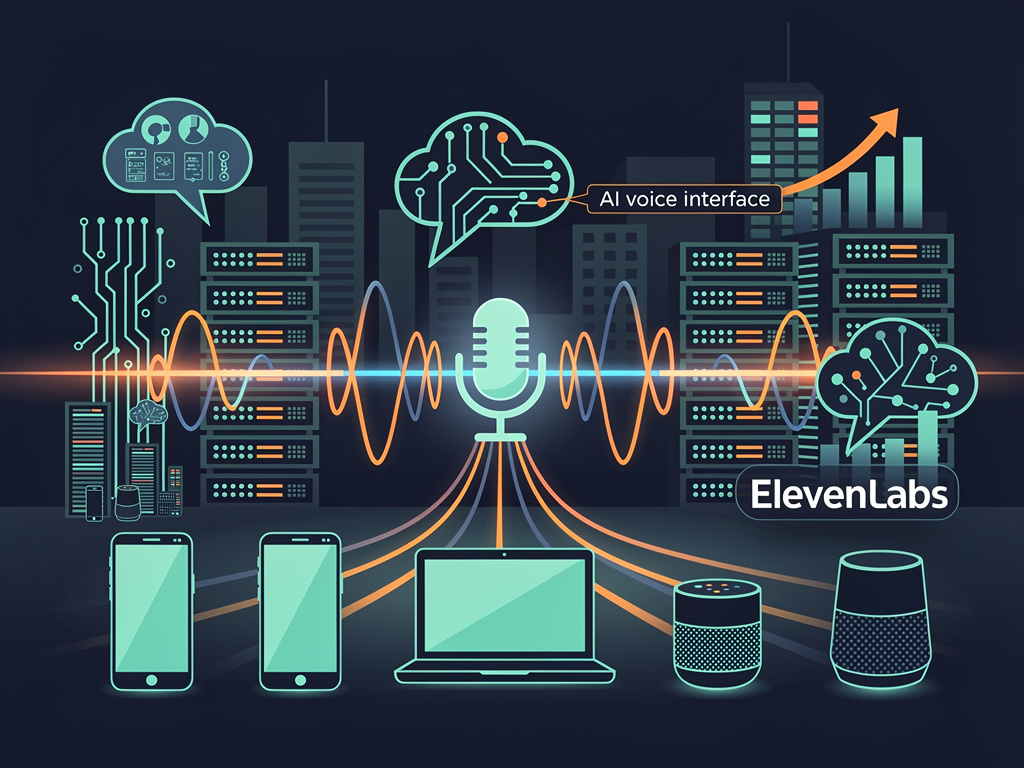
The artificial intelligence industry stands at an inflection point where the dominant mode of human-computer interaction is shifting from text-based prompts to spoken language. At the forefront of this transformation is ElevenLabs, a voice AI company whose chief executive believes voice technology will fundamentally reshape how billions of people engage with intelligent systems—a prediction that carries significant implications for the technology sector’s future architecture.
According to TechCrunch, ElevenLabs CEO Mati Staniszewski has articulated a vision where voice becomes the primary interface for AI interactions, supplanting the text-based chat paradigms that currently dominate the market. This strategic perspective arrives as the company continues to expand its voice synthesis capabilities and conversational AI products, positioning itself as a critical infrastructure provider in an emerging market that analysts project could reach tens of billions of dollars in annual revenue within the next decade.
The company’s trajectory reflects broader industry momentum toward multimodal AI systems. While text-based large language models captured initial market attention through applications like ChatGPT, industry insiders increasingly recognize that voice represents a more natural and accessible interface for the majority of potential users. This shift carries profound implications for user experience design, computational requirements, and the competitive dynamics among AI platform providers.
The Technical Architecture Behind Voice-First AI
ElevenLabs has built its market position on proprietary voice synthesis technology that generates remarkably human-like speech across multiple languages and emotional tones. The company’s neural networks process linguistic inputs and convert them into audio outputs with unprecedented fidelity, capturing subtle prosodic features that earlier text-to-speech systems struggled to reproduce. This technical capability forms the foundation for more sophisticated conversational AI applications that require not just accurate speech generation but contextually appropriate vocal delivery.
The engineering challenges in voice AI extend beyond synthesis to encompass real-time speech recognition, natural language understanding, and response generation—all of which must operate with minimal latency to create fluid conversational experiences. ElevenLabs has invested heavily in reducing the computational overhead required for these processes, enabling voice AI applications to run efficiently across various deployment scenarios from cloud-based services to edge devices. This optimization work addresses one of the primary barriers to widespread voice AI adoption: the need for responsive, low-latency interactions that feel natural to users.
Market Positioning in a Crowded Competitive Field
The voice AI sector has attracted significant capital and talent, with established technology giants and well-funded startups competing for market share. Companies including Google, Amazon, Microsoft, and OpenAI have all announced voice-related AI initiatives, while specialized firms like Deepgram, AssemblyAI, and Speechmatics focus on specific components of the voice technology stack. ElevenLabs differentiates itself through its focus on voice quality and emotional expressiveness, capabilities that prove particularly valuable for content creation, entertainment, and customer service applications.
The company has pursued a platform strategy, offering APIs and tools that enable third-party developers to integrate advanced voice capabilities into their own applications. This approach creates network effects as more developers build on ElevenLabs’ infrastructure, while also generating recurring revenue streams through usage-based pricing models. Industry observers note that successful AI infrastructure companies often achieve durable competitive advantages by becoming embedded in their customers’ technology stacks, making switching costs prohibitively high even as alternatives emerge.
Enterprise Adoption Patterns and Use Cases
Early enterprise adoption of voice AI technology has concentrated in sectors where human voice interaction plays a central role in business operations. Customer service organizations have deployed voice AI to handle routine inquiries, freeing human agents to address more complex issues. Media and entertainment companies use voice synthesis for content localization, dubbing, and the creation of synthetic voiceovers. Educational technology firms incorporate conversational AI to provide personalized tutoring experiences. These applications demonstrate the technology’s versatility across different business contexts.
Financial services institutions have begun exploring voice AI for secure authentication and conversational banking interfaces. Healthcare organizations investigate applications in patient engagement and clinical documentation. The common thread across these deployments is the desire to make technology interactions more intuitive and accessible, particularly for users who may struggle with traditional text-based interfaces due to literacy challenges, visual impairments, or situational constraints like driving or multitasking.
Privacy and Security Considerations in Voice Technology
The proliferation of voice AI raises significant privacy and security questions that enterprises and consumers must carefully consider. Voice data contains rich biometric information that could potentially be used for unauthorized identification or impersonation. The synthesis capabilities that make voice AI powerful also create opportunities for misuse, including the generation of convincing audio deepfakes. ElevenLabs and other responsible voice AI providers have implemented safeguards including voice cloning restrictions, watermarking technologies, and usage monitoring to detect and prevent malicious applications.
Regulatory frameworks governing voice data collection, storage, and processing continue to evolve across different jurisdictions. The European Union’s AI Act and various U.S. state-level privacy laws impose requirements on companies deploying voice AI systems. Compliance with these regulations adds complexity and cost to voice AI implementations, though it also establishes baseline standards that may accelerate enterprise adoption by providing clearer guidelines for responsible use. Industry participants generally recognize that proactive attention to privacy and security concerns will prove essential for maintaining public trust and avoiding regulatory backlash.
The Economics of Voice-First Computing
The business models surrounding voice AI reflect the technology’s infrastructure-like characteristics. ElevenLabs and similar providers typically charge based on usage metrics such as characters synthesized or minutes of audio processed. This consumption-based pricing aligns provider revenue with customer value realization, though it also creates variable cost structures that enterprises must manage. As voice AI becomes more deeply integrated into core business processes, organizations may negotiate volume commitments or reserved capacity arrangements to achieve more predictable pricing.
The total addressable market for voice AI extends beyond direct API revenue to encompass adjacent opportunities in voice-enabled applications, devices, and services. Analysts estimate that voice commerce alone could generate hundreds of billions in transaction volume as consumers become comfortable making purchases through conversational interfaces. The advertising industry explores voice-based ad formats and measurement capabilities. These downstream revenue opportunities dwarf the infrastructure layer revenue, suggesting that today’s voice AI platform providers could eventually expand into higher-margin application businesses.
Technical Challenges on the Roadmap Ahead
Despite rapid progress, significant technical challenges remain before voice can fully supplant other AI interaction modalities. Current voice AI systems still struggle with complex multi-turn conversations that require maintaining context across extended dialogues. Accents, dialects, and speech patterns that deviate from training data distributions can degrade recognition accuracy. Background noise and acoustic interference present ongoing challenges for real-world deployments. Addressing these limitations requires continued advances in model architectures, training methodologies, and signal processing techniques.
The computational requirements for sophisticated voice AI also remain substantial, creating cost and latency tradeoffs that constrain certain applications. Real-time voice processing demands significant GPU resources, which translates into higher operating costs compared to text-based alternatives. Edge deployment scenarios face additional constraints around model size and power consumption. The industry continues to pursue optimization strategies including model compression, specialized hardware accelerators, and hybrid cloud-edge architectures to make voice AI more economically viable across diverse use cases.
Strategic Implications for the Broader AI Industry
The shift toward voice-first AI interfaces carries strategic implications that extend beyond the voice technology sector itself. If voice becomes the dominant interaction modality, companies that control voice AI infrastructure could occupy similarly powerful positions to those held by today’s cloud computing and mobile platform providers. This possibility has prompted major technology companies to accelerate their voice AI investments and acquisitions. The competitive dynamics may ultimately determine not just which companies succeed in voice AI specifically, but which organizations shape the next generation of computing platforms more broadly.
The integration of voice capabilities into AI systems also influences the development priorities for large language models and other foundational AI technologies. Training regimes increasingly incorporate speech data alongside text, creating truly multimodal models that can process and generate both written and spoken language. This convergence suggests that the distinction between “voice AI” and “AI” more generally may eventually dissolve, with voice simply becoming one of several modalities that all AI systems support natively. For now, however, specialized voice AI providers like ElevenLabs maintain technical advantages in audio quality and conversational fluency that justify their continued independent existence.
As voice AI technology matures and adoption accelerates, the industry faces critical decisions about standards, interoperability, and governance. The establishment of common protocols for voice AI interactions could accelerate market development by reducing integration friction, much as web standards facilitated the internet’s growth. Conversely, fragmentation across incompatible proprietary systems could slow adoption and increase costs for enterprises and developers. The choices that leading companies make in the coming years regarding openness, collaboration, and competition will significantly influence how quickly voice realizes its potential as the next major interface for artificial intelligence.


 WebProNews is an iEntry Publication