
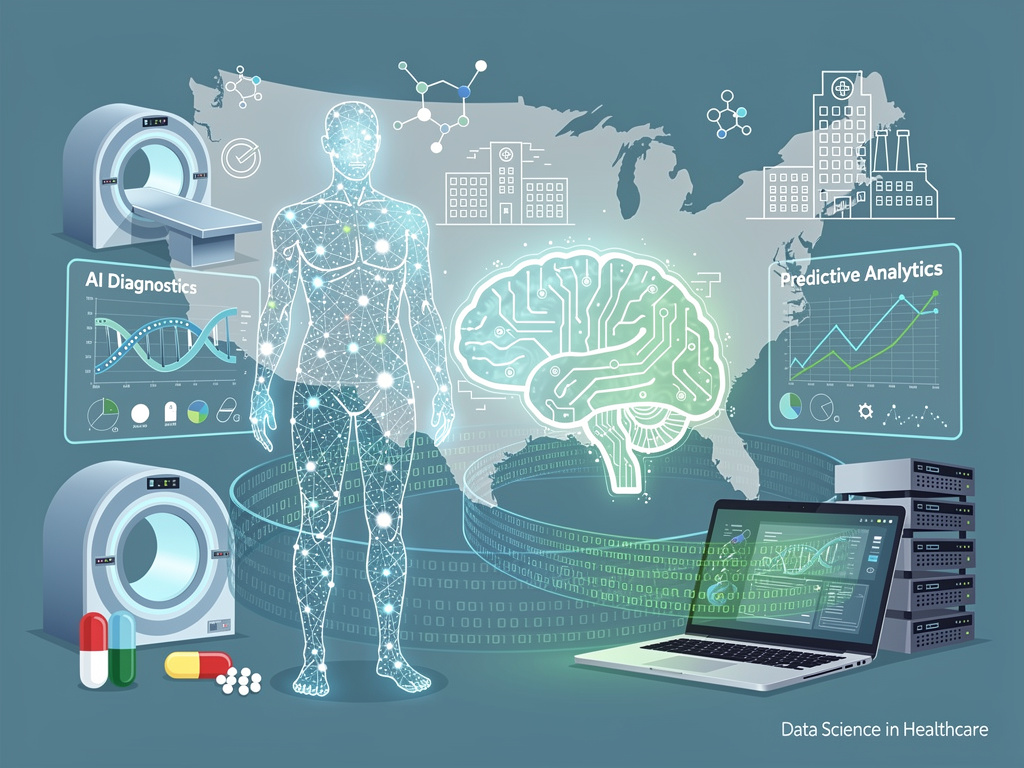
The operating room at Massachusetts General Hospital looks different than it did a decade ago. Surgeons still wield scalpels, but now they’re guided by algorithms that predict surgical complications before the first incision. Radiologists review imaging scans alongside artificial intelligence systems that flag potential tumors invisible to the human eye. Pharmaceutical researchers design drug molecules not in wet labs alone, but through computational simulations that compress years of trial-and-error into weeks of analysis.
This transformation represents more than incremental technological progress. Data science has emerged as medicine’s most disruptive force since the discovery of antibiotics, fundamentally altering how diseases are diagnosed, treatments are developed, and healthcare systems operate. The field combines machine learning, statistical analysis, and massive computational power to extract actionable insights from the exponential growth of medical data—from electronic health records and genomic sequences to real-time patient monitoring systems and population health databases.
According to research published by the Nature Medicine journal, machine learning models now match or exceed human performance across multiple diagnostic tasks, including diabetic retinopathy screening, skin cancer classification, and pneumonia detection from chest radiographs. These aren’t experimental prototypes confined to research laboratories. Major health systems including Kaiser Permanente, Cleveland Clinic, and the Mayo Clinic have integrated predictive analytics into clinical workflows, using algorithms to identify patients at risk for sepsis, heart failure, and hospital readmission.
The Economics of Medical Intelligence
The financial incentives driving this revolution are substantial. Healthcare data scientists command salaries reflecting their specialized expertise and the value they generate. According to Glassdoor data, healthcare data scientists earn an average of $165,018 annually in the United States, with total compensation packages frequently exceeding $200,000 when bonuses and equity are included. Pharmaceutical data scientists focusing on clinical trials and drug development analytics average $122,738, while medical AI and machine learning engineers see salaries ranging from $89,600 to $188,100 depending on experience and geographic location.
These compensation levels reflect both scarcity and impact. The U.S. Bureau of Labor Statistics projects employment of data scientists will grow 36 percent from 2021 to 2031, much faster than the average for all occupations. Within healthcare specifically, demand outpaces supply as health systems race to build analytics capabilities. A single data scientist who develops an algorithm reducing hospital readmissions by even two percent can generate millions in savings while improving patient outcomes—a return on investment few other roles can match.
Bioinformatics specialists, who analyze genomic and molecular data, represent another critical segment of this workforce. With average salaries starting at $89,500 and climbing substantially with experience, these professionals bridge biology and computation, translating raw genetic sequences into clinically meaningful insights. Their work underpins precision medicine initiatives that tailor treatments to individual patients based on their unique genetic profiles.
From Pixels to Prognosis: Medical Imaging’s Algorithmic Revolution
Nowhere is data science’s impact more visible than in medical imaging. Radiologists at Stanford University collaborated with computer scientists to develop an algorithm that diagnoses pneumonia from chest X-rays with accuracy exceeding that of individual radiologists. The research, published in PLOS Medicine, demonstrated that deep learning models trained on 112,120 frontal-view chest X-ray images could identify 14 different pathologies, providing a probability score for each diagnosis.
This technology doesn’t replace radiologists—it augments their capabilities. Dr. Matthew Lungren, a radiologist and data scientist at Stanford, explained to STAT News that AI systems serve as a “second reader,” catching abnormalities that might be missed during high-volume reading sessions and prioritizing urgent cases for immediate review. In practice, this means a patient with a suspicious lung nodule gets flagged for expedited follow-up rather than waiting weeks for routine results.
The technical foundation for these advances rests on convolutional neural networks, a type of deep learning architecture particularly effective at processing visual information. These models learn to recognize patterns by analyzing millions of labeled images, developing an intuition for what distinguishes normal anatomy from pathology. Companies like Zebra Medical Vision and Aidoc have commercialized these technologies, offering FDA-cleared algorithms that integrate directly into hospital imaging systems.
Predicting Disease Before Symptoms Emerge
Predictive analytics represents data science’s most proactive application in medicine. Rather than waiting for patients to present with symptoms, algorithms analyze electronic health records, vital signs, and laboratory results to identify deterioration before it becomes clinically obvious. The Johns Hopkins Hospital implemented a sepsis prediction model that analyzes patient data every hour, calculating the probability that a patient will develop this life-threatening condition in the next six hours.
Sepsis kills nearly 270,000 Americans annually and costs hospitals billions in treatment and penalties for preventable cases. Early intervention—administering antibiotics and fluids within the first hour of sepsis onset—dramatically improves survival rates. Johns Hopkins’ algorithm, developed by data scientists analyzing historical records from thousands of patients, identifies at-risk individuals with enough lead time for clinicians to intervene. According to research published in NPJ Digital Medicine, such early warning systems can reduce sepsis mortality by up to 18 percent when properly implemented.
Hospital readmission prediction represents another high-value application. Medicare penalizes hospitals with excessive readmissions, creating strong financial incentives to identify which discharged patients need additional support. Data scientists at Kaiser Permanente developed models that analyze hundreds of variables—from diagnosis codes and medication lists to social determinants like housing stability and transportation access—to calculate readmission risk. High-risk patients receive intensive case management, home visits, and coordinated follow-up care, reducing readmissions while improving outcomes.
Accelerating Drug Discovery Through Computational Chemistry
The pharmaceutical industry’s embrace of data science has compressed timelines that traditionally stretched across decades. Discovering a new drug conventionally requires screening hundreds of thousands of chemical compounds through laboratory experiments, identifying promising candidates, and then conducting years of safety and efficacy testing. Data science accelerates this process by using computational models to predict which molecules will bind effectively to disease targets before synthesizing them in the lab.
Atomwise, a San Francisco-based company, uses deep learning to analyze molecular structures and predict binding affinity—how strongly a potential drug will attach to its target protein. According to Forbes reporting, their technology can evaluate 10 million compounds per day, compared to the few thousand a traditional laboratory might screen in the same period. This computational approach identified potential treatments for Ebola in 2015 and has since been applied to multiple sclerosis, antibiotic-resistant bacteria, and other conditions.
The COVID-19 pandemic demonstrated data science’s potential in drug development under extreme time pressure. Researchers at BenevolentAI used machine learning to analyze existing drugs that might be repurposed against the novel coronavirus. Their algorithm identified baricitinib, a rheumatoid arthritis medication, as a candidate based on its mechanism of action. Clinical trials confirmed its efficacy, and the FDA granted emergency use authorization—a process that took months rather than the typical years, as reported by Nature.
Precision Medicine: Matching Treatments to Individual Biology
Perhaps data science’s most transformative application lies in precision medicine—tailoring treatments to individual patients based on their genetic makeup, environment, and lifestyle. This approach recognizes that a medication effective for 70 percent of patients may be useless or harmful for the remaining 30 percent. By analyzing genomic data alongside clinical information, data scientists can predict which patients will respond to specific therapies.
The National Institutes of Health’s All of Us Research Program exemplifies this vision at scale. The initiative aims to gather health data from one million Americans, including genetic information, electronic health records, and lifestyle surveys. Data scientists will analyze this massive dataset to identify patterns linking genetic variants to disease risk and treatment response. Early findings, published in the New England Journal of Medicine, have already revealed previously unknown genetic variants affecting medication metabolism and disease susceptibility.
Oncology has advanced furthest in implementing precision medicine. Companies like Foundation Medicine sequence tumor DNA to identify specific mutations driving cancer growth, then match patients to targeted therapies designed to attack those particular genetic abnormalities. This approach has transformed treatment for lung cancer, melanoma, and other malignancies. According to National Cancer Institute data, patients whose treatments are matched to their tumor’s genetic profile show significantly better outcomes than those receiving standard chemotherapy.
Building the Skills for Medical Data Science
The technical requirements for medical data science extend beyond traditional statistical training. Practitioners must master programming languages including Python for machine learning implementations, R for statistical analysis, and SQL for database querying. Familiarity with specialized libraries like TensorFlow, PyTorch, and scikit-learn enables building and deploying predictive models. Cloud computing platforms including Amazon Web Services and Google Cloud provide the computational infrastructure for analyzing massive datasets.
Equally critical is domain expertise in medicine and healthcare operations. Data scientists must understand clinical workflows to build tools that integrate seamlessly into practice rather than creating additional burden. Knowledge of medical terminology, diagnostic processes, and treatment protocols ensures analyses ask clinically meaningful questions. Regulatory compliance, particularly with HIPAA privacy requirements, governs how patient data can be accessed, analyzed, and shared. A technically brilliant model that violates privacy regulations or disrupts clinical workflows will never reach patients.
Communication skills separate exceptional medical data scientists from merely competent ones. The ability to translate complex statistical findings into actionable insights for clinicians, hospital administrators, and patients determines whether analyses influence decisions or gather dust. As Dr. Suchi Saria, director of the Machine Learning and Healthcare Lab at Johns Hopkins, told Science Magazine, “You need to be bilingual—fluent in both the language of data science and the language of medicine.”
Educational Pathways and Professional Development
Academic institutions have responded to workforce demand by developing specialized degree programs. Harvard’s Master of Science in Health Data Science combines biostatistics, epidemiology, and computational methods with clinical applications. Yale’s Biomedical Informatics program offers tracks focused on clinical informatics, data science, and translational bioinformatics. University of Michigan’s Coursera specialization provides accessible online education for working professionals seeking to transition into the field.
For those already holding degrees in related fields, certificate programs offer accelerated entry points. The Data Science in Medicine Certificate from Stanford covers machine learning applications in healthcare, clinical data analysis, and ethical considerations in medical AI. Harvard’s Data Science Professional Certificate through edX provides foundational skills applicable across industries, which students can then specialize toward healthcare applications.
Professional development extends beyond formal education. Competitions like those hosted on Kaggle allow aspiring medical data scientists to practice on real-world datasets, including challenges predicting diabetic retinopathy severity, classifying lung cancer types, and forecasting patient deterioration. Contributing to open-source projects in medical AI, publishing research, and presenting at conferences like the Machine Learning for Healthcare Conference build portfolios demonstrating practical expertise.
Ethical Challenges and Algorithmic Accountability
The integration of data science into medicine raises profound ethical questions that the field continues to grapple with. Algorithmic bias represents perhaps the most pressing concern. Machine learning models learn patterns from historical data, which often reflects existing healthcare disparities. If training data underrepresents certain demographic groups or contains biased clinical decisions, resulting algorithms may perpetuate or amplify these inequities. Research published in Science revealed that a widely used algorithm for allocating healthcare resources systematically discriminated against Black patients because it used healthcare costs as a proxy for medical need—and Black patients historically received less care and thus generated lower costs.
Transparency and interpretability present additional challenges. Deep learning models often function as “black boxes,” making predictions without providing clear explanations for their reasoning. When an algorithm recommends a particular treatment or predicts a patient will develop sepsis, clinicians need to understand why to make informed decisions. The FDA’s framework for regulating AI medical devices increasingly emphasizes explainability, requiring developers to document how models arrive at conclusions.
Data privacy concerns intensify as healthcare organizations aggregate ever-larger patient datasets. While HIPAA provides baseline protections, sophisticated re-identification techniques can potentially link supposedly anonymous health records to specific individuals. The tension between data sharing necessary for research and individual privacy rights remains unresolved. Initiatives like differential privacy, which adds mathematical noise to datasets to prevent individual identification while preserving overall patterns, offer partial solutions but require careful implementation.
The Future of Medical Practice
The trajectory of data science in medicine points toward increasingly personalized, predictive, and preventive care. Continuous monitoring through wearable devices and smartphone sensors will generate real-time health data streams that algorithms analyze for early warning signs of deterioration. Apple Watch already monitors heart rhythm and can detect atrial fibrillation; future iterations will likely track additional biomarkers and integrate with predictive models to alert users and physicians to emerging health risks.
Drug development will continue accelerating as computational methods improve. DeepMind’s AlphaFold, which predicts protein structures with remarkable accuracy, exemplifies how AI can solve problems that stymied researchers for decades. Understanding protein folding enables rational drug design—creating molecules specifically shaped to interact with disease targets. This approach could generate effective treatments for conditions currently considered undruggable.
The integration of data science into medical education represents another frontier. Tomorrow’s physicians will need fluency in interpreting algorithmic predictions, understanding model limitations, and collaborating effectively with data science colleagues. Medical schools including Stanford and Harvard have begun incorporating data science and AI curricula into training, recognizing that future clinicians will practice in an algorithmically augmented environment.
Healthcare delivery will shift from reactive treatment of symptoms to proactive management of risk. Data scientists will build models that identify individuals at high risk for diabetes, heart disease, or mental health crises years before symptoms manifest, enabling preventive interventions. This transition from sick care to health optimization could fundamentally reshape medicine’s economics and outcomes, though realizing this vision requires addressing current challenges around access, equity, and algorithmic accountability. The data scientists building these systems today are not merely applying technical skills—they are architecting the future of human health.


 WebProNews is an iEntry Publication