
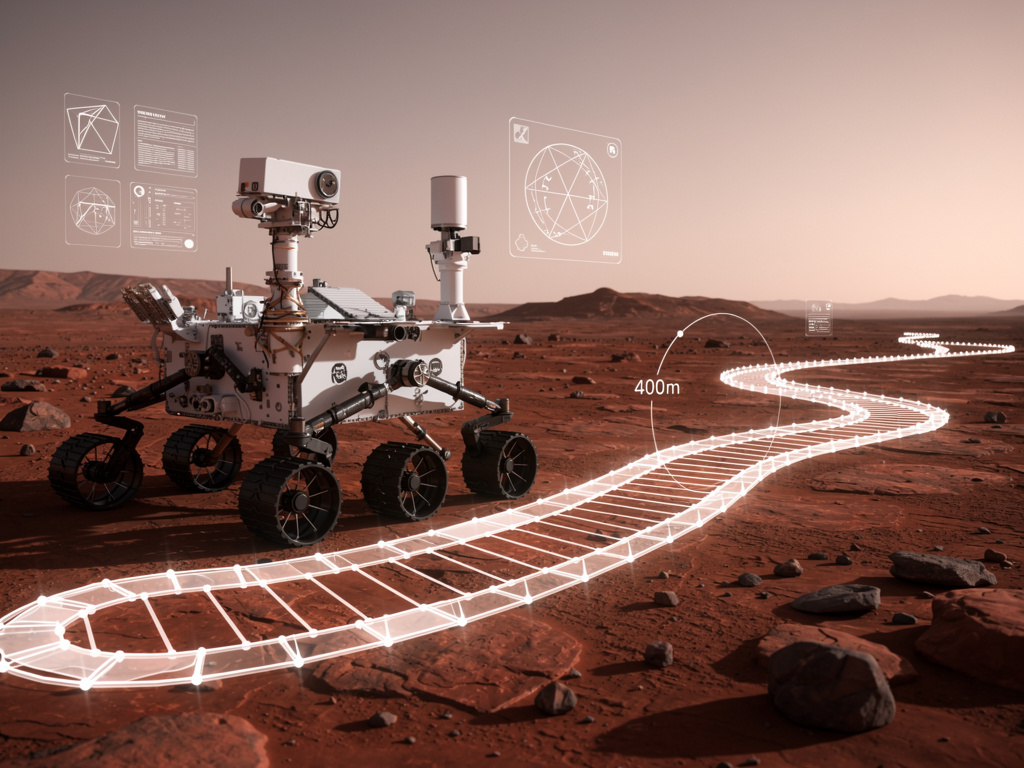
In a development that marks a watershed moment for interplanetary exploration, NASA engineers have successfully deployed Anthropic’s Claude artificial intelligence system to autonomously plan a driving route for the Perseverance rover across approximately 400 meters of Martian terrain. This represents the first time an AI system has independently charted a navigation path on another planet, fundamentally altering how space agencies might approach remote planetary operations in the years ahead.
The achievement addresses one of the most vexing challenges in space exploration: the communication delay between Earth and Mars. According to Anthropic’s detailed case study, this lag can range from four to twenty-four minutes depending on the planets’ relative positions, meaning that traditional command-and-control approaches require mission controllers to work with significantly outdated information. When engineers at NASA’s Jet Propulsion Laboratory see images from Mars, they’re looking at a world that existed minutes or even hours in the past, making real-time navigation impossible and forcing a painstaking process of analysis, planning, and transmission that can take days to move the rover mere meters.
The conventional workflow for planning a single drive involves multiple specialized teams working in sequence. Mission planners must analyze orbital imagery, rover engineers assess vehicle capabilities and constraints, scientists identify targets of interest, and navigation specialists plot safe paths around obstacles. This human-intensive process, while remarkably successful over Perseverance’s mission, creates a bottleneck that limits the rover’s mobility and scientific productivity. Each drive requires extensive review cycles, with experts poring over stereo imagery to identify rocks, slopes, and other hazards that could damage the six-wheeled explorer.
Breaking the Communication Bottleneck Through Machine Intelligence
The NASA team’s implementation of Claude represents a dramatic departure from this methodical approach. Rather than waiting for human planners to spend hours or days analyzing terrain data, the AI system can process stereo images from the rover’s navigation cameras and generate viable driving routes in minutes. The system evaluates terrain features, assesses slopes and rock distributions, and plots paths that balance scientific objectives with safety constraints—tasks that previously required coordination among multiple human specialists.
What makes this application particularly noteworthy is the stakes involved. Unlike terrestrial autonomous vehicles, which can afford occasional errors, the Perseverance rover operates in an environment where a single navigation mistake could end a multi-billion-dollar mission. The rover cannot simply call for roadside assistance if it becomes stuck in sand, tips over on a steep slope, or damages its wheels on sharp rocks. As Anthropic notes in their analysis, “exploring new planets means that you’re always operating in the past,” a constraint that makes autonomous decision-making both more valuable and more risky.
How Claude Processes Martian Terrain Data
The technical approach involves feeding Claude stereo imagery from Perseverance’s navigation cameras along with specific mission parameters and safety constraints. The AI system must interpret the three-dimensional terrain structure from these images, identifying features like rocks, sand patches, slopes, and potential wheel hazards. It then generates a proposed route that navigates around obstacles while progressing toward scientifically interesting targets identified by mission planners.
According to information shared by Yuchen Jin, a researcher involved with the project, on social media platform X, the system’s ability to understand spatial relationships and reason about physical constraints proved crucial. Claude doesn’t simply identify objects in images; it must understand how the rover’s mechanical systems will interact with terrain features, predicting whether a given path will be traversable given the vehicle’s ground clearance, wheel diameter, and articulation capabilities.
The 400-meter route planned by Claude represents a significant distance for a Mars rover. For context, Perseverance typically travels between 100 and 300 meters per sol (Martian day) when actively driving, though many sols involve no movement at all due to the planning overhead. The ability to autonomously plan longer routes could dramatically increase the rover’s range and scientific productivity, potentially allowing it to cover in weeks what might otherwise take months using traditional planning methods.
Validation and Safety Protocols in Autonomous Planetary Navigation
NASA’s implementation includes multiple layers of verification to ensure safety. The AI-generated route doesn’t execute automatically; instead, it’s reviewed by human experts who can override or modify the plan if they identify concerns. This human-in-the-loop approach provides a safety net while still capturing most of the efficiency gains from automated planning. Engineers can quickly verify that the AI’s route avoids obvious hazards and aligns with mission objectives, a process far faster than generating the entire plan from scratch.
The validation process revealed Claude’s sophisticated understanding of rover operations. Anthropic highlighted on X that the system demonstrated an ability to reason about trade-offs between route efficiency, safety margins, and scientific targets—the kind of nuanced decision-making that typically requires experienced mission planners. The AI didn’t simply plot the shortest path between two points; it generated routes that reflected a deeper understanding of mission priorities and operational constraints.
Implications for Future Deep Space Missions
The successful demonstration opens possibilities for more ambitious applications of AI in space exploration. Future missions to more distant destinations—such as the moons of Jupiter or Saturn—face even longer communication delays, measured in hours rather than minutes. For these missions, greater autonomy becomes not just beneficial but essential. A rover on Europa or Titan cannot wait hours for instructions from Earth every time it encounters an obstacle or identifies a target of interest.
The technology could also enable more dynamic mission operations. Rather than planning a single drive days in advance, rovers could potentially execute multiple autonomous drives per day, responding to discoveries in near-real-time (within the constraints of the light-speed delay). If the rover’s instruments detect something unexpected—a particular mineral signature, an unusual rock formation, or evidence of past water activity—the AI could immediately plan an approach route without waiting for the next planning cycle.
Beyond Mars, the approach demonstrated with Claude could inform autonomous navigation systems for lunar rovers, asteroid explorers, and even crewed missions where AI assistants help astronauts plan traverses and avoid hazards. The Moon’s shorter communication delay (about 1.3 seconds each way) makes real-time control more feasible than on Mars, but autonomous planning could still enhance efficiency and reduce the workload on both astronauts and mission control.
Technical Challenges and Lessons from Martian AI Deployment
Deploying AI for planetary navigation presented unique challenges distinct from terrestrial autonomous vehicle applications. Martian lighting conditions vary dramatically throughout the day and with seasonal dust storms, affecting image quality and feature visibility. The terrain includes rock types and formations without Earth analogues, requiring the AI to generalize beyond its training data. Additionally, the rover’s mechanical behavior on Martian regolith—with one-third Earth’s gravity and unique soil properties—differs from terrestrial vehicle dynamics.
According to Anthropic’s social media posts, the team worked closely with NASA engineers to encode domain-specific knowledge about rover capabilities and Martian conditions. This collaboration ensured that Claude’s route planning reflected not just general navigation principles but the specific constraints and capabilities of Perseverance operating in Mars’s environment. The AI needed to understand, for instance, that the rover’s rocker-bogie suspension system allows it to traverse obstacles up to wheel-height but that repeated encounters with large rocks accelerate wheel wear.
The Evolution of Human-AI Collaboration in Space Exploration
This application exemplifies a broader shift in how space agencies approach AI integration. Rather than pursuing fully autonomous systems that replace human decision-making, NASA’s implementation maintains human oversight while automating time-consuming analytical tasks. Mission planners remain in control of high-level objectives and retain veto power over AI-generated plans, but they’re freed from the tedious work of manually tracing paths through stereo imagery and calculating slope angles.
The collaborative model addresses both technical and organizational realities. Technically, it provides safety redundancy and allows human experts to catch edge cases or unusual situations that might confuse the AI. Organizationally, it respects the expertise and institutional knowledge of mission teams while giving them more powerful tools. Engineers who’ve spent years operating Mars rovers bring irreplaceable intuition about vehicle behavior and terrain hazards; the AI augments rather than replaces this expertise.
The success of this initial demonstration will likely encourage more ambitious applications. Future iterations might handle increasingly complex scenarios: planning multi-sol traverses, coordinating navigation with scientific observations, or even autonomously responding to equipment anomalies. As AI systems prove themselves in lower-stakes applications, mission planners may gradually expand their autonomy and responsibility.
Economic and Scientific Productivity Gains
The efficiency improvements from AI-assisted route planning translate directly into scientific returns. Every day saved in planning is a day the rover can spend driving to new locations or conducting experiments. Over a multi-year mission, these incremental gains compound into significantly expanded exploration range and sample collection opportunities. For Perseverance, whose primary mission includes collecting rock samples for eventual return to Earth, increased mobility means access to a more diverse array of geological formations and potentially more scientifically valuable samples.
The economic implications extend beyond single missions. If AI planning tools reduce the ground crew required for rover operations, space agencies could operate multiple rovers simultaneously with the same human resources, or redirect personnel to other mission-critical tasks. The technology could make planetary exploration more cost-effective, potentially enabling more frequent missions or allowing agencies with smaller budgets to undertake ambitious surface exploration programs.
Looking forward, the integration of advanced AI systems like Claude into planetary exploration represents more than a technical upgrade—it signals a fundamental reimagining of how humanity explores distant worlds. By enabling rovers to make intelligent decisions with minimal human input, these systems extend our reach across the solar system, allowing us to explore more territory, conduct more science, and make discoveries that would be impossible under traditional operational constraints. The first AI-planned drive on Mars may well be remembered as the moment when machine intelligence became an indispensable partner in humanity’s journey beyond Earth.


 WebProNews is an iEntry Publication