
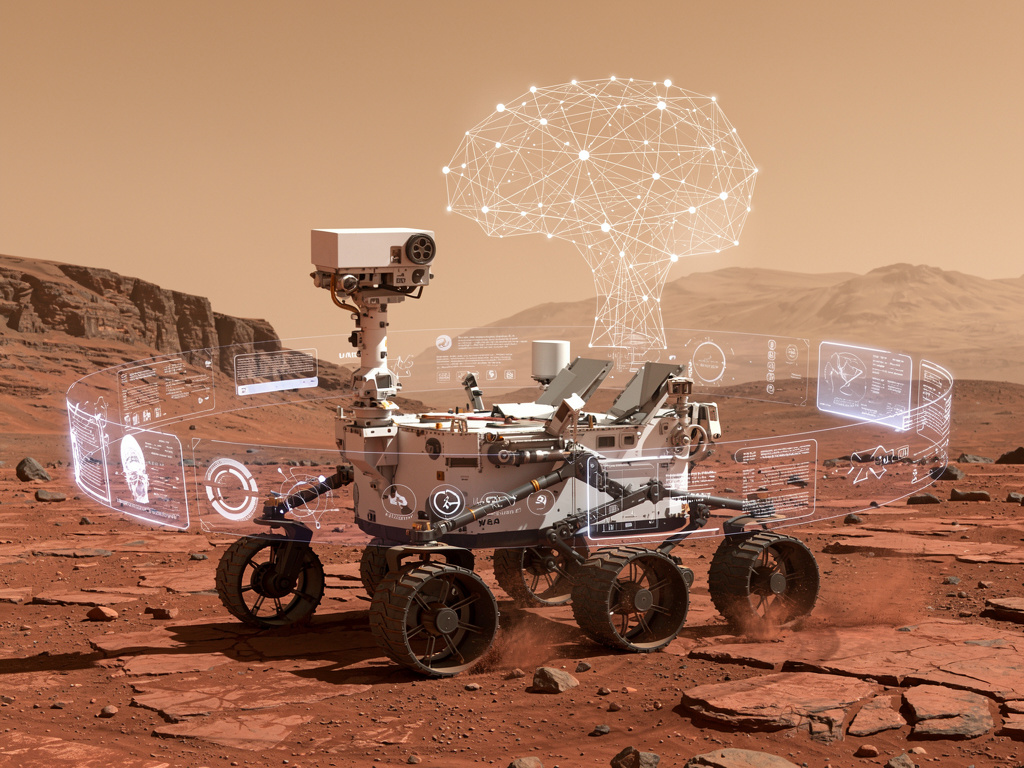
In a groundbreaking collaboration between artificial intelligence and space exploration, NASA has deployed Anthropic’s Claude AI system to navigate its Perseverance rover across the Martian surface, marking a significant shift in how autonomous systems are being utilized in extraterrestrial missions. This partnership represents not just a technological milestone, but a fundamental reimagining of how human engineers and AI can work together to solve complex navigation challenges millions of miles from Earth.
According to Engadget, NASA’s Jet Propulsion Laboratory has integrated Claude into its mission operations to analyze terrain data and propose optimal routes for Perseverance. The AI system processes vast amounts of visual data from the rover’s cameras and scientific instruments, identifying potential hazards and scientifically interesting targets with unprecedented speed. This capability is particularly crucial given the communication delay between Earth and Mars, which can range from four to twenty-four minutes depending on planetary positions.
The implementation of Claude represents a departure from traditional rover navigation methods, which have historically relied on human operators meticulously planning each movement over the course of days. While human oversight remains essential, the AI’s ability to rapidly process and interpret Martian terrain data has accelerated decision-making processes that previously consumed significant mission time. Engineers can now evaluate multiple routing scenarios in hours rather than days, allowing Perseverance to cover more ground and conduct more scientific investigations.
The Technical Architecture Behind Martian AI Navigation
Claude’s deployment on the Mars mission required extensive customization to handle the unique challenges of planetary exploration. The AI system was trained on thousands of images from previous Mars missions, including data from the Curiosity rover, Mars Reconnaissance Orbiter, and archived imagery from earlier missions. This training enabled Claude to recognize Martian geological features, identify potential obstacles such as loose sand, sharp rocks, and steep slopes, and suggest paths that balance safety with scientific opportunity.
The system operates through a multi-layered analysis framework. First, Claude processes high-resolution imagery to create detailed topographical assessments. It then cross-references this visual data with scientific objectives provided by the mission team, such as reaching specific rock formations or investigating areas with potential biosignatures. Finally, the AI generates multiple route proposals, each accompanied by risk assessments and estimated energy consumption calculations—critical factors for a solar-powered rover operating in Mars’s harsh environment.
Transforming Mission Operations and Scientific Discovery
The integration of Claude into Perseverance’s operations has fundamentally altered the rhythm of mission planning at JPL. Mission scientists report that they can now engage in more iterative and exploratory planning sessions, testing hypotheses about Martian geology in near-real-time. When an interesting rock formation appears in rover imagery, teams can quickly task Claude with analyzing approach options, allowing them to pivot scientific priorities more dynamically than ever before.
This enhanced agility has proven particularly valuable in Perseverance’s primary mission: searching for signs of ancient microbial life and collecting samples for eventual return to Earth. The rover has been exploring Jezero Crater, believed to be an ancient lake bed, where rapid decision-making about which rocks to sample could mean the difference between collecting mundane sediment and securing evidence of past Martian life. Claude’s ability to identify subtle variations in rock composition and structure from imagery has helped prioritize sampling locations with the highest scientific potential.
The Human-AI Partnership in Space Exploration
Despite Claude’s sophisticated capabilities, NASA has been careful to emphasize that human expertise remains central to mission operations. The AI serves as a powerful tool for analysis and recommendation, but final routing decisions rest with experienced mission planners who understand the rover’s capabilities, limitations, and the broader scientific context of the mission. This human-AI collaboration model reflects a growing recognition across the aerospace industry that the most effective approach to complex challenges combines machine processing power with human judgment and creativity.
Engineers at JPL describe their work with Claude as a form of “AI-augmented exploration,” where the technology handles data-intensive tasks while humans focus on strategic decision-making and creative problem-solving. This division of labor has reduced cognitive load on mission teams, who previously spent exhausting hours poring over imagery to identify safe paths. Now, they can dedicate more time to scientific analysis and mission strategy, knowing that Claude has already flagged potential concerns and opportunities in the terrain ahead.
Implications for Future Deep Space Missions
The success of Claude on the Perseverance mission has significant implications for upcoming NASA initiatives, including the Artemis program’s planned lunar missions and eventual human expeditions to Mars. As missions venture farther from Earth and communication delays grow longer, the need for autonomous decision-making systems becomes more acute. A mission to Jupiter’s moon Europa, for instance, would face communication delays of up to ninety minutes, making real-time human control impractical for many operations.
NASA is already exploring how lessons learned from Claude’s Mars deployment can inform AI systems for future missions. The agency is particularly interested in developing AI that can handle increasingly complex autonomous operations, from sample collection to emergency hazard avoidance, while maintaining the reliability and predictability essential for billion-dollar space missions. The Perseverance experience is serving as a proving ground for these technologies, demonstrating both their potential and their current limitations.
Addressing Safety and Reliability Concerns
The deployment of AI in mission-critical space operations has not been without concerns. Space agencies worldwide have historically maintained conservative approaches to new technologies, given the impossibility of physical repairs once a spacecraft leaves Earth. NASA’s integration of Claude into Perseverance operations involved extensive testing and validation protocols to ensure the AI’s recommendations would not compromise rover safety or mission objectives.
These protocols include redundant verification systems where multiple AI models and human operators must agree on high-risk maneuvers, extensive simulation testing using digital twins of Martian terrain, and carefully defined boundaries within which the AI can operate autonomously. The agency has also implemented robust monitoring systems that track Claude’s decision-making patterns, allowing engineers to identify and address any anomalies before they affect rover operations. This cautious approach reflects the aerospace industry’s understanding that AI in space must meet even higher reliability standards than terrestrial applications.
The Broader AI Revolution in Aerospace
NASA’s partnership with Anthropic is part of a broader trend of space agencies and private aerospace companies embracing AI technologies. The European Space Agency has been developing AI systems for satellite operations and space debris tracking, while private companies like SpaceX use machine learning for rocket landing optimization and trajectory planning. China’s space program has also invested heavily in AI for its lunar and Mars missions, viewing autonomous systems as crucial for maintaining competitive advantage in space exploration.
This widespread adoption of AI in aerospace is driving innovation in the technology itself. The unique challenges of space operations—extreme reliability requirements, limited computational resources, and the need to function in unpredictable environments—are pushing AI developers to create more robust and efficient systems. Advances made for space applications often find their way back to terrestrial uses, from autonomous vehicles to disaster response systems, creating a virtuous cycle of innovation.
Economic and Strategic Dimensions
The collaboration between NASA and Anthropic also highlights the evolving relationship between government space agencies and private AI companies. Rather than developing all technologies in-house, NASA is increasingly partnering with commercial entities that can move faster and take more risks in technology development. This approach allows the agency to access cutting-edge AI capabilities while focusing its resources on core mission requirements and scientific objectives.
For Anthropic, the Mars mission provides invaluable validation of Claude’s capabilities in one of the most demanding operational environments imaginable. Success in space exploration serves as a powerful demonstration of the AI’s reliability and versatility, potentially opening doors to other high-stakes applications in fields like autonomous transportation, medical diagnosis, and critical infrastructure management. The partnership also gives Anthropic’s engineers unique insights into extreme edge cases and failure modes, improving the AI’s overall robustness.
As Perseverance continues its journey across Mars with Claude’s assistance, the mission serves as a compelling proof of concept for AI-augmented space exploration. The technology is not replacing human expertise but amplifying it, enabling mission teams to make faster, more informed decisions about navigating one of the solar system’s most challenging environments. This human-AI partnership model may well define the future of space exploration, as humanity pushes deeper into the cosmos with artificial intelligence as an essential companion on the journey.


 WebProNews is an iEntry Publication