
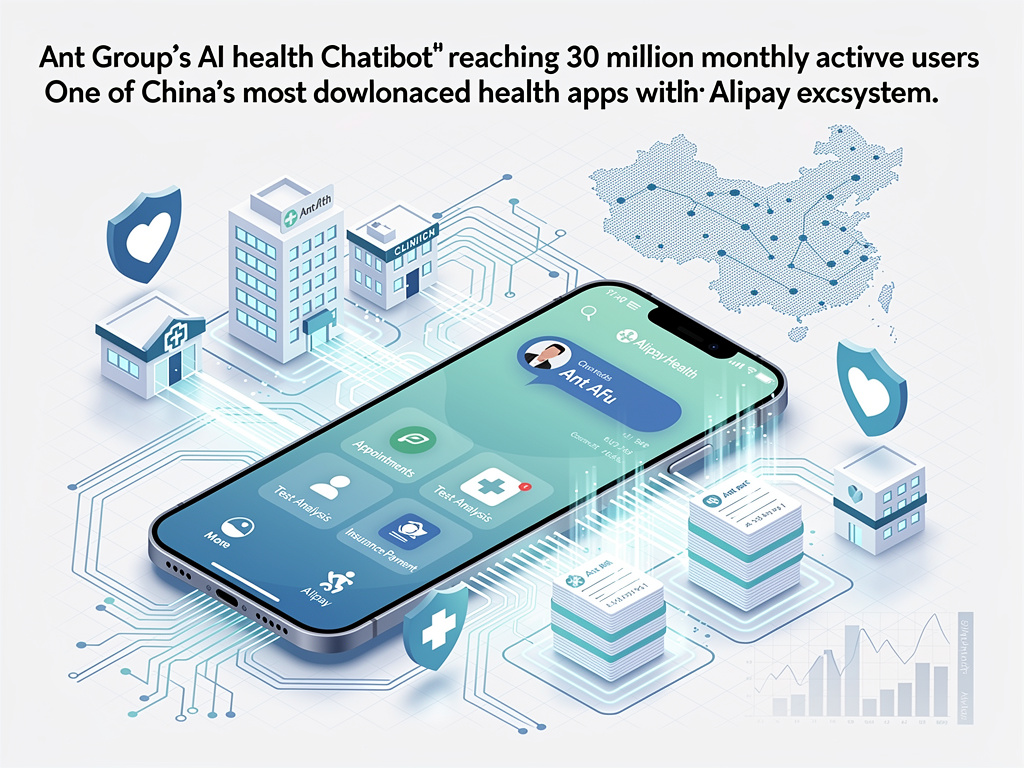
In a remarkable demonstration of artificial intelligence’s growing role in healthcare delivery, Ant Group’s AI-powered health chatbot Ant Afu has amassed 30 million monthly active users, positioning itself as one of China’s most downloaded health applications. The platform, seamlessly integrated within Alipay’s expansive digital ecosystem, represents a significant shift in how Chinese consumers access medical services, combining appointment scheduling, diagnostic test analysis, and insurance payment processing into a single interface.
The rapid adoption of Ant Afu reflects a broader transformation in China’s healthcare sector, where technology companies are stepping in to address systemic challenges that have long plagued the country’s medical system. According to Rest of World, users are increasingly turning to the AI chatbot to obtain personalized medical guidance that remains largely unavailable through traditional channels, particularly as public hospitals struggle under the weight of patient volume that far exceeds their capacity to deliver individualized care.
The success of Ant Afu signals more than just technological achievement; it highlights fundamental gaps in China’s healthcare infrastructure and the willingness of consumers to embrace AI-driven alternatives. With the platform processing millions of health queries monthly, Ant Group has effectively created a digital front door to healthcare services that bypasses many of the friction points that have historically deterred patients from seeking timely medical attention.
The Architecture of Digital Health Integration
Ant Afu’s technical architecture leverages Alipay’s existing user base of over one billion registered accounts, creating an immediate distribution advantage that few standalone health applications could match. The integration strategy eliminates the need for separate app downloads or account creation, reducing barriers to entry that typically hinder health technology adoption. Users can access Ant Afu directly through Alipay’s interface, where the chatbot functions as an intelligent triage system, helping patients understand symptoms, identify appropriate specialists, and navigate the often-confusing process of securing hospital appointments.
The platform’s diagnostic test analysis feature represents a particularly innovative application of AI in healthcare delivery. Rather than waiting days for physician interpretation, patients can upload laboratory results and medical imaging reports to receive preliminary analysis and explanations in plain language. While Ant Group emphasizes that these AI-generated interpretations are not substitutes for professional medical advice, they provide patients with immediate context and help them formulate more informed questions for their healthcare providers.
The insurance payment integration addresses one of the most significant pain points in China’s healthcare system: the complexity of navigating multiple insurance schemes and out-of-pocket payment requirements. By consolidating these financial transactions within the same platform that handles medical consultations and appointments, Ant Afu reduces administrative burden and creates a more streamlined patient experience. This vertical integration across the healthcare value chain distinguishes Ant Group’s approach from competitors who focus on individual components rather than end-to-end service delivery.
Market Forces Driving Adoption
The explosive growth of Ant Afu occurs against a backdrop of severe strain on China’s public hospital system. Major urban hospitals routinely face patient volumes that exceed their designed capacity by factors of two or three, resulting in wait times that can stretch to hours for routine consultations and weeks or months for specialist appointments. This capacity crisis has created fertile ground for digital health solutions that can provide immediate, if limited, medical guidance and help patients make more informed decisions about when and where to seek in-person care.
Demographic trends further amplify demand for accessible health information and services. China’s rapidly aging population, combined with rising rates of chronic diseases associated with urbanization and lifestyle changes, has created unprecedented pressure on healthcare resources. Younger, digitally-native consumers demonstrate particular enthusiasm for AI-powered health tools, viewing them as more convenient and less intimidating than traditional medical encounters. This generational shift in healthcare consumption patterns favors platforms like Ant Afu that prioritize user experience and accessibility.
The economic dimensions of healthcare access also play a crucial role in driving adoption. Despite significant government investment in expanding health insurance coverage, out-of-pocket medical expenses remain substantial for many Chinese families, particularly for specialized treatments or medications not covered by basic insurance plans. AI-powered preliminary consultations offer a cost-effective alternative to immediate hospital visits for non-urgent concerns, potentially saving patients both money and time while reserving scarce medical resources for cases requiring in-person intervention.
Regulatory Environment and Data Governance
The success of Ant Afu unfolds within China’s evolving regulatory framework for digital health services and artificial intelligence applications. Chinese authorities have demonstrated increasing sophistication in their approach to health technology regulation, seeking to encourage innovation while establishing guardrails around data privacy, clinical accuracy, and consumer protection. Ant Group must navigate requirements that govern both its financial services operations and its expanding healthcare activities, a dual regulatory burden that few competitors face.
Data governance represents a particularly sensitive issue given the volume and sensitivity of health information flowing through the platform. The integration of medical data with financial transaction records and personal identification information creates a comprehensive digital profile that carries significant privacy implications. While Chinese regulations require explicit user consent for data collection and impose restrictions on data sharing, enforcement mechanisms remain under development, and questions persist about how effectively current frameworks protect consumer interests in practice.
The regulatory environment also shapes competitive dynamics in China’s digital health market. Licensing requirements for telemedicine services, restrictions on AI diagnostic claims, and rules governing insurance product distribution all influence how platforms like Ant Afu structure their offerings and communicate capabilities to users. Ant Group’s established relationships with regulators through its core financial services business may provide advantages in navigating these complex requirements, though the company’s previous regulatory challenges, including the suspended IPO in 2020, demonstrate the risks inherent in operating at the intersection of technology and heavily regulated sectors.
Competitive Positioning and Market Share
Ant Afu competes in an increasingly crowded digital health market that includes offerings from technology giants, healthcare providers, and specialized health technology startups. Tencent, through its WeChat ecosystem, has developed similar integrated health services, while Alibaba Health operates parallel initiatives within the broader Alibaba Group structure. Traditional healthcare providers have also launched digital platforms, though these typically lack the seamless integration and user experience advantages that technology companies can leverage.
The competitive advantage Ant Group derives from Alipay’s massive installed base cannot be overstated. While competitors must invest heavily in user acquisition and retention, Ant Afu benefits from immediate access to hundreds of millions of active Alipay users who already trust the platform with sensitive financial information. This embedded distribution channel, combined with Alipay’s sophisticated data analytics capabilities and established payment infrastructure, creates network effects that reinforce Ant Afu’s market position.
However, market leadership in user numbers does not automatically translate to sustainable competitive advantage in healthcare delivery. Clinical accuracy, the breadth and depth of medical knowledge encoded in AI systems, and the quality of partnerships with healthcare providers all influence long-term success. Ant Group faces ongoing challenges in demonstrating that its AI capabilities can match or exceed those of competitors while maintaining user trust and regulatory compliance across multiple dimensions of healthcare service delivery.
Clinical Implications and Medical Community Response
The medical community’s response to platforms like Ant Afu reflects both recognition of potential benefits and concern about risks. Proponents argue that AI-powered health assistants can improve healthcare efficiency by handling routine inquiries, providing basic health education, and helping patients better prepare for clinical encounters. By serving as an intelligent triage system, these platforms may reduce unnecessary emergency room visits and help direct patients to appropriate levels of care, potentially easing burden on overextended hospital staff.
Critics raise concerns about diagnostic accuracy, the potential for AI systems to miss serious conditions or provide misleading guidance, and the risk that patients may delay necessary medical care while relying on chatbot consultations. The medical establishment also worries about liability issues when AI-generated advice contributes to adverse outcomes, particularly given the current lack of clear legal frameworks governing responsibility for AI-assisted medical decisions. These concerns intensify in China’s context, where medical malpractice litigation, while less common than in Western markets, increasingly shapes provider behavior and risk management strategies.
The relationship between AI health platforms and traditional healthcare providers remains evolving and sometimes contentious. While Ant Group positions Ant Afu as complementary to rather than competitive with physician services, the reality involves more complex dynamics. Some hospitals and physicians view these platforms as threats to patient relationships and revenue streams, while others recognize opportunities for collaboration that could enhance rather than replace human clinical judgment. The eventual equilibrium between AI-assisted and traditional healthcare delivery will likely emerge through ongoing negotiation between technology companies, medical providers, regulators, and patients themselves.
Technology Architecture and AI Capabilities
The artificial intelligence powering Ant Afu draws on natural language processing, machine learning models trained on extensive medical literature and clinical datasets, and integration with real-time health information systems. While Ant Group has not disclosed detailed technical specifications, industry observers believe the platform utilizes large language models adapted specifically for medical applications, similar to approaches employed by other leading health AI developers. The challenge lies in achieving sufficient accuracy and reliability to provide useful guidance while avoiding the generation of plausible-sounding but clinically incorrect information, a known limitation of current AI systems.
The test analysis functionality likely employs computer vision and pattern recognition algorithms to interpret laboratory reports and medical imaging, comparing results against normal ranges and flagging potential abnormalities. However, the complexity of medical interpretation, which often requires consideration of patient history, medication interactions, and subtle clinical context, presents significant technical challenges. Ant Group’s approach appears to focus on providing educational context and highlighting areas that warrant professional medical attention rather than attempting definitive diagnosis, a strategy that balances utility with risk management.
Continuous improvement of AI capabilities requires ongoing access to diverse, high-quality training data, presenting both opportunities and challenges for Ant Group. The platform’s large user base generates valuable real-world data on health queries, symptom presentations, and patient concerns, which can inform model refinement. However, ensuring data quality, managing selection bias in the user population, and maintaining privacy protections while leveraging data for AI development requires sophisticated governance frameworks and technical safeguards.
Business Model and Revenue Strategy
While Ant Group has not publicly detailed Ant Afu’s specific revenue model, the platform likely generates value through multiple channels aligned with Alipay’s broader business strategy. Transaction fees from insurance payments processed through the platform represent one obvious revenue stream, as do potential referral fees from healthcare providers who receive patient appointments facilitated by the chatbot. The platform may also serve as a distribution channel for health insurance products, wellness services, and pharmaceutical sales, creating additional monetization opportunities.
The strategic value of Ant Afu extends beyond direct revenue generation to encompass user engagement and ecosystem lock-in. By expanding Alipay’s utility beyond financial transactions into healthcare services, Ant Group increases the frequency and depth of user interactions with its platform, generating data insights that inform product development across its entire service portfolio. This ecosystem strategy mirrors approaches employed by other technology platforms seeking to become indispensable components of users’ daily lives across multiple domains.
The long-term financial sustainability of AI-powered health services remains an open question, particularly as competition intensifies and regulatory requirements potentially increase operational costs. While the marginal cost of serving additional users through AI chatbots is relatively low compared to traditional healthcare delivery, the investments required to maintain clinical accuracy, ensure regulatory compliance, and continuously improve AI capabilities are substantial. Ant Group’s ability to build a profitable business around Ant Afu while maintaining service quality will influence whether the current wave of digital health innovation proves sustainable or represents another cycle of technology hype followed by market correction.
Global Context and International Implications
The success of Ant Afu in China offers lessons for digital health development in other markets, though significant differences in healthcare systems, regulatory environments, and consumer preferences limit direct transferability. The United States and European markets have seen various attempts to deploy AI-powered health assistants, but none have achieved the scale and integration that Ant Group has accomplished in China. Factors including fragmented payment systems, stricter medical liability frameworks, and more cautious regulatory approaches to AI in healthcare have slowed adoption in Western markets.
The Chinese experience demonstrates that AI health tools gain traction most readily when they address clear pain points in existing healthcare delivery systems and integrate seamlessly with platforms that users already trust and use regularly. Markets with similar challenges around healthcare access, long wait times, and limited personalized attention may find the Chinese model more applicable than markets where these issues are less acute. However, cultural factors around trust in AI, comfort with data sharing, and preferences for human versus automated interactions also significantly influence adoption patterns.
As AI capabilities continue advancing globally, the competitive dynamics of digital health may increasingly transcend national boundaries. Chinese companies like Ant Group have accumulated valuable experience and technical capabilities that could potentially be exported to other markets, while Western technology companies and healthcare providers study Chinese innovations for applicable insights. The resulting cross-pollination of ideas and approaches may accelerate global progress in AI-assisted healthcare delivery, though regulatory fragmentation and data localization requirements will likely maintain significant market segmentation for the foreseeable future.
Future Trajectory and Market Evolution
The 30 million monthly active users currently using Ant Afu represent a substantial achievement, but the platform’s ultimate potential remains far larger given Alipay’s total user base and the breadth of healthcare needs across China’s population. Ant Group faces questions about whether it can sustain current growth rates as it moves beyond early adopters to serve more diverse user populations with varying levels of digital literacy and different healthcare needs. Expansion into underserved rural areas, where healthcare access challenges are most acute, presents both significant opportunities and substantial obstacles related to connectivity, user education, and integration with local healthcare systems.
The evolution of AI capabilities will fundamentally shape Ant Afu’s future development. As large language models and other AI technologies advance, the platform may be able to handle increasingly sophisticated medical queries, provide more personalized recommendations based on individual health histories, and potentially identify health risks before they manifest as acute problems. However, these enhanced capabilities will also raise the stakes around accuracy, liability, and the appropriate boundaries between AI-assisted and physician-delivered care.
The broader trajectory of China’s healthcare system will ultimately determine whether platforms like Ant Afu represent transitional solutions to current capacity constraints or permanent fixtures of a transformed healthcare delivery model. Government initiatives to expand hospital capacity, increase the physician workforce, and strengthen primary care could potentially reduce the gap that digital health platforms currently fill. Alternatively, if AI-powered tools prove sufficiently capable and cost-effective, they may become preferred first points of contact for many health concerns, fundamentally restructuring how healthcare services are accessed and delivered. The outcome will depend on technological progress, regulatory decisions, market dynamics, and the evolving preferences of Chinese healthcare consumers navigating an increasingly complex array of options for managing their health.


 WebProNews is an iEntry Publication