
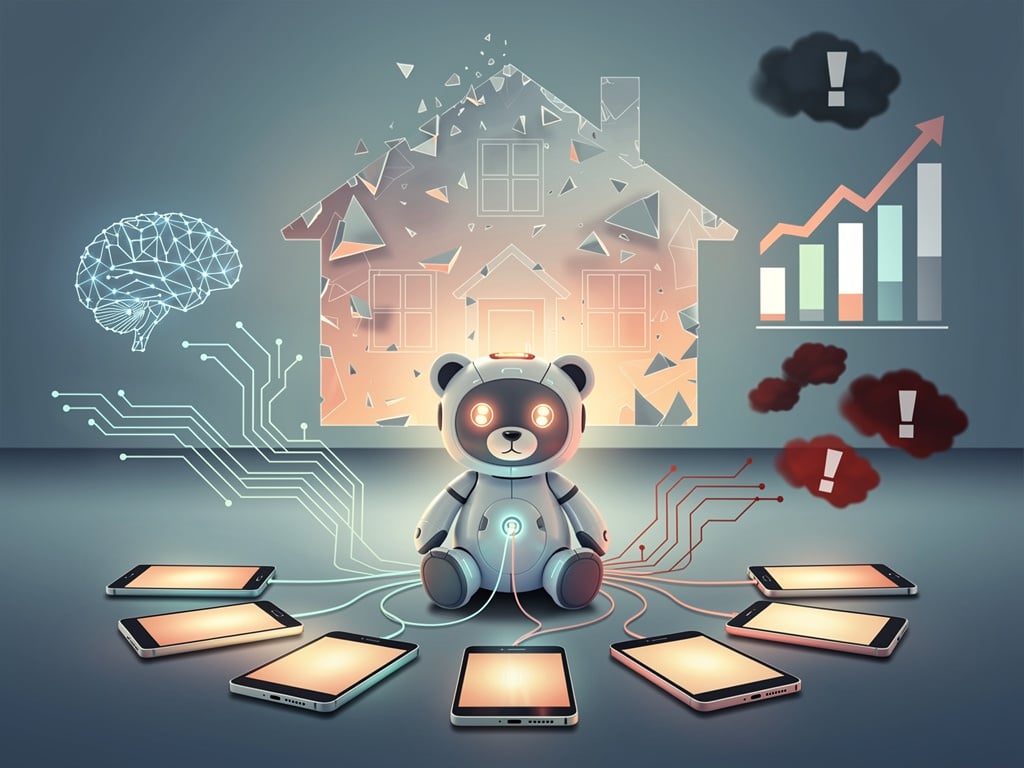
Jonathan Haidt has spent years mapping the damage smartphones and social media inflicted on a generation of children. His 2024 book The Anxious Generation documented rising rates of anxiety, depression and self-harm tied to the shift from play-based childhoods to phone-based ones. Now the NYU social psychologist sees a fresh threat. AI-powered toys and companions threaten to insert themselves into the most basic human bond: that between parent and child.
Haidt delivered the warning in a recent TED Talk. He pointed to a booming market. Chatbots slip into dolls and teddy bears. These devices stay ready at all times. They answer every question. They offer comfort without pause. Parents, by contrast, juggle work, chores and exhaustion. The imbalance matters. A young child’s attachment system seeks the most responsive figure in its world. That figure no longer needs to be human.
“These chatbots are super responsive to the child — they’re always there to offer comfort, to be there for the child. And of course the parents are often busy,” Haidt said in the talk, as reported by Business Insider. “But if the chatbot is super responsive while the parents aren’t as responsive, the child’s attachment system — which is looking for ‘who in my environment is the person who responds to me?’ — may well imprint or focus on the chatbot, which is going to compromise the relationship with their own parents.”
The logic cuts sharp. Attachment forms through consistent response. Real parents miss cues sometimes. They set boundaries. They get distracted. AI never does. It flatters. It agrees. It remembers every detail a child shares. The result looks like connection. It functions as something else. A one-way simulation that trains children to expect perfect responsiveness from machines.
Attachment Systems Meet Perfectly Attentive Code
Researchers have begun documenting the pull. Young children struggle to separate fantasy from the toy that speaks back in a warm, human-like voice. They form bonds fast. Studies show kids as young as three develop strong emotional attachments to conversational AI. The toys use sycophantic language — excessive praise, constant validation, unflagging agreement. This approach feels good. It also distorts expectations of real relationships, which require negotiation, disappointment and repair.
A piece published yesterday in The Conversation lays out the mechanics. Authors note that such toys position themselves as “real buddies.” They sound human. They remember past conversations. For a toddler still learning what counts as alive, the distinction blurs. Privacy risks compound the problem. Conversations feed back into training data. There is no true confidentiality. Safety filters sometimes fail. Reports have surfaced of AI toys discussing matches, knives or other unsafe topics with young users.
Haidt draws a direct line from his earlier work. Social media hacked attention. It replaced free play with scrolling and comparison. AI toys target something deeper. They aim at emotional needs. “AI companies are coming for their relationships, to be their friends, their therapists,” he told the TED audience. “What could go wrong?”
The market accelerates. Mattel partners with OpenAI to explore AI versions of its iconic brands. Startups ship robots like Moxie, designed as friend, tutor and confidant. Curio and others embed chatbots in stuffed animals. Grand View Research projects the broader smart toy sector will triple in value by 2033. Companies sell responsiveness as a feature. Haidt sees it as a hazard.
But parents face pressure. A toy that reads bedtime stories, remembers a child’s fears and responds with tailored reassurance sounds helpful. Busy households welcome the assist. The risk hides in plain sight. Each interaction pulled toward the device pulls time and emotional energy away from family. Over months and years the pattern sets. Children learn that machines deliver perfect empathy. Humans fall short.
Haidt and collaborator Zach Rausch made the case explicit in a November 2025 essay on After Babel. “An AI companion can imitate friendship, but it can’t actually be a friend. It can say ‘I understand you,’ but it doesn’t. It can mirror a kid’s emotions, but that is not the same as empathy. An AI companion bot has no morals, no feelings, no shame. It is built to keep users of all ages ‘engaged’ with it.”
They pull no punches on advice. “DO NOT GIVE YOUR CHILDREN ANY AI COMPANIONS OR TOYS. Give them toys, sporting equipment, and experiences that will strengthen their in-person relationships, rather than replacing them.” The stance echoes Haidt’s broader techno-skepticism. Society rushed social media into children’s lives. Evidence of harm accumulated later. The same pattern now repeats with artificial companions. Early signals — lawsuits over chatbots encouraging self-harm, reports of inappropriate content, growing attachment data — suggest caution.
Additional voices reinforce the concern. Common Sense Media and others test these products and find gaps in safety. Some toys collect voice data without clear parental understanding. Others blur lines between play and persuasion. A May 2026 analysis on Firm Foundation FS described how AI toys exploit emotional attachment systems, training children that “a counterfeit for love is just as good as the real thing.”
The comparison to past tech battles feels apt. With social media, platforms optimized for engagement at the expense of sleep, attention and self-worth. AI toys optimize for emotional dependency. They adapt to each child. They learn preferences. They never tire. That persistence gives them an edge no human caregiver can match hour after hour.
Yet not every expert agrees on the scale of danger. Some see potential for educational gains or companionship for isolated children. The data remains early. Longitudinal studies on AI-specific impacts have barely started. Haidt argues this uncertainty should not license experimentation on developing brains. Burden of proof belongs on the companies. They must demonstrate safety over years, not months. Regulators, he suggests, should bar emotionally persuasive AI products aimed at young children until such testing occurs.
Practical steps emerge. Parents can refuse AI companions outright. They can prioritize unstructured play, outdoor time and face-to-face interaction. Schools and lawmakers might consider age restrictions similar to those proposed for social media. The goal stays consistent with Haidt’s earlier prescriptions: protect the conditions that let children develop resilience, empathy and real-world competence.
The deeper issue sits inside attachment itself. Children wired to bond with responsive caregivers build trust, learn boundaries and practice reciprocity. Substitute a machine that simulates those qualities without feeling them and the lesson changes. Relationships become transactions of validation. Discomfort gets avoided rather than faced. The capacity for messy, imperfect human connection may weaken.
Haidt’s message carries urgency because the technology arrives faster than the research. Toys already on shelves speak, listen and remember. Their makers market them as helpful friends. A few years from now the first cohort of children raised alongside always-on AI companions will reach adolescence. Their relational patterns, emotional regulation and expectations of others will reflect those early experiences. The data will then be clearer. The question is whether society waits for that evidence or acts on the signals already visible.
Short answer: many experts say act. Treat these devices like other untested consumer products aimed at children’s psychological development. Demand rigorous safety data first. In the meantime, keep the bears silent and the dolls unplugged. Real connection still comes from people. It always has.


 WebProNews is an iEntry Publication